LED Signs in Arlington, TX: A Business Owner's Guide to Lighted Signs, Permits & Upgrades
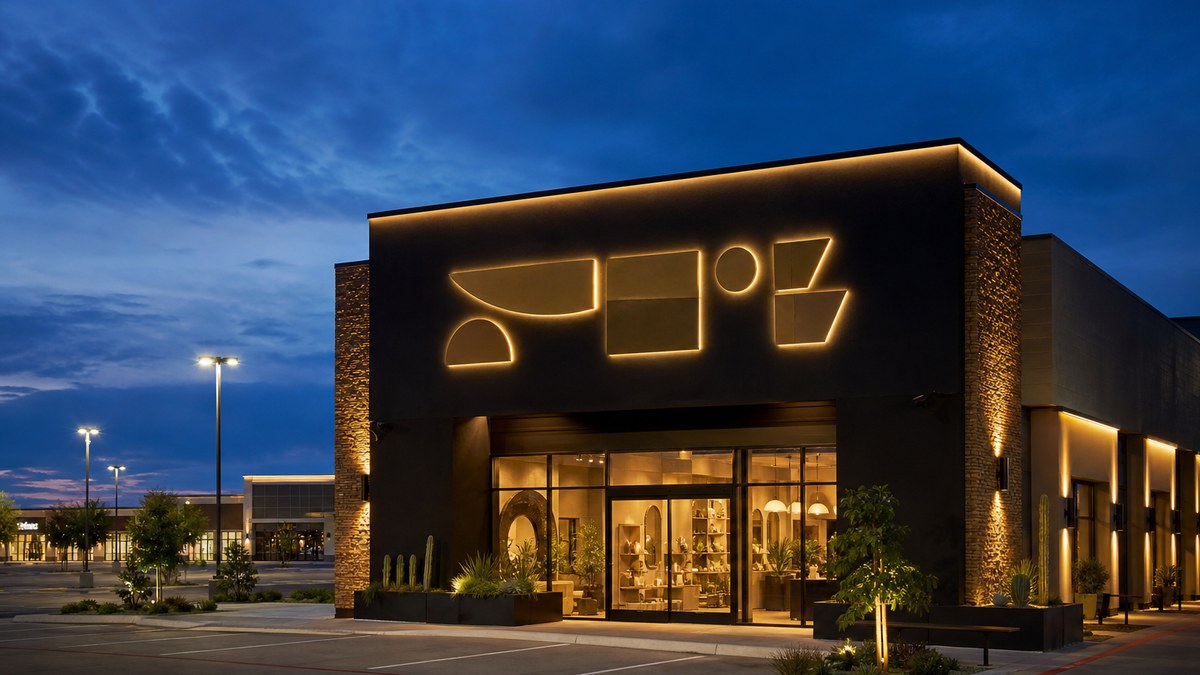
LED signs in Arlington do more work for a business than almost any other piece of equipment on the property. A bright, clean, well-lit sign tells drivers on Cooper Street, Collins Street or I-20 exactly where you are, makes a shopping center look open and safe after dark, and keeps working every night while you sleep. A dim, patchy or outdated sign does the opposite: it makes a good business look closed, tired or hard to find.
This guide is written for Arlington business owners, property managers and facility teams who are planning a new lighted sign, replacing an old one, or converting fluorescent and neon signs to LED. We cover the main types of LED business signs, how to choose brightness and size, what to know about LED message centers, how Arlington's sign rules and Texas licensing affect your project, how retrofits work, and how to avoid the mistakes that make signs fail early. By the end you will know the right questions to ask before you sign a proposal.
LED signs are business signs lit by light-emitting diodes instead of neon tubes, fluorescent lamps or incandescent bulbs. For most Arlington businesses they are the default choice for new and replacement signs.
- Common types: channel letters, cabinet (lightbox) signs, monument signs, pylon signs, LED message centers, blade signs and externally lit signs
- Why LED: commonly far less energy than fluorescent or neon, long service life, even brightness, and dimming control
- Rules: new signs in Arlington must meet Article 7 of the city's Unified Development Code, and moving signs and roof signs are prohibited
- Licensing: electrical sign work in Texas is done under a TDLR electrical sign contractor or electrical contractor license
- Retrofits: many existing sign cabinets and letters can be converted to LED without replacing the whole sign
- Pricing: every sign is quoted as a project-specific proposal based on size, type, structure and site conditions
Why Arlington businesses are switching signs to LED
Not long ago most lighted business signs used fluorescent tubes inside a plastic cabinet, neon tubes bent into letters, or floodlights aimed at a painted panel. LED has replaced all three for good reasons.
- Lower energy use. LED sign modules commonly use far less energy than the fluorescent lamps or neon they replace, and the savings run every night of the year.
- Long service life. Quality LED modules and power supplies last many years, which means fewer bucket-truck visits to change burned-out tubes.
- Even, clean light. Properly spaced LED modules light a sign face evenly, without the dark ends and hot spots that make old fluorescent cabinets look tired.
- Better in the heat and cold. Fluorescent lamps struggle in cold weather and neon is fragile. LED modules are solid-state and handle Texas temperature swings well when the sign is properly ventilated.
- Dimming and control. LED signs can be put on photocells, timers and dimmers, and LED message centers can adjust their brightness automatically between day and night.
- Design freedom. LED makes slim cabinets, halo-lit letters, color-changing accents and full-color digital displays practical.
There may also be utility incentives for efficient lighting upgrades. Some sign retrofits may qualify for Oncor programs depending on program availability, and certain building lighting improvements may support a 179D deduction; confirm with your tax advisor. We note what may apply during the proposal stage, but we never build a project around an incentive that is not confirmed.
The main types of LED business signs
The right sign depends on your building, your zoning, how far away customers see you, and what you want the sign to say. These are the types we are asked about most often in Arlington.
| Sign type | How it is lit | Best for |
|---|---|---|
| Front-lit channel letters | LED modules inside each letter shine through a translucent face | Storefronts, restaurants, retail centers, offices |
| Halo-lit (reverse) channel letters | LEDs light the wall behind solid metal letters for a glowing outline | Upscale retail, offices, medical, hospitality |
| Cabinet / lightbox signs | LED modules or edge-lit panels behind a single printed face | Tenant panels, budget-friendly wall signs, multi-tenant pylons |
| Monument signs | Internally lit faces, push-through letters or ground-mounted lights | Office parks, churches, schools, shopping centers |
| Pylon and pole signs | Internally lit cabinets, often with multiple tenant panels | Highway frontage and large retail centers, where allowed |
| LED message centers (EMCs) | Full-color or monochrome LED pixels showing changeable content | Churches, schools, retail, restaurants, venues |
| Blade and projecting signs | Double-sided internally lit cabinets or letters | Walkable streets and storefronts seen from the sidewalk |
| Externally lit signs | LED gooseneck, wall-wash or ground-mounted fixtures aimed at the sign | Classic or historic looks, painted and dimensional signs |
Channel letters
Channel letters are individual fabricated letters, usually aluminum with an acrylic face, each lit by LED modules inside. They are the most common storefront sign in DFW retail centers because they read clearly at night and look sharp in the day. Letters can be mounted directly to the wall or on a raceway, a slim box that holds the wiring and power supplies and reduces the number of holes in the building. Many landlords and centers specify the type of mounting, face color and lighting style, so always check your lease and center sign criteria first.
Halo-lit and combination letters
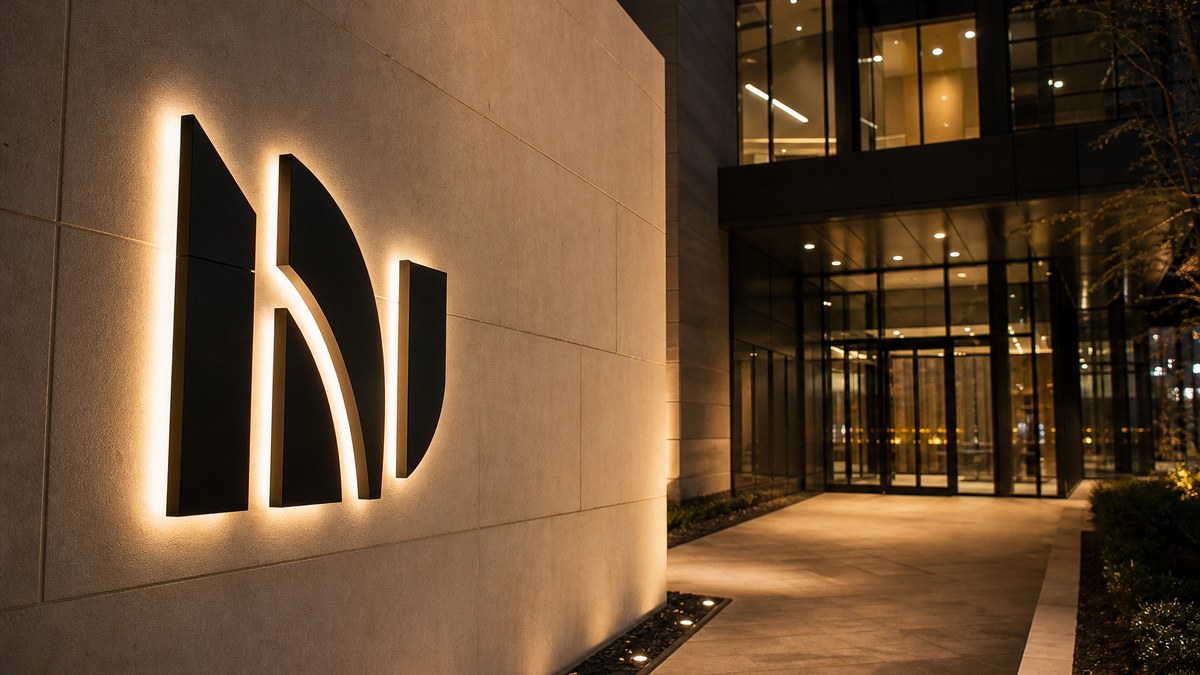
Halo-lit letters have solid fronts and open or clear backs. The LEDs face the wall and create a soft glow behind each letter. The look is refined and works well for offices, salons, medical practices and hotels. Combination letters light both the face and the halo for extra presence. Halo lighting depends on the wall: a light, smooth surface reflects the glow well, while a dark or rough wall needs more output or a backer panel.
Cabinet and lightbox signs
A cabinet sign is a single box with a printed face lit from inside. Cabinets are practical in multi-tenant centers where tenants change, because the face can be replaced without replacing the cabinet. Older fluorescent cabinets are some of the best candidates for an LED retrofit, which we cover below.
Monument and pylon signs
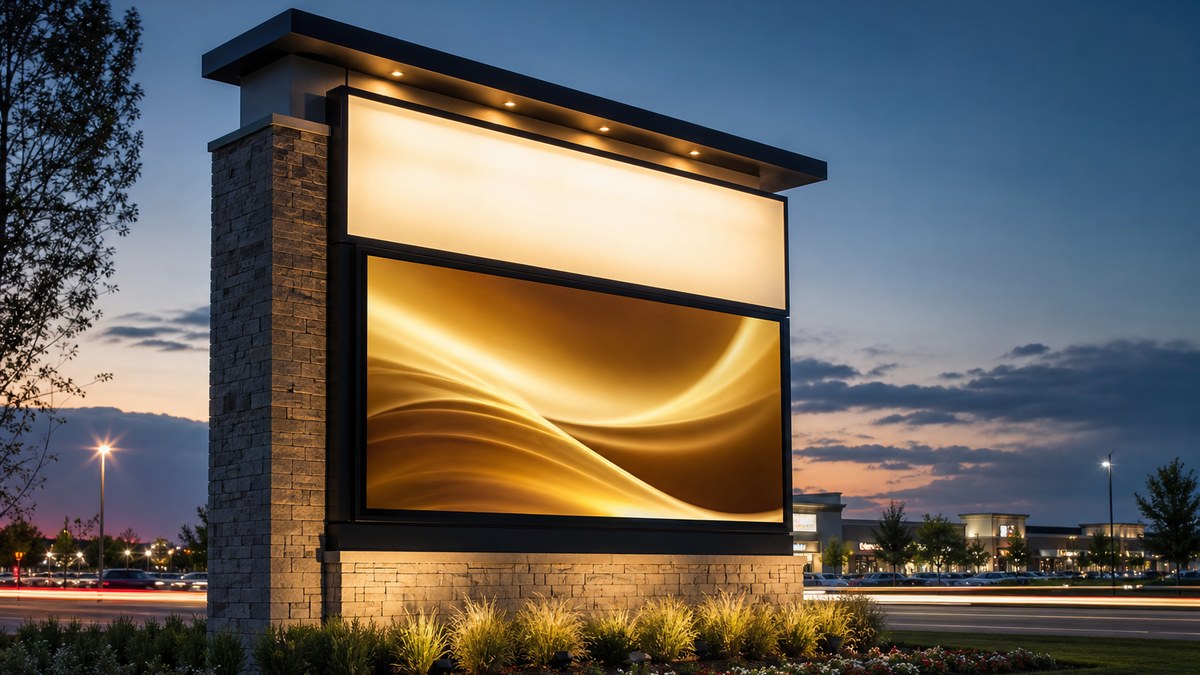
Monument signs sit low to the ground on a solid base and are common at office parks, churches, schools, apartment communities and newer retail developments. Pylon and pole signs are taller and are used where long-distance visibility matters. Arlington has been moving away from older pole signs in some corridors, so a taller freestanding sign needs to be checked against current standards before it is designed.
LED message centers
An LED message center, also called an electronic message center or EMC, is a programmable LED display that can show changing text, graphics and images. Churches use them for service times and events, schools for announcements, and restaurants and retailers for specials. Message centers are a cousin of the LED video walls we install indoors, but they are built for outdoor brightness, weather and long-distance viewing. They are also subject to more rules, so they need the most planning of any sign type.
Brightness, size and visibility
A sign that cannot be read in time is a sign that does not work. Visibility comes down to three things: how far away and how fast customers are moving, how big the letters are, and how bright and even the lighting is.
Letter height and viewing distance
A common sign-industry rule of thumb is roughly one inch of letter height for every 10 feet of comfortable reading distance. A storefront seen from a parking lot needs much smaller letters than a sign that must be read by drivers on a six-lane road. Speed matters too: a driver passing at highway speed has only a few seconds to read the sign, so fewer words and larger letters beat a long message every time.
Contrast and color
High contrast between letters and background is more important than raw brightness. White, yellow and red faces read well at night; dark blue and dark green faces transmit less light and need more LED output to look bright. Halo-lit letters need contrast between the letter and the wall. Brand colors can be matched with translucent vinyl or colored acrylic, and we review the face material with the LED color temperature so the brand looks right at night, not just in daylight.
Even lighting
The difference between a premium sign and a cheap one is often uniformity. LED modules have to be spaced correctly for the depth of the letter or cabinet, or the sign shows bright dots and dark gaps. Deeper cabinets diffuse light better. Quality modules with consistent color keep every letter the same shade instead of a mix of cool and warm whites.
Look at your current sign at night from the farthest point a customer would see it, such as the far side of the road or the entrance to the parking lot. If you cannot read it comfortably from there, the next sign needs bigger letters, better contrast or better lighting, not just a new face.
Planning an LED message center
Message centers are powerful, but they reward careful planning. These are the decisions that matter most.
- Pixel pitch. Like an indoor video wall, a message center is made of pixels. A smaller pitch shows sharper text and images up close; a larger pitch is fine for signs read from a distance. The right pitch depends on the closest and farthest viewers.
- Full color or monochrome. Full-color displays show photos and branded graphics. Monochrome displays are simpler and work well for text-only messages like service times and prices posted by gas stations.
- Brightness control. Outdoor message centers must be bright enough for Texas sun, but the same brightness at night causes glare. A light sensor that dims the display automatically after dark is essential, both for neighbors and for compliance with local standards.
- Content and transitions. Many cities regulate how long a message must stay on screen and what kinds of transitions are allowed. Arlington's sign standards prohibit signs with motion, so animation and scrolling need to be checked against current code before content is planned.
- Software and connectivity. Decide who will update the sign and how. Cloud-based scheduling software lets staff update content from an office computer or phone.
- Structure and power. Message centers are heavy and draw real power, so the cabinet, foundation and electrical service must be designed for the display.
For dedicated message center and digital sign projects, our network partner American LED Signage focuses on LED signs and message centers, and we coordinate those projects with the building lighting work we handle in Arlington.
Arlington sign rules, permits and licensing
Every sign project in Arlington has to work within city rules and state licensing. A good sign partner handles this for you, but it helps to understand the basics so there are no surprises.
The city's sign standards
The City of Arlington regulates signs through Article 7 of its Unified Development Code. The city's commercial sign standards make a few points especially clear:
- Signs must comply with the sign standards whether or not a permit is required.
- Signs with motion are prohibited, and roof signs are prohibited.
- Freestanding signs over eight feet tall require plans signed and sealed by a professional engineer.
- Window signs are limited to 25 percent of a single window per tenant, per elevation.
- Temporary signs, such as banners, may not be illuminated and may not have moving parts.
- Signs, supports and anchors must be kept in good repair, and exterior surfaces must be kept free of peeling paint and rust.
Zoning district, frontage, building size and any planned development or overlay rules can change what is allowed for size, height and placement. Shopping centers and office parks usually add their own sign criteria on top of city code. We review the property's zoning, the landlord or association criteria and the city standards before design starts, so the sign you approve is a sign that can actually be permitted.
Older pole signs and the city's improvement program
Arlington has run a Commercial Signage Improvement Program that offers grants toward replacing non-conforming pole signs with new, conforming signs, starting with businesses along Abram Street. Funding is limited and program details can change, so check with the city's planning staff for current availability. If your property has an older pole sign, it is worth asking whether it qualifies before you plan a replacement.
Texas electrical licensing
Electrical work on signs in Texas is regulated by the Texas Department of Licensing and Regulation. Sign companies that do electrical work operate under an Electrical Sign Contractor license, which must employ a Master Sign Electrician or Master Electrician, or under a full electrical contractor license. Electric signs are also covered by the National Electrical Code, which generally requires signs to be listed and installed with proper disconnects, grounding and branch circuits. Ask any sign provider whose license the electrical work will be done under. Our licensed installation partners handle the electrical side of every sign and lighting project we coordinate.
Planning a new sign or an LED upgrade?
Send us a photo of your building or current sign and tell us what you need. We will review the site, the rules and the options, and prepare a project-specific proposal.
Retrofitting existing signs to LED
A full replacement is not always necessary. If the sign structure, cabinet and faces are in good condition, an LED retrofit can bring an old sign up to date for a fraction of the disruption of a new sign.
Fluorescent cabinet retrofits
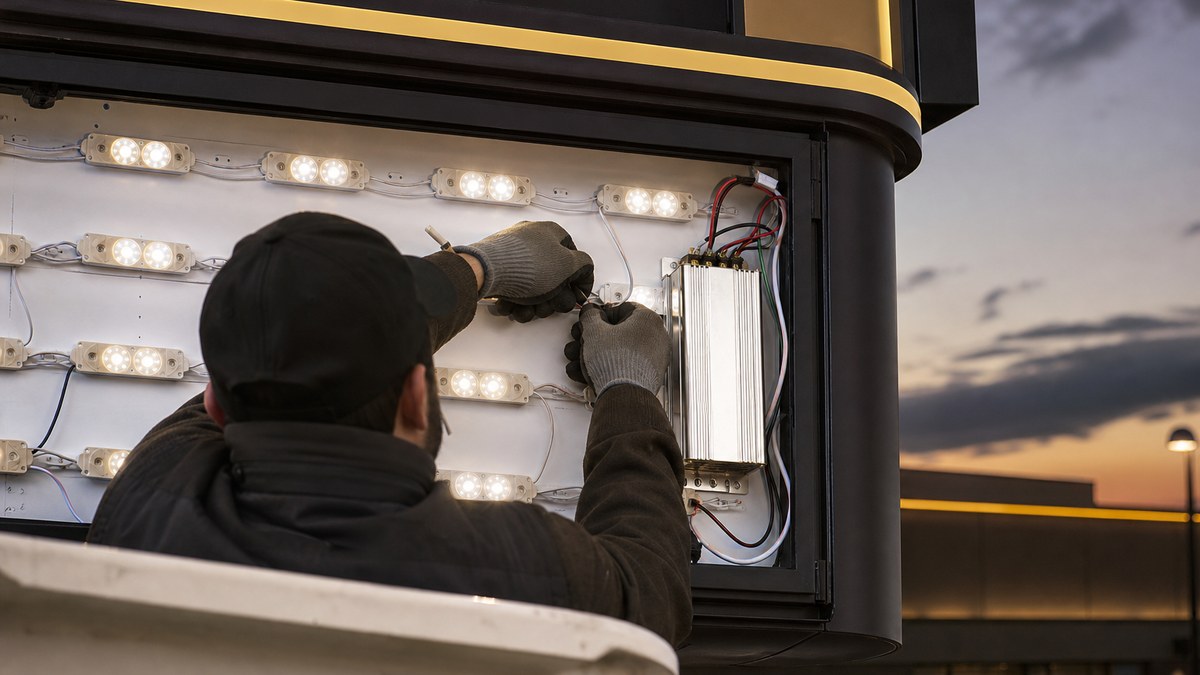
Many pylon, monument and wall cabinets in Arlington still use fluorescent tubes and ballasts. A retrofit removes the lamps, sockets and ballasts and installs LED modules or LED sign lighting systems with new power supplies. The result is brighter, more even light, less maintenance, and lower energy use. Retrofits are also a good time to replace yellowed or cracked faces.
Neon to LED
Neon has character, but it is fragile, uses high voltage and is expensive to repair. Channel letters lit by neon can usually be converted to LED modules inside the existing cans. For signs where the neon look itself is the point, LED neon-style flex can recreate the glowing line with lower voltage and better durability.
Upgrading controls
Many old signs run on worn-out timers or stay on all day. A retrofit is the right time to add a photocell or astronomical timer so the sign turns on at dusk and off when you choose. Message centers and color-changing signs can be tied into scheduling software.
Signs as part of your whole property's lighting
A great sign on a dark building still looks like a closed business. The sign, the facade, the entrance and the parking lot work together. A few examples of how we plan them as one system:
- Facade and architectural lighting frames the sign and makes the whole building visible from the road. See our architectural lighting services.
- Parking lot and site lighting makes customers feel safe and draws the eye toward the entrance. Old metal halide poles next to a new LED sign create a mismatch in color and brightness.
- Entrance and canopy lighting leads customers from the sign to the door.
- Interior lighting visible through the windows tells people you are open. Our business lighting services guide covers interior retrofits.
For larger projects, our Luminance design-build program plans signage, facade, site and interior lighting together so a property looks consistent and finished after dark.
Where LED signs work hardest in Arlington
Arlington is a driving city with busy commercial corridors and a constant stream of visitors. The places where sign visibility matters most include:
- Major corridors such as Cooper Street, Collins Street, Division Street, Abram Street, Pioneer Parkway and the I-20 and I-30 frontage roads, where drivers decide quickly whether to turn in.
- The Entertainment District around AT&T Stadium, Globe Life Field and Texas Live!, where hotels, restaurants and bars compete for game-day and event crowds.
- South Arlington, Pantego and Mansfield retail centers along the growing southern corridors; see our South Arlington, Pantego and Mansfield guide.
- Near UT Arlington and downtown, where storefronts, restaurants and student-focused businesses are seen by pedestrians as well as drivers.
- Industrial and flex areas such as the Great Southwest area, where warehouses and showrooms need clear building identification for drivers and deliveries.
- Churches, schools and community buildings that use monument signs and message centers to share service times and events.
We serve all of Arlington and nearby communities, including Grand Prairie, Mansfield, Pantego, Kennedale and the wider DFW area. See our service areas.
How an LED sign project works
- Consultation and site review. We look at the building, sightlines, existing signs and electrical service, and talk through your goals and brand.
- Rules check. City standards, zoning, landlord or association criteria and any special district requirements are reviewed before design.
- Design. Sign type, size, materials, colors, lighting style and mounting are drawn up with a night view of how the sign will look lit.
- Proposal. You receive a clear, project-specific proposal covering fabrication, structure, electrical, permits and installation.
- Permits and engineering. Permit drawings are prepared, and engineered plans are added where required, such as for taller freestanding signs.
- Fabrication. The sign is built with listed components, quality LED modules and properly sized power supplies.
- Installation. Licensed crews install the sign, complete the electrical connections and set up photocells, timers or message center software.
- Final check and support. We confirm the sign is even, bright and working correctly, show your staff how to run any controls, and remain available for service and repairs.
Maintenance and common sign problems
LED signs need far less maintenance than fluorescent or neon signs, but they are not maintenance-free. Most problems we see trace back to a few causes:
- Failed power supplies. The LED modules often outlast the power supply. When a whole letter or section goes dark at once, the power supply is the first thing to check.
- Water intrusion. Missing weep holes, failed seals and damaged faces let water in, which corrodes connections. Hail and wind-driven rain in North Texas make good sealing important.
- Heat. Sun-facing signs get hot in a Texas summer. Ventilation and quality components help LEDs and power supplies last.
- Flicker and color shift. Mismatched modules, loose connections or failing drivers can cause flicker or uneven color. Matching replacement parts keeps the sign consistent.
- Timer and photocell issues. A sign that is on all day or off at night usually has a control problem, not a lighting problem.
- Faded faces and finishes. Sun fades vinyl and acrylic over time, and Arlington's standards require signs to be kept in good repair.
A quick look at your sign each month after dark catches most issues early, before a dark letter turns into a misspelled sign. If something is out, our commercial lighting services team can diagnose and repair it.
What affects the cost of an LED sign
Every sign is quoted individually, and we provide a project-specific proposal after reviewing the site. The main factors are:
- Sign type and size: channel letters, cabinets, monuments and message centers are built very differently
- Materials and finish: face materials, custom colors, dimensional elements and premium finishes
- Lighting style: front-lit, halo-lit, combination or external lighting
- Display technology: for message centers, pixel pitch, full color or monochrome, and software
- Structure: wall conditions, raceways, foundations and engineering for freestanding signs
- Electrical work: new circuits, disconnects, controls and distance to power
- Permits and access: permit preparation, engineering where required, and equipment needed to reach the sign
- Retrofit or replace: whether existing cabinets and letters can be reused
Common mistakes when buying an LED sign
- Designing before checking the rules. A sign that is too large, too tall or the wrong type for the zoning or the center criteria will be rejected, and redesigns cost time.
- Too much text. A sign is not a brochure. Your name and what you do, in large letters, beats a list of services drivers cannot read.
- Choosing the cheapest LEDs. Low-quality modules and power supplies fail early, shift color and create a patchwork look within a few years.
- Ignoring night appearance. Approving a design from a daytime drawing alone can lead to surprises. Ask to see how the sign will look lit.
- No dimming on message centers. A message center at full brightness at night is glaring and can create complaints.
- Forgetting the rest of the building. A bright new sign next to dark windows and a dim parking lot still looks closed.
Why work with Arlington LED Lights
Arlington LED Lights plans commercial lighting, signage and LED displays as one system for Arlington and DFW businesses. We bring more than 15 years as an authorized architectural lighting dealer and project coordinator, and our licensed installation partner has completed over 200 major sports and commercial projects across the US and Canada — NFL, NBA, NHL, MLS, NCAA and NASCAR. Whether you need one storefront sign or a coordinated upgrade of signs, facade and site lighting across a property, we start with your goals and the rules, then deliver a clear proposal. Read more about our LED signage services, our commercial LED lighting and all services, or see our step-by-step lighting installation guide and large-scale project guide.
Frequently Asked Questions
What types of LED signs are best for Arlington businesses?
Do I need a permit for an LED sign in Arlington, TX?
Are LED message centers allowed in Arlington?
Can my old fluorescent or neon sign be converted to LED?
How long do LED signs last?
How bright should a business sign be?
Who is licensed to install electric signs in Texas?
How much does an LED sign cost in Arlington?
Do you also light the rest of the building?
Let's make your business easy to find
Request a consultation and we will follow up to discuss your building, your sign and your timeline.
Related
Our DFW lighting network: Dallas LED video walls and commercial lighting, Fort Worth LED lighting, Irving LED lighting, Plano LED lighting, statewide Texas LED lighting, wholesale LED components, LED signs and message centers, fiber optic starlight ceilings, 360° fiber optic lighting, modular building solutions, and Dallas modular structures.