LED Sports Lighting in Texas: A Guide to Fields, Gyms & Venues in Arlington and DFW
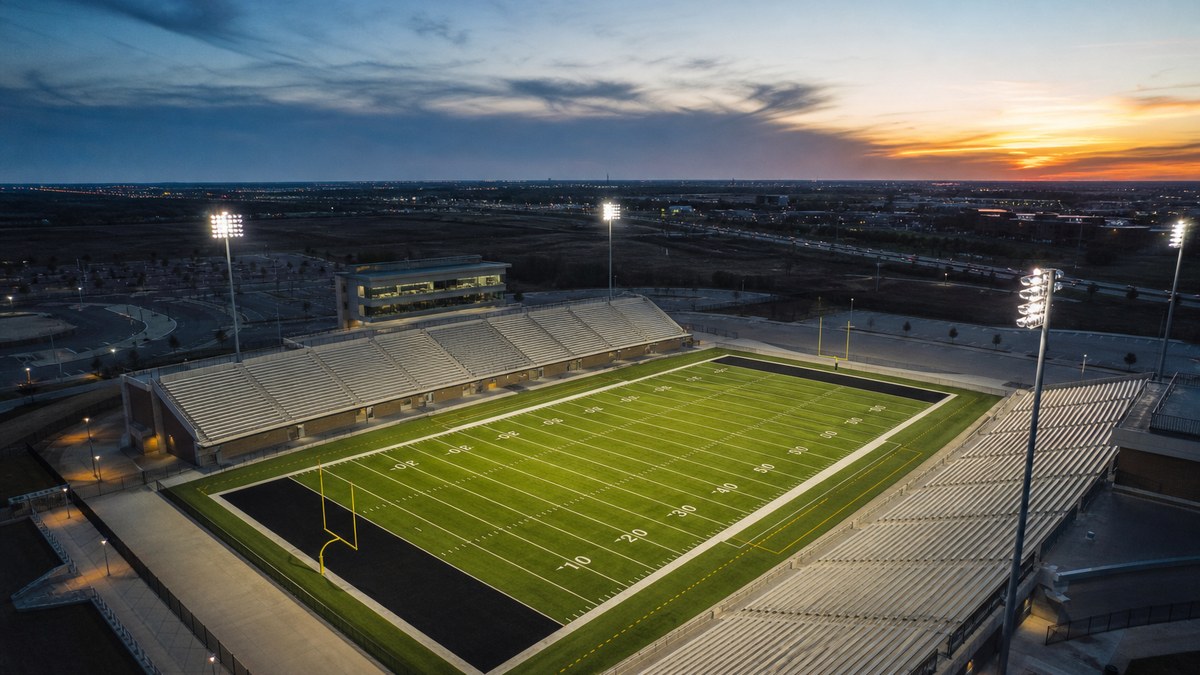
LED sports lighting in Texas has become the standard for new fields and the default upgrade for old ones. Friday night football, select baseball, youth soccer, tennis and pickleball courts, school gyms, and multi-sport complexes across Arlington and the DFW metroplex are replacing aging metal halide fixtures with LED systems that turn on instantly, light the playing surface more evenly, and keep light out of the neighbors' windows. Done well, a sports lighting project makes play safer, games look better on camera, and evenings easier to schedule. Done poorly, it creates glare, dark spots, and complaints.
This guide is for athletic directors, facility managers, school districts, parks departments, private sports complexes, churches with recreation fields, and property owners comparing Texas LED sports lighting companies. It explains how sports lighting is designed, which light levels different sports and levels of play typically call for, what separates a good LED system from a cheap one, how retrofits and new installs differ, and the questions to ask any supplier before you sign. Every project we take on is quoted individually, so you will find planning guidance here, not price tags.
LED sports lighting uses high-output, precisely aimed LED floodlights on poles or in ceilings to light a playing surface evenly while controlling glare and spill light.
- Light levels depend on the sport and level of play: industry guidance (IES RP-6) sets higher targets for broadcast and college play than for high school, recreation, or practice
- Uniformity matters as much as brightness: an even field with no dark spots is safer and looks better on camera
- Optics control glare and spill: good LED fixtures put light on the field, not in players' eyes or neighbors' yards
- Instant on and dimmable: no warm-up or restrike delay, and scenes for games, practice, and maintenance
- Long life, less maintenance: LEDs commonly last far longer than metal halide lamps and use far less energy
- Pricing: every field, gym, or venue is quoted to its size, sport, poles, power, and controls
Why Texas facilities are switching to LED
For decades, most Texas fields were lit with metal halide fixtures on tall poles. They did the job, but they come with well-known problems. Metal halide lamps take several minutes to warm up and longer to restrike after a power blip, which can stop a game cold. Their output fades steadily over their life, so a field that measured well when new can be noticeably dimmer a few seasons later. Relamping means bucket trucks or crane time at the top of a pole, and the large reflectors throw a lot of light where it is not wanted.
LED changes each of those. LED floodlights reach full output instantly, can be dimmed and switched in zones, hold their output far longer, and use precision optics to aim light exactly where it is needed. The result is a field that is brighter where it counts, darker where it should be, and far cheaper to run and maintain over its life. For Texas facilities that host long seasons in heat, wind, and storms, that combination is hard to beat.
The main benefits at a glance
- Instant on, instant restrike: no waiting after a storm-related power interruption
- Better uniformity: fewer hot spots and dark corners across the playing surface
- Glare and spill control: sharper cutoff optics keep light on the field
- Lower energy use: LED commonly uses far less energy than metal halide for the same result
- Less maintenance: no group relamping; service shifts to inspections and the occasional driver
- Controls: dimming, scheduling, and remote control for practice, games, and events
- Better color: higher color rendering makes uniforms, the ball, and the field look true, on site and on camera
How much light does a sports field need?
Sports lighting is measured in foot-candles (or lux) on the playing surface. The most widely used reference in the United States is the Illuminating Engineering Society's sports lighting recommended practice, ANSI/IES RP-6. It groups facilities into classes by level of play and spectator count, and sets higher targets for faster sports and higher classes. Here is how the classes are commonly described:
- Class I: professional and broadcast venues with large spectator capacity
- Class II: college, minor league, and other venues with mid-size crowds
- Class III: high school and recreational facilities with smaller crowds
- Class IV: practice, training, and leisure play with few or no spectators
The table below shows commonly cited maintained horizontal light levels from RP-6-based guidance. Treat these as planning starting points; a photometric design for your actual field, sport, and league requirements is what sets the final target.
| Sport | Class I | Class II | Class III | Class IV |
|---|---|---|---|---|
| Football (outdoor) | 100 fc | 50 fc | 30 fc | 20 fc |
| Baseball / softball (outdoor) | 100 fc | 70 fc | 50 fc | 30 fc |
| Soccer (outdoor) | 75 fc | 50 fc | 30 fc | 20 fc |
| Tennis (outdoor) | 100 fc | 75 fc | 50 fc | 30 fc |
| Pickleball (outdoor) | 75 fc | 50 fc | 30 fc | 20 fc |
| Basketball / volleyball (indoor) | 100 fc | 75 fc | 50 fc | 30 fc |
| Track and field (outdoor) | 50 fc | 30 fc | 20 fc | 10 fc |
Recommended levels are maintained values: what the field should still measure after years of dirt and normal output loss, not on day one. A good design starts above the target so the field is still on spec seasons later. Ask any supplier whether their numbers are initial or maintained.
Uniformity: the number people forget
Average foot-candles tell only half the story. Uniformity compares the brightest and darkest points on the playing surface. A field with a great average but bright patches near the poles and dim areas in the corners is harder to play on, because the ball and players move through changing light. Well-designed LED systems commonly achieve tight maximum-to-minimum ratios, and higher classes of play call for tighter uniformity. When comparing proposals, ask for the full point-by-point photometric grid, not just the average.
Vertical light for broadcast and streaming
Cameras see the vertical faces of players, not the ground. Venues that broadcast or stream games, which now includes many high school and college programs, should plan for vertical illuminance as well as horizontal. That affects pole placement, aiming, and fixture count, so it is much easier to design in from the start than to add later.
Glare, spill light and being a good neighbor
Sports lighting is some of the most visible lighting in any community. Many Texas fields sit next to neighborhoods, roads, and other facilities, and older systems were notorious for lighting up backyards and bedrooms. LED gives designers much better tools to prevent that:
- Precision optics shape the beam so light lands on the field instead of spilling past it
- Visors and shields cut the light that would otherwise escape upward or sideways
- Correct pole height and setback lets fixtures aim more steeply down, which reduces glare for players and neighbors
- Aiming from multiple angles helps players track fly balls, high kicks, and tennis lobs without losing them in a hot spot
- Dimming and curfews drop light levels or shut the field off automatically at set times
Many cities and school districts have rules or expectations about outdoor lighting, glare, and light trespass, and these can vary by zoning district and property type. Arlington has updated its Unified Development Code in recent years, so it is worth checking current requirements with the city early in planning. A good photometric study can show spill light at the property line before a single pole goes up, which makes conversations with neighbors and permitting staff much easier.
Indoor sports lighting: gyms, natatoriums and field houses
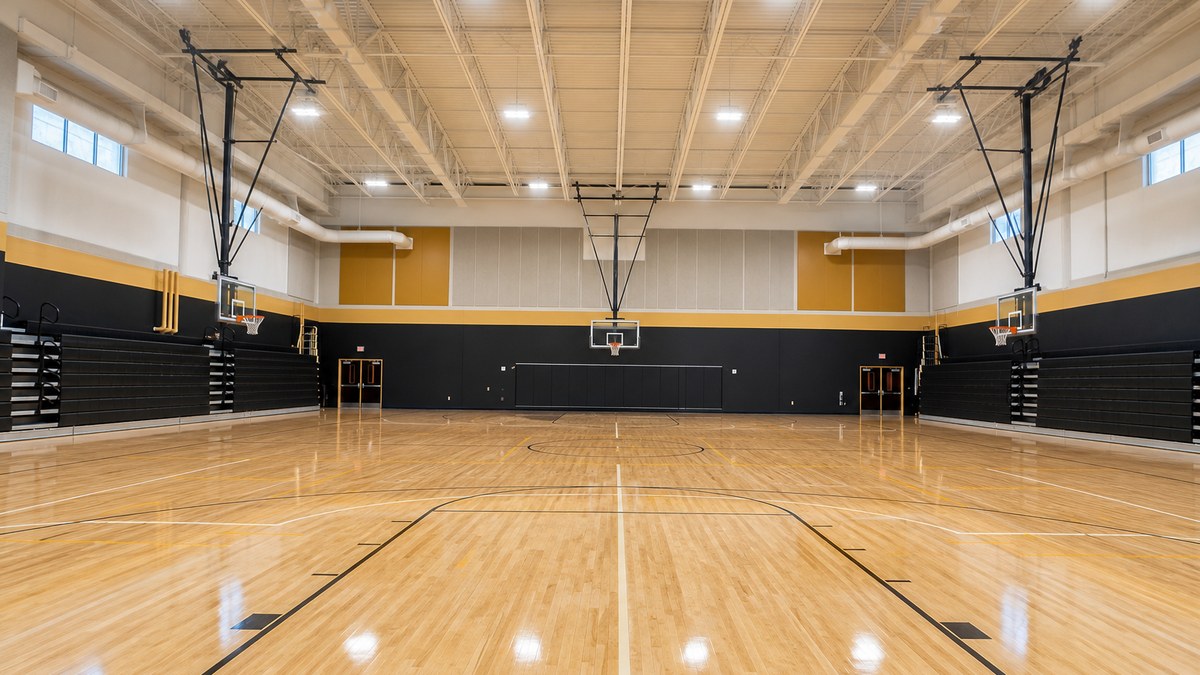
Indoor facilities have their own challenges. Basketball and volleyball players spend much of the game looking up, so fixtures directly over the court can blind them during rebounds, serves, and blocks. Light-colored walls and floors bounce light around, which helps uniformity but can also add glare. And many school gyms double as assembly halls, testing centers, and event spaces, so the lighting needs to do more than one job.
What good indoor sports lighting looks like
- Even light across the court with no dark sidelines or corners
- Low-glare high bay fixtures with diffusers or optics chosen for upward-looking sports
- Impact protection: wire guards or impact-rated fixtures where balls will hit them
- Instant on and dimming for practices, games, assemblies, and cleaning crews
- Scenes and zoning so a half-court practice does not light the whole building
- Camera-friendly light with flicker-free drivers and good color for streaming games
Natatoriums add humidity and corrosive air, which call for fixtures and mounting hardware rated for wet and chemical environments, plus careful aiming to limit reflections off the water that can make it hard for lifeguards and officials to see. Indoor tennis, pickleball, and multi-sport field houses share many of the same needs as gyms, scaled up. Our guide to commercial lighting installation in Arlington covers how high bay installs are planned and scheduled in occupied buildings.
Outdoor fields and courts in North Texas
Football and soccer stadiums
Texas high school football is played under the lights, and many stadiums also host soccer, band, track, and community events. These fields typically use four, six, or eight poles depending on field size, stands, and the level of play. Stadiums that stream or broadcast games benefit from planning vertical light and color quality from the start, and from controls that can switch between game, practice, and event modes.
Baseball and softball
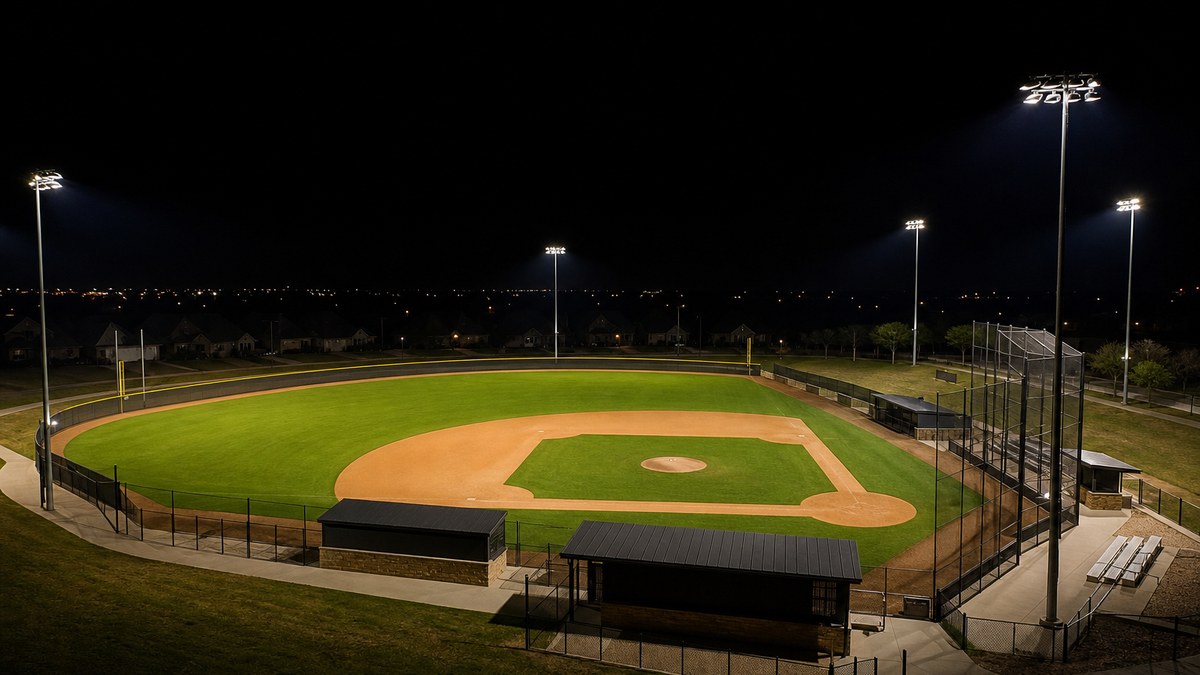
Baseball and softball fields are among the hardest to light well because the ball travels high and far. Infields usually need more light than outfields, and fixtures must be aimed and shielded so fielders do not lose fly balls in glare. Pole placement around fences and dugouts, and aiming from both sides of the field, makes a big difference.
Tennis and pickleball courts
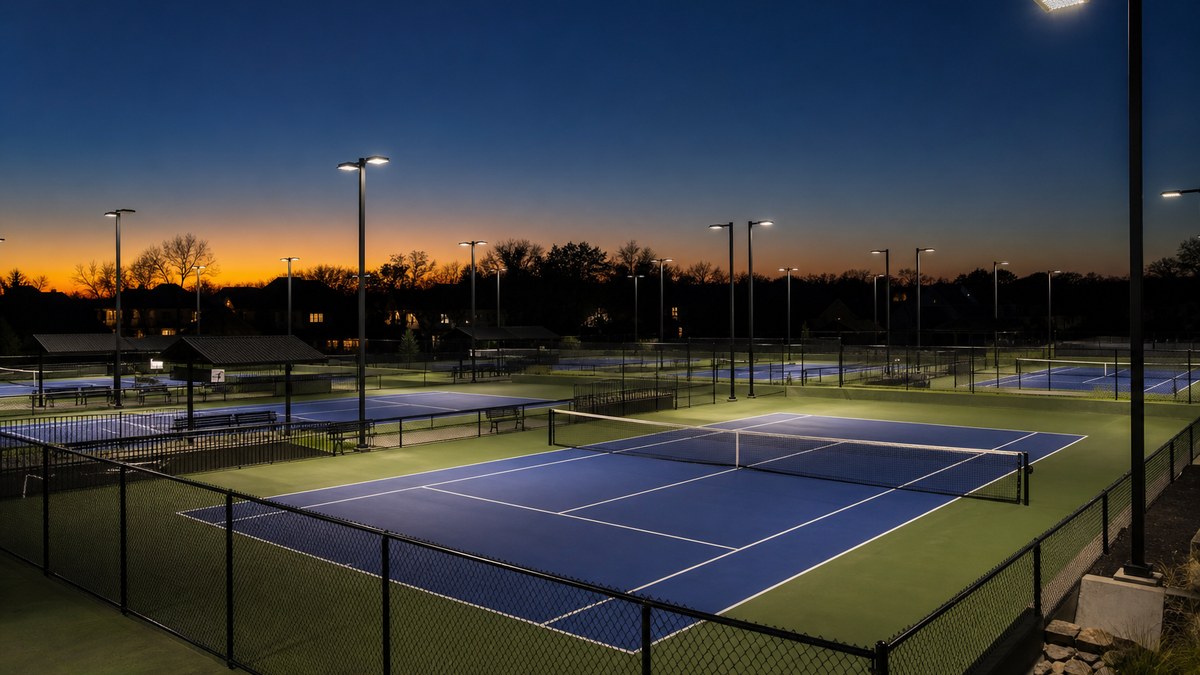
Courts are compact and often sit close to homes, apartments, and parking lots. That makes spill control critical. With pickleball growing across DFW, many parks, clubs, HOAs, and churches are adding or converting courts, and LED lets them light play without lighting the neighborhood.
Multi-sport complexes and practice fields
Large complexes can benefit most from LED controls. Scheduling software can turn on only the fields that are booked, dim fields between games, and shut everything off at curfew. Practice fields may not need game-level light, so designing them to the right class saves energy and equipment without shortchanging players.
Arlington, the home of big-time sports
Few cities are as closely tied to sports as Arlington. AT&T Stadium, Globe Life Field, and the Texas Live! district bring national attention, and the University of Texas at Arlington and local school districts host athletics all year. That big-league backdrop raises expectations everywhere else too: parents, players, and fans now expect high school stadiums, select ball fields, and rec centers to look and feel polished. (These landmarks are part of what makes Arlington special; they are not our projects.)
Arlington LED Lights brings commercial-grade sports lighting to the facilities that serve local communities: school and church fields, private sports complexes, clubs, courts, gyms, and the hotels and entertainment venues around the district. Our licensed installation partner has completed over 200 major sports and commercial projects across the US and Canada — NFL, NBA, NHL, MLS, NCAA and NASCAR. We also bring 15+ years as an authorized architectural lighting dealer and project coordinator.
Lighting a field, court or gym?
Tell us the sport, level of play, and what you have today. We will review the site and prepare a project-specific proposal with photometrics.
Retrofit vs. new sports lighting system
Not every project needs new poles. The right answer depends on the condition of what is already there and what the facility needs going forward.
| Option | When it fits | What to check |
|---|---|---|
| Fixture retrofit on existing poles | Poles, foundations, and wiring are sound and pole layout still suits the field | Structural capacity of poles and crossarms for new fixture weight and wind load; condition of wiring and electrical gear |
| Retrofit plus added or relocated poles | Existing layout leaves dark spots or causes glare, or the field is changing use | Photometric study of the new layout; foundations; trenching and electrical capacity |
| Complete new system | Unlit field, failing poles, or a major renovation or new build | Pole heights and setbacks, engineered foundations, power service, controls, and local requirements |
| Indoor high bay upgrade | Gyms, field houses, natatoriums with aging fluorescent or metal halide | Mounting heights, impact protection, environment rating, controls, and work schedule around use |
Why "just swap the heads" can backfire
A one-for-one fixture swap can look like the quickest path, but sports fixtures are only as good as their aiming. If the existing poles were placed for older technology, or if the new fixtures are heavier or catch more wind, a simple swap can leave the field uneven or overload the structure. A proper retrofit starts with a structural check and a photometric design for the actual poles you have.
The sports lighting project process
- Site review. We look at the field or building, existing poles and fixtures, electrical service, neighbors, and how the facility is used.
- Goals and class of play. We confirm sports, levels of play, broadcast or streaming plans, and any league or district requirements.
- Photometric design. A computer model sets fixture counts, aiming, and pole layout, and shows light levels, uniformity, and spill at the property line.
- Structural and electrical review. Poles, foundations, crossarms, and power are checked or engineered for the new system.
- Proposal. A clear scope covering fixtures, poles, electrical, controls, installation, and commissioning.
- Permits and coordination. We help coordinate with the city, school district, or property owner as needed.
- Installation. Work is scheduled around seasons, games, and school calendars where possible.
- Aiming and commissioning. Fixtures are aimed, light levels are verified on the field, and controls are set up.
- Training and service. Staff learn to run the controls, and service plans keep the system on spec.
Controls: getting more from every hour of light
One of the biggest advantages of LED sports lighting is control. Metal halide systems were effectively on or off. LED systems can do much more:
- Game, practice, and maintenance scenes at different light levels from the same fixtures
- Zoning to light half a field, one court, or one diamond at a time
- Scheduling tied to bookings, seasons, and curfews
- Remote control so staff can turn fields on or off from a phone or office
- Special effects such as light shows for touchdowns or player introductions, which are an optional add-on that needs compatible fixtures and controls
- Monitoring to spot a failed fixture or driver before someone complains
Controls also connect sports lighting with the rest of a facility: parking lots, walkways, concessions, and scoreboards or LED video displays. For a full facility, that is where design-build planning through our Luminance program can pull everything together.
What to ask LED sports lighting suppliers in Texas
There are many fixture manufacturers and resellers in the sports lighting market, and spec sheets can make very different products look alike. These questions help separate a lighting system from a box of fixtures:
- Can I see the photometric plan? Ask for point-by-point light levels, uniformity, and spill at the property line for your actual field.
- Are the levels initial or maintained? Maintained values tell you what the field will measure years from now.
- What glare and spill control is included? Ask about optics, visors, and shields, and how they affect neighbors.
- Will my poles handle the new fixtures? Weight and wind load matter in Texas; ask who checks the structure.
- What is the warranty, and who honors it? Ask what the fixture warranty covers and who handles service locally.
- Who aims and verifies the system? Commissioning with on-field measurements should be part of the job.
- What controls are included? Dimming, scheduling, and remote control should be clear in the scope.
- Is the system flicker-free for cameras? Important if you stream games or capture slow-motion video.
- How is surge protection handled? Lightning and power surges are a real risk for tall poles in North Texas storms.
Compare proposals on the same basis: same sport, same class of play, same maintained light level and uniformity, same controls. A lower-priced proposal that quietly drops a class or skips spill control is not really cheaper.
Built for Texas weather
North Texas sports lighting has to handle summer heat, high winds, hail, heavy rain, and lightning. That affects every part of the system:
- Thermal management: LED fixtures need good heat sinking to hold output and life during long summer evenings
- Wind load: fixtures, crossarms, and poles must be rated for local wind conditions
- Sealing: fixtures and drivers should be rated for outdoor, wet conditions
- Surge protection: pole-mounted fixtures and drivers benefit from proper surge protection and grounding
- Remote drivers: some systems place drivers in cabinets at the base of the pole for easier service
Energy, incentives and long-term value
LED sports lighting commonly uses far less energy than the metal halide it replaces, and controls cut use further by lighting only what is needed. Maintenance falls too, since there is no group relamping and fixtures hold their output much longer. Depending on program availability, LED upgrades for commercial and public facilities in the Oncor service area may qualify for utility incentives, and some commercial building upgrades may also qualify for the federal 179D deduction; confirm with your tax advisor. We help clients look at the whole picture, including energy, maintenance, and how the facility will be used, so the proposal reflects real long-term value rather than the lowest first cost.
What shapes the cost of a sports lighting project
Every project is quoted individually. The main factors are:
- Sport and class of play: higher light levels and tighter uniformity mean more fixtures
- Field or court size and layout
- Poles: reusing existing poles vs. new poles and engineered foundations
- Electrical work: service capacity, trenching, and wiring
- Controls: from simple on/off to scheduling, zoning, and effects
- Broadcast or streaming needs: vertical light and color quality
- Site access and schedule: lift or crane access and working around seasons
Common sports lighting mistakes to avoid
- Buying on wattage or lumens alone. What matters is light on the field, uniformity, and glare control, which only a photometric design shows.
- Ignoring the neighbors. Spill light and glare create complaints and can run into local rules. Design for the property line from day one.
- Skipping the structural check. New fixtures on old poles need to be verified for weight and wind load.
- Lighting practice fields to game levels. Designing each field to its real use saves equipment and energy.
- Forgetting controls. A system without easy controls gets left on, or left off when it is needed.
- No commissioning. Fixtures that are not aimed and measured on site rarely match the design.
- Treating the field in isolation. Parking, walkways, concessions, and signage all affect how a facility feels on game night.
Beyond the field: the whole venue
Game night does not start at kickoff. Fans arrive in parking lots, walk past ticket windows and concessions, and see the scoreboard and signs before they see the field. Bright, even commercial LED lighting in parking areas and walkways improves safety; architectural lighting makes stadium entries and facades stand out; LED signage and message centers keep fans informed; and video displays bring replays and sponsors to life. We plan these elements with the sports lighting so the whole venue works together. For larger developments, see our guide to large-scale commercial LED lighting in Arlington.
Serving Arlington and the DFW metroplex
Arlington LED Lights works with schools, churches, parks, clubs, sports complexes, and venues across our service area, including Arlington, Grand Prairie, Mansfield, Pantego, Fort Worth, Irving, and Dallas. If you are in South Arlington, Pantego, or Mansfield, our local lighting guide covers the area in more detail. For general facility upgrades, see business lighting services in Arlington, and for scoreboards and entry signs, our guide to LED signs in Arlington.
Frequently Asked Questions
What is LED sports lighting?
How many foot-candles does a high school football field need?
Can I put LED fixtures on my existing light poles?
Does LED sports lighting reduce light spill onto neighbors?
How much does LED sports lighting cost in Texas?
How long do LED sports lights last?
Is LED sports lighting good for streaming and broadcast?
Are there rebates for LED sports lighting in Arlington?
Can you light indoor gyms and pickleball courts too?
How long does a sports lighting upgrade take?
Let's light your field
Request a consultation and we will follow up to discuss your facility, sports, and timeline.
Related
Our DFW lighting network: Dallas LED video walls and commercial lighting, Fort Worth LED lighting, Irving LED lighting, Plano LED lighting, statewide Texas LED lighting, wholesale LED components, LED signs and message centers, pool and natatorium lighting, fiber optic starlight ceilings, 360° fiber optic lighting, modular building solutions, and Dallas modular structures.