Shopping Center LED Lighting in Texas: A Property Owner's Guide to Parking Lots, Storefronts & Canopies
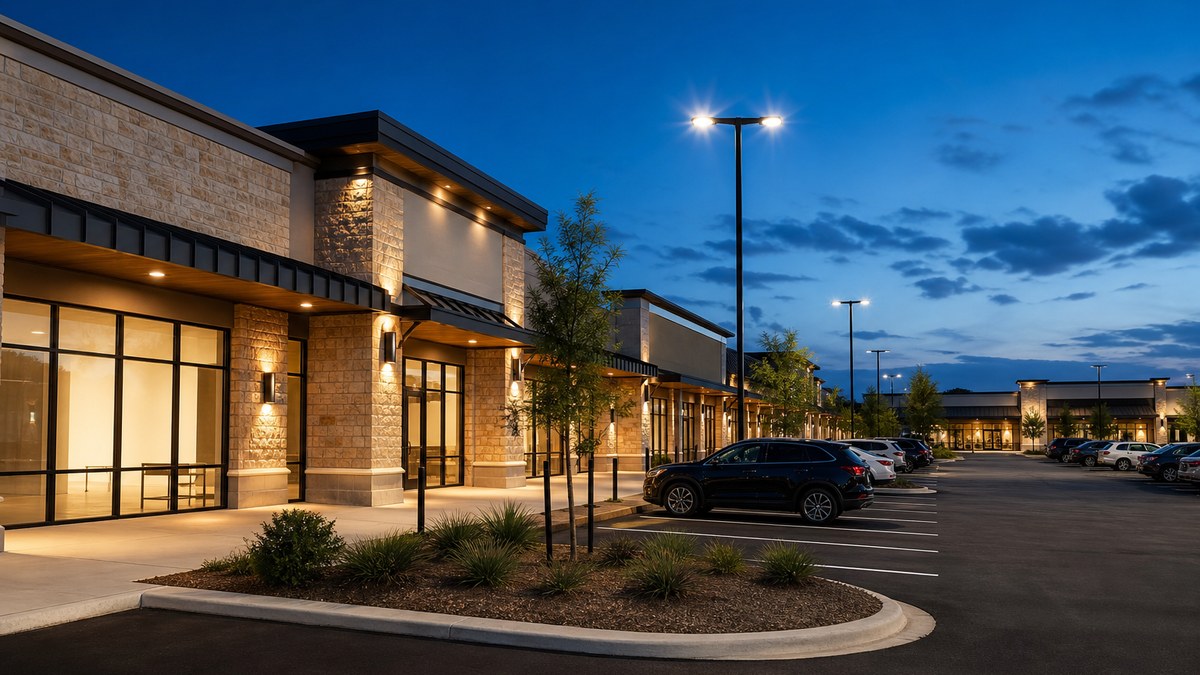
Shopping center LED lighting in Texas does a lot more than keep the parking lot bright. For a strip center, neighborhood center or power center, lighting shapes how safe customers feel after dark, how visible tenants are from the road, how much the property spends on energy and maintenance, and how the center looks to prospective tenants driving by at night. When it is planned as one system, it works much better than a patchwork of fixtures added one at a time over the years.
This guide is written for property owners, asset managers, facility managers and retail landlords in Arlington, the DFW metroplex and across Texas. It covers every lighting zone in a typical retail center (parking fields, drive aisles, storefront walkways, canopies, building facades, signage, back-of-house service areas and parking structures) and explains how to plan an LED upgrade that tenants and shoppers will notice for the right reasons.
Shopping center LED lighting means upgrading or designing every outdoor and common-area lighting zone of a retail property with LED fixtures and controls.
- Parking lots need even, glare-controlled light from LED area fixtures on poles, not just brightness
- Storefront walkways and canopies set the first impression and help shoppers feel comfortable at night
- Facades and signage make tenants visible from the road and give the center a branded look after dark
- Controls such as photocells, schedules and dimming cut wasted after-hours energy
- Local rules on shielding, light trespass and signs vary by city, so confirm requirements before you design
- Pricing: every center is different, so projects are quoted with a project-specific proposal after a site review
Why shopping center lighting matters more than ever
Texas retail centers compete for shoppers, diners and tenants. Restaurants, fitness studios, medical offices, salons and service businesses keep many centers busy well into the evening, and in winter it is dark before the dinner rush begins. A center with dim corners, flickering poles and mismatched storefront lighting sends a message that customers pick up on immediately, even if they could not explain why.
Lighting is also one of the few common-area upgrades that touches every tenant at once. A coordinated LED upgrade can make the whole property feel newer without a full facade renovation. For owners, it is a practical way to support leasing, reduce maintenance calls and address after-hours concerns from tenants.
What a good lighting plan does for a retail property
- Supports a sense of safety: even light across parking fields and walkways, with fewer dark pockets between poles
- Improves visibility: storefronts, monument signs and facades read clearly from the road at night
- Reduces maintenance: LED fixtures last far longer than older metal halide and high-pressure sodium lamps, so lift-truck service calls drop
- Lowers energy use: LED commonly uses far less energy than the legacy fixtures it replaces, and controls reduce wasted hours
- Creates a consistent look: one color temperature and one fixture family across the property instead of a mix of yellow, blue and white light
The lighting zones of a typical retail center
Most shopping centers, from a small Arlington strip center to a large anchored center along I-20, share the same lighting zones. Each has a different job, so each needs a different approach.
| Zone | Typical LED fixtures | Main goal |
|---|---|---|
| Parking fields and drive aisles | Pole-mounted LED area lights with optics matched to the layout | Even coverage, low glare, visibility of people and vehicles |
| Entrances and driveways | Area lights, accent lighting at monuments | Wayfinding and a clear, welcoming entry |
| Storefront walkways | Soffit downlights, wall sconces, linear fixtures | Comfortable pedestrian light, attractive storefronts |
| Canopies and covered walks | Low-profile LED canopy fixtures, recessed downlights | Bright, glare-free light under cover |
| Building facades | Wall grazers, floodlights, linear and color-changing accents | Architecture, branding and night-time presence |
| Signage | LED channel letters, monument and pylon sign retrofits | Tenant visibility from the road |
| Rear service areas | LED wall packs with cutoff optics | Security for deliveries, dumpsters and employee exits |
| Parking garages | Garage fixtures with occupancy sensing | Uniform light, all-night operation at lower energy |
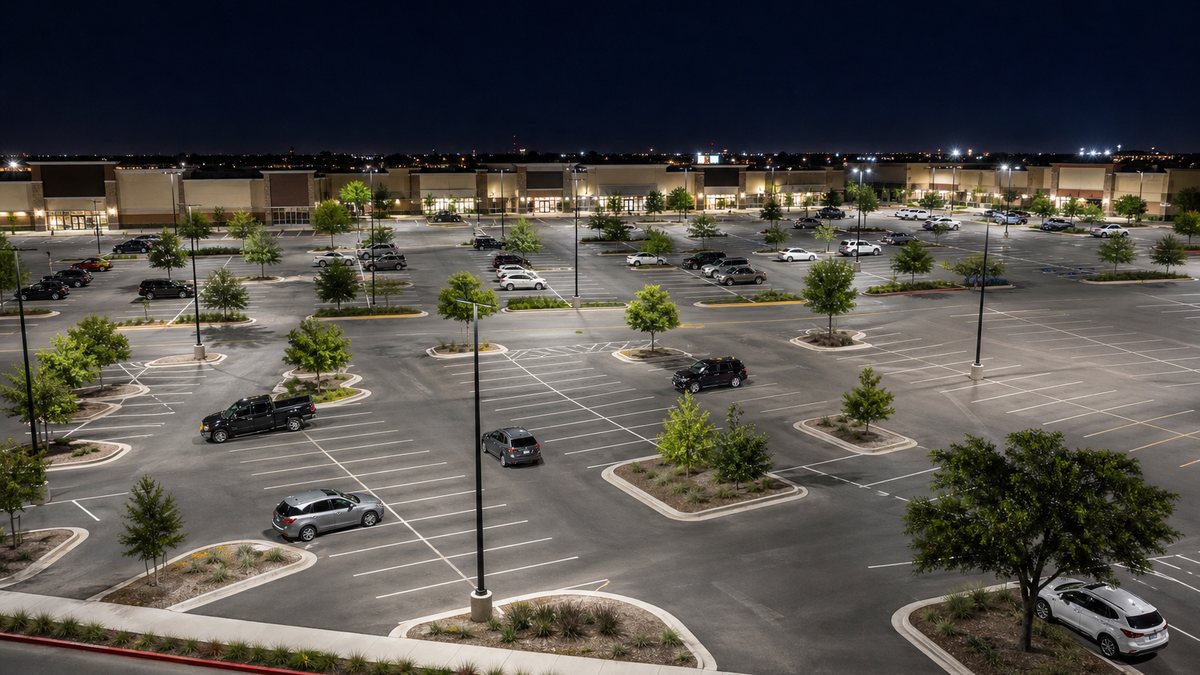
Parking lot lighting: uniformity beats brightness
The parking field is usually the biggest lighting load on a retail property and the zone customers judge first. The most common mistake is assuming brighter is better. A lot with very bright spots directly under each pole and dark gaps in between can feel less comfortable than a lot with moderate, even light everywhere. The eye adapts to the bright areas, which makes the dark areas look even darker.
Lighting professionals use guidance from the Illuminating Engineering Society (IES) when designing parking areas. Commonly cited IES guidance for open parking lots calls for a minimum horizontal illuminance of about 0.2 footcandles with a maximum-to-minimum uniformity ratio of no more than 20:1, and for lots needing enhanced security, about 0.5 footcandles with a uniformity ratio of no more than 15:1. Many owners and designers choose to exceed these minimums for retail properties, but the uniformity principle matters as much as the light level.
What makes a good LED parking lot design
- Optics matched to pole placement: LED area lights come with different distribution patterns (Type II, III, IV, V and others) that push light where it is needed, such as down a drive aisle or forward from a perimeter pole
- Vertical light on faces and vehicles: people feel safer when they can see who is walking toward them, not only the pavement
- Glare control: fully shielded fixtures aimed downward reduce glare for drivers and neighbors
- Pole condition: many older centers have poles, bases and wiring that need inspection before new heads go up
- A photometric plan: a computer layout that shows predicted light levels across the lot before anything is ordered
Before replacing fixtures one for one, ask for a photometric layout of the whole lot. Upgrading to LED is often the moment to fix old dark spots, correct over-lit areas near the building, and sometimes reduce the number of fixtures needed.
Storefronts, walkways and canopies
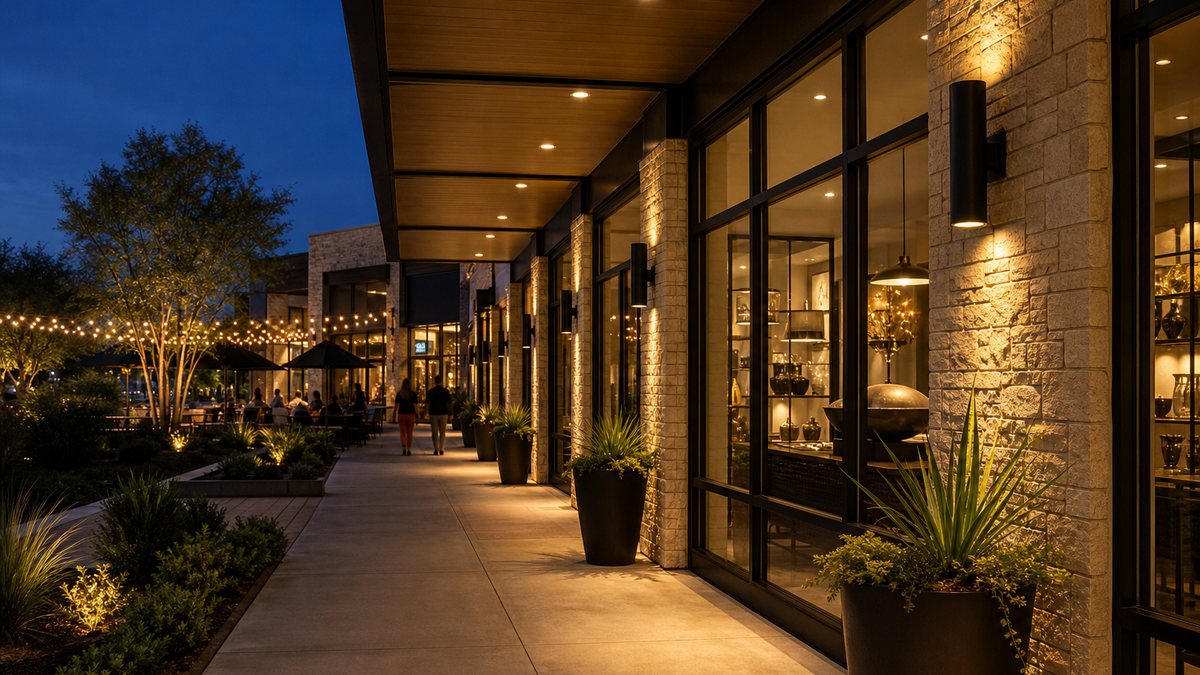
The walkway in front of the stores is where shoppers slow down, look in windows and decide where to go. Lighting here should feel comfortable and inviting rather than harsh. Soffit downlights, wall sconces and linear fixtures under canopies create a consistent band of light along the storefronts, while well-shielded optics keep glare out of shoppers' eyes.
Common storefront lighting upgrades
- Replacing mixed soffit fixtures with one consistent LED downlight family and color temperature
- Adding wall sconces or accent lights at columns and tenant entries to create rhythm along the facade
- Upgrading canopy lighting with low-profile LED fixtures designed for covered outdoor areas
- Lighting landscape beds, planters and seating areas so the walkway feels like a place, not just a path
- Coordinating with tenant-controlled window and sign lighting so the whole row looks unified
Restaurants with patios deserve special attention. Patio lighting, string lights, heaters and canopy fixtures can all be designed together so outdoor dining feels warm and comfortable in the evening. For more on interior and exterior lighting for businesses, see our guide to business lighting services in Arlington.
Color temperature, CRI and a consistent look
Many older centers glow in a mix of colors: orange high-pressure sodium in the lot, bluish metal halide on the building and whatever each tenant installed in their sign cabinet. LED gives owners a chance to choose one look and apply it everywhere.
| Color temperature | How it looks | Where it is often used in retail centers |
|---|---|---|
| 2700K to 3000K | Warm, inviting, hospitality feel | Restaurant patios, walkways, upscale lifestyle centers, landscape |
| 3500K to 4000K | Neutral white, crisp but not cold | Parking lots, canopies, storefront soffits, most general areas |
| 5000K | Cool white, very bright appearance | Service areas, loading docks, some parking applications |
Color rendering (CRI) also matters. Higher CRI makes vehicle colors, landscaping, storefront displays and people's faces look natural, which helps both shoppers and security cameras. Many communities and dark-sky advocates also prefer warmer color temperatures outdoors, so it is worth checking local preferences before choosing.
Facade, architectural and signage lighting
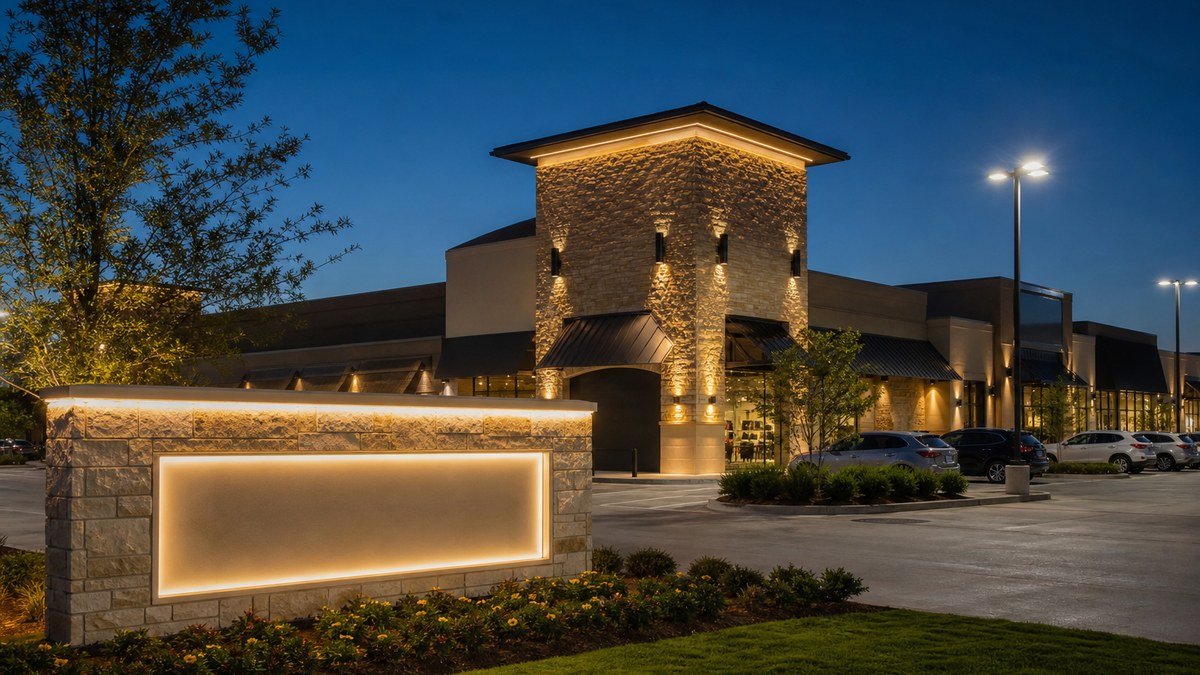
A shopping center's facade is its billboard. Architectural LED lighting can wash a tower element, graze textured stone, outline a parapet or highlight the center's name on a monument sign. Color-changing fixtures can mark holidays, local events and game days without new hardware. For more on this, our architectural and facade lighting services cover design and installation.
Signage is the other half of visibility. Older fluorescent pylon and monument sign cabinets and neon or fluorescent channel letters can be retrofitted with LED modules for brighter, more even faces and far less maintenance. Our detailed guide to LED signs in Arlington covers channel letters, monument signs, message centers and local permit rules. In Arlington, signs are governed by Article 7 of the Unified Development Code, and the city's commercial sign standards prohibit signs with motion and roof signs, so any sign changes should be confirmed with the city first.
Planning an upgrade for your center?
Tell us about your property, the zones that concern you and any tenant feedback. We will review the site and prepare a project-specific proposal.
Back-of-house, service areas and parking garages
Rear service drives, loading areas, dumpster enclosures and employee exits are often the most neglected lighting on a retail property, yet they matter for tenant staff who close late and for vendors making deliveries. LED wall packs with cutoff optics put light on the ground and doors rather than into neighbors' yards. Motion-responsive controls can keep a low level of light all night and boost it when someone approaches.
Centers with parking structures face a different challenge: garages are lit around the clock. LED garage fixtures with integrated occupancy sensors can dim unused levels and bays while maintaining a safe base level, which is one of the most effective energy upgrades on a mixed-use or larger retail property.
Controls: the upgrade inside the upgrade
Swapping old fixtures for LED is only half the opportunity. Controls decide when lights are on and how bright they are. Many centers still run every light from dusk to dawn at full output, even after the last tenant closes.
- Photocells turn lighting on at dusk and off at dawn automatically
- Astronomical time clocks follow sunrise and sunset through the year and allow schedules by zone
- Dimming after hours reduces parking lot output once stores close while keeping a safe base level
- Motion and occupancy sensors raise light levels when people or vehicles are present
- Networked or wireless controls let property managers adjust schedules and see fixture status remotely
- Zoning by tenant hours keeps lights brighter near late-night restaurants and fitness studios while dimming quieter areas
Energy codes also matter. Texas has a statewide minimum commercial energy code, and many cities have adopted newer editions locally. Exterior lighting controls and power limits are typically part of those codes, so a qualified designer should confirm the current requirements with your city before work begins.
Local rules, neighbors and light trespass
Retail centers often border homes, apartments and schools. Many Texas cities regulate outdoor lighting through zoning and development codes, with rules on fixture shielding, pole height, light spilling over property lines and lighting near residential districts. Requirements vary by city and sometimes by zoning district, so it is important to check before ordering fixtures.
In Arlington, start with the city's Unified Development Code and the planning and development services staff. If your center is in Grand Prairie, Mansfield, Fort Worth, Dallas or another city, the same principle applies: confirm the current lighting and sign requirements with that city. Well-designed LED fixtures with good optics and full shielding make it much easier to light the property well while keeping neighbors happy.
Aim light down and in, not up and out. Shielded LED area lights, backlight control on perimeter poles and lower after-hours levels reduce complaints and often improve the look of the property at the same time.
Energy, maintenance and utility incentives
LED commonly uses far less energy than older metal halide and high-pressure sodium fixtures, and it lasts many times longer. For shopping centers, the maintenance side is often just as important as energy. Every lamp change on a tall parking lot pole needs a lift and a crew, and older systems tend to fail one fixture at a time, creating a constant stream of dark spots and service calls.
Utility programs can also help. Shopping centers on Oncor meters in North Texas may qualify for incentives through Oncor's commercial programs, depending on program availability, and other parts of Texas are served by utilities such as CenterPoint, AEP Texas and TNMP with their own programs. Programs, funding and eligibility change, so incentives are checked for each project rather than assumed. The federal 179D deduction ended for projects whose construction begins after June 30, 2026; earlier projects may still qualify, so confirm with your tax advisor.
Who pays: landlords, tenants and CAM
Lighting at a shopping center usually falls into two buckets. Common-area lighting (parking lots, walkways, canopies, facades and shared signs) is typically the landlord's responsibility and is often handled through common area maintenance. Tenant lighting (interior lighting, window displays and tenant signs) is typically the tenant's responsibility under the lease. Leases vary, so owners should review how lighting upgrades and their maintenance are treated before planning a project.
A coordinated approach often works best: the owner upgrades common areas, sets a lighting standard for color temperature and sign illumination, and offers tenants a simple path to upgrade their own signs and storefronts to match. Our Luminance design-build program is built for this kind of whole-property transformation.
How a shopping center LED project runs
- Site walk and night survey. We review the property during the day and after dark, noting dark spots, glare, failed fixtures, pole condition and tenant concerns.
- Inventory and goals. Every fixture is counted by zone, and goals are set for safety, appearance, energy and maintenance.
- Design and photometrics. Fixtures, optics, color temperature and controls are selected, and a photometric layout confirms coverage.
- Code and incentive check. Local lighting and sign rules are confirmed, and utility incentive eligibility is reviewed.
- Proposal. A clear, project-specific proposal covering fixtures, controls, labor, lifts, poles and any electrical work.
- Phased installation. Work is scheduled around tenant hours, often early morning or after close, to keep stores open and parking available.
- Commissioning. Controls are programmed, schedules are set and the property is checked at night.
- Service. Ongoing support keeps the system working as the center changes.
For a closer look at installation steps, see our lighting installation guide. Large and multi-site portfolios may also benefit from our guide to large-scale commercial LED projects. Our licensed installation partner has completed over 200 major sports and commercial projects across the US and Canada — NFL, NBA, NHL, MLS, NCAA and NASCAR — and we bring 15+ years as an authorized architectural lighting dealer and project coordinator.
What affects the cost of a shopping center lighting project
Every center is quoted individually. The main factors are:
- Size of the property: number of poles, fixtures and zones
- Scope: parking lot only, or parking plus canopies, facades, signs and service areas
- Pole and wiring condition: reusing sound poles versus repairing or replacing bases, poles and circuits
- Controls: simple photocells versus scheduled dimming, sensors and networked controls
- Architectural features: facade accents, color-changing systems and custom elements
- Access and scheduling: lift requirements, after-hours work and phasing around tenants
Arlington LED Lights prepares a project-specific proposal after reviewing the property, so you can compare options and phase the work in a way that fits your plans.
Common mistakes in retail center lighting upgrades
- One-for-one swaps with no layout. Replacing each old head with the brightest LED available often creates glare and keeps the old dark spots.
- Mixing color temperatures. Different products bought over time make the center look patched together.
- Ignoring poles and bases. New heads on rusted or damaged poles are a risk, not an upgrade.
- Forgetting controls. Running everything all night at full output wastes much of the benefit.
- Overlooking the back of the building. Service areas matter to tenant employees and vendors.
- Skipping the code check. Shielding, light trespass and sign rules vary by city.
- Not involving tenants. A short notice and coordinated schedule keep stores open and tenants happy.
Retail lighting across Arlington and Texas
Arlington's retail is varied: centers along Cooper Street, Collins Street and I-20, neighborhood centers in South Arlington, and the restaurant and entertainment destinations near the Entertainment District around AT&T Stadium, Globe Life Field and Texas Live!. Each setting calls for a different lighting approach, from family-friendly neighborhood centers to busy destinations that see crowds on game days and concert nights. For nearby communities, see our local guide to commercial lighting in South Arlington, Pantego and Mansfield.
The same principles apply to retail centers statewide. For a broader view of commercial LED lighting for offices, warehouses, retail and facilities across the state, read our commercial LED lighting in Texas buyer's guide. Centers that host events or want dynamic displays should also look at LED video walls, and centers with athletic tenants or nearby fields can learn more in our guide to LED sports lighting in Texas.
Frequently Asked Questions
What is shopping center LED lighting?
How bright should a shopping center parking lot be?
What color temperature is best for retail center lighting?
Can we keep our existing parking lot poles?
Do shopping centers in Texas qualify for LED rebates?
Are there outdoor lighting rules for retail centers in Arlington?
Can the upgrade happen while stores stay open?
Who pays for lighting upgrades at a shopping center?
How much does a shopping center LED lighting upgrade cost?
Do you work on retail centers outside Arlington?
Let's light your shopping center
Request a consultation and we will follow up to schedule a site review and discuss your goals, tenants and timeline.
Related
Explore all our services, see our service areas or browse more guides on the Arlington LED Lights blog.
Our DFW lighting network: Dallas LED video walls and commercial lighting, Fort Worth LED lighting, Irving LED lighting, Plano LED lighting, statewide Texas LED lighting, wholesale LED components, LED signs and message centers, fiber optic starlight ceilings, 360° fiber optic lighting, pool and water feature lighting, modular building solutions, and Dallas modular structures.