Warehouse & Industrial LED Lighting in Arlington, TX: A Guide for Distribution Centers, Manufacturing & the Great Southwest Corridor
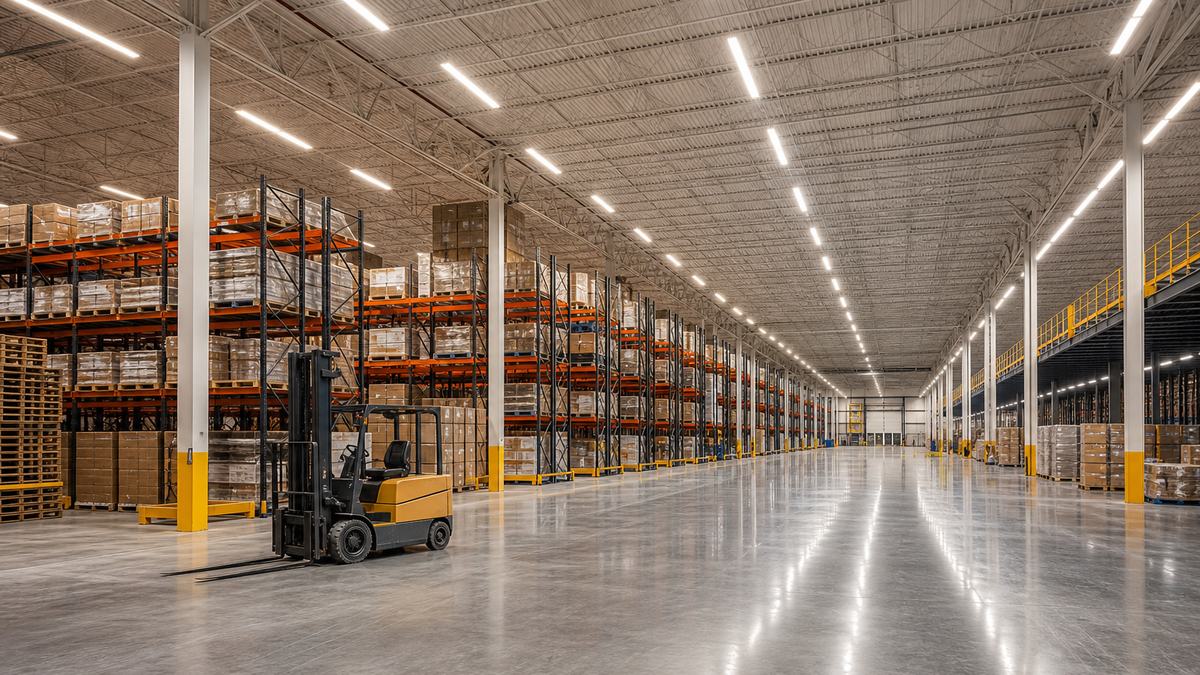
Warehouse LED lighting in Arlington has to do more than fill a big box with light. It has to let forklift drivers see into the top of a rack, let pickers read a label at shoulder height, keep loading docks safe at 3 a.m., survive a Texas summer under an uninsulated roof deck, and switch itself down when an aisle is empty. Get it right and a building feels brighter, safer and easier to work in while using commonly far less energy than the metal halide or fluorescent fixtures it replaces. Get it wrong and you end up with glare, dark rack faces and sensors that shut lights off on people.
This guide is written for owners, facility managers, tenants and property managers of warehouses, distribution centers, manufacturing plants, flex buildings and cold storage across Arlington, Grand Prairie and the surrounding DFW industrial corridors. It covers light levels by zone, how to choose high bay fixtures, aisle and dock lighting, controls and energy code, special environments, exterior lighting, how retrofits are planned around live operations, and what drives the cost of a project. Every project we deliver is quoted individually, so you will not find price lists here, just the questions that lead to a good result.
Good warehouse and industrial LED lighting matches the light level and fixture optics to each zone of the building, then adds controls so lights only run at full output when someone needs them.
- Light levels vary by task: inactive bulk storage needs far less light than active forklift aisles, loading docks, or picking and packing areas
- High bay fixtures (linear or round) are the workhorse above roughly 20 feet; low bays and vapor-tight fixtures suit lower ceilings and harsh areas
- Aisle optics push light down narrow rack aisles and onto rack faces instead of the tops of the racks
- Controls such as occupancy sensors and daylight dimming are usually required by energy code and save the most energy in warehouses
- Special areas such as freezers, wash-down rooms, hot mezzanines and hazardous locations need fixtures rated for those conditions
- Pricing: every project gets a project-specific proposal after a site review
Why industrial lighting in Arlington is its own discipline
Arlington is known for stadiums and the Entertainment District, but a large share of the city's working square footage is industrial. The Great Southwest Industrial District, which spans south Arlington and Grand Prairie along Great Southwest Parkway, is widely described as the largest industrial park in North Texas. It began in 1956 as a master-planned business park built around what is now Interstate 30, and today it is a dense mix of older dock-high warehouses, modern tilt-wall distribution centers, manufacturing plants, flex space and service yards. Add the I-20 corridor, the industrial pockets near Mansfield and Kennedale, and the logistics buildings that serve DFW Airport to the north, and there are a lot of buildings in our area where lighting directly affects productivity and safety.
That mix creates specific lighting challenges:
- Older buildings from earlier decades often still run metal halide or high-pressure sodium high bays, T5 or T8 fluorescent fixtures, or a patchwork of all three after years of tenant changes.
- Newer distribution centers have clear heights of 32 to 40 feet or more, very long aisles and huge truck courts, where fixture optics and spacing matter more than raw fixture output.
- Texas heat builds up under the roof deck in summer, so fixtures mounted high in a warehouse can see far higher ambient temperatures than the floor. Fixture temperature ratings and driver quality matter.
- Tenant turnover means rack layouts change. Lighting that was laid out for one tenant's racking can leave the next tenant's aisles dark.
- Around-the-clock operations mean many buildings cannot shut down for a lighting project, so installation has to be phased around shifts.
For an overview of LED options across every building type, see our commercial LED lighting buyer's guide for Texas. This article goes deeper on the industrial side.
How much light does a warehouse actually need?
The right light level depends on the task in each zone, not the building as a whole. The Illuminating Engineering Society (IES) publishes recommended practices for industrial and warehouse spaces, and lighting designers commonly work from ranges like the ones below. They are general starting points; a lighting design for your building should confirm targets for your tasks, workforce and any customer or insurance requirements.
| Warehouse zone | Commonly cited horizontal light level | What matters most |
|---|---|---|
| Inactive bulk storage | Roughly 5 to 10 footcandles | Safe movement; lights can dim deeply when empty |
| Active forklift aisles | Roughly 10 to 20 footcandles | Vertical light on rack faces so drivers can see loads and labels up high |
| General open storage and staging | Roughly 10 to 30 footcandles | Even light without dark spots between fixtures |
| Loading docks | Roughly 20 to 30 footcandles | Light inside trailers, at dock edges and on levelers |
| Picking, packing and shipping stations | Roughly 30 to 50 footcandles | Reading labels and screens, checking orders, color accuracy |
| Assembly and detailed manufacturing | Often 50 footcandles and up, task-dependent | Task lighting, glare control and good color rendering |
Footcandles on the floor are only half the story in a racked warehouse. What a forklift driver needs is light on the vertical face of the rack, all the way up to the top beam. A design can hit its floor target and still leave the upper rack levels dim. Ask your designer for both horizontal and vertical light levels in the aisles.
On safety, OSHA's general approach is that walking and working areas must be adequately lit, and its powered industrial truck rule calls for auxiliary directional lighting on forklifts where general lighting is too low. In practice, a properly designed LED system with good uniformity reduces the dark zones, shadows and glare that contribute to near-misses around racking and docks.
Choosing the right high bay fixtures
Most warehouse and industrial lighting comes down to a handful of fixture families. The best choice depends on ceiling height, rack layout, environment and how the space will be controlled.
Linear high bays
Long, slim fixtures that distribute light evenly along an aisle or across open floor. They are a common choice in racked warehouses because their shape lines up with aisles and their optics can be tailored for narrow aisles or wide open areas. Many accept integrated sensors.
Round high bays
Compact round fixtures (often called UFO high bays) that throw a concentrated beam from high mounting heights. They work well in open manufacturing floors, gyms and high-ceiling areas where a tight, powerful beam is needed, and they are quick to hang from existing hooks or chains during a retrofit.
Low bays, strip fixtures and vapor-tight fixtures
Below roughly 15 to 20 feet, such as under mezzanines, in shop areas and in older single-story buildings, low bays and LED strip fixtures give better uniformity without glare. Sealed vapor-tight fixtures are used in wash-down areas, dusty production spaces, car washes and anywhere moisture or debris would get into an open fixture.
Specialty industrial fixtures
- Cold-rated fixtures for freezers and coolers, designed to start and run reliably at low temperatures
- High-ambient-temperature fixtures for hot process areas and the space directly under uninsulated roofs
- Hazardous location fixtures rated for areas where flammable vapors, gases or combustible dust may be present (the facility's classification drives the fixture rating)
- Food-safe fixtures with shatter-resistant lenses for food and beverage processing
Specifications worth asking about
- Optics and beam spread: aisle, wide and medium distributions put light where the work happens
- Color temperature: most warehouses use neutral to cool white (around 4000K to 5000K) for alertness and visibility; offices and break rooms are often warmer
- Color rendering (CRI): higher CRI helps where workers check product color, labels or quality
- Lumen maintenance and rated life: how long the fixture holds its output, which matters more than initial brightness
- Driver quality and surge protection: drivers are the most common failure point, and North Texas storms make surge protection worth specifying
- Listings: UL or ETL safety listing, and DesignLights Consortium (DLC) qualification, which many utility incentive programs require
- Warranty: read what is covered, for how long, and who handles a claim
Aisle and rack lighting: designing for the layout
The biggest difference between a good warehouse lighting design and a poor one is how well it matches the racking. Fixtures centered over the aisles with aisle optics put light down onto the floor and across the rack faces. Fixtures hung over the tops of racks waste light on the top of the product and leave the aisle in shadow.
Good aisle lighting starts with an accurate layout:
- Document the racking: rack height, aisle width, aisle orientation and top-of-load height.
- Note obstructions: sprinkler lines, ductwork, conveyors and joists all affect where fixtures can hang.
- Plan for change: if racking may move, consider fixtures on cord-and-plug or flexible mounting so they can be relocated without rewiring.
- Model it: a photometric layout shows horizontal and vertical light levels and uniformity before anything is ordered.
- Coordinate with fire protection: fixtures must keep the required clearance from sprinkler heads.
In very narrow aisles and automated storage, mounting heights and clearances get tighter still, and the lighting has to work with lift trucks, shuttles or robots. That is where a site walk and a photometric study pay for themselves.
Loading docks, truck courts and exterior lighting
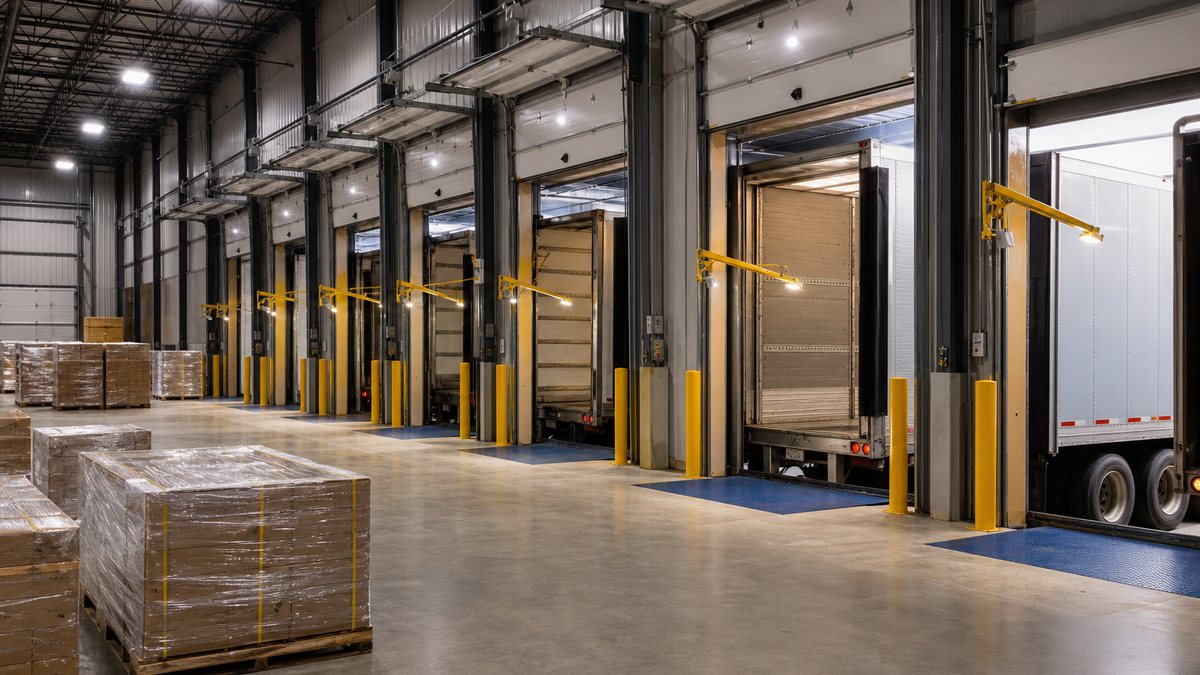
The dock is where the warehouse meets the outside world, and it is one of the highest-risk areas in any facility. Dock lighting usually combines several systems:
- Interior dock area lighting bright enough for staging, scanning and moving pallets across the dock
- LED dock lights on articulating arms that shine into the trailer so workers can see while loading and unloading
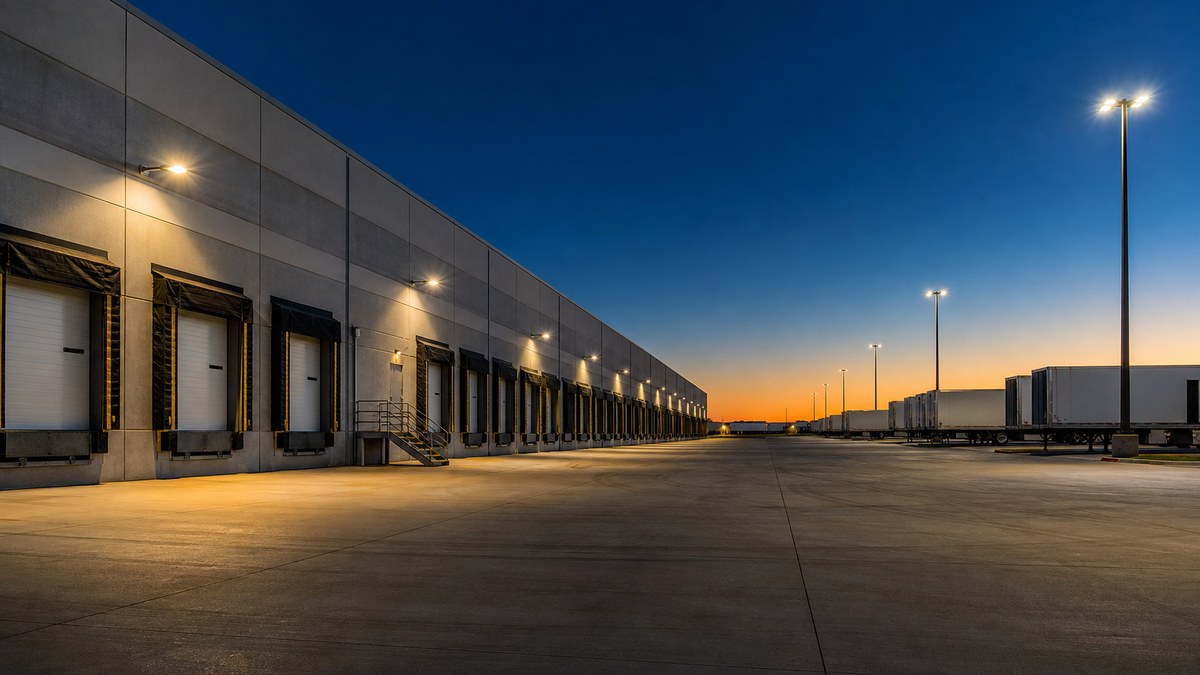
- Exterior wall packs over the dock doors for trailer positioning, security and camera coverage
- Pole lights across the truck court, employee parking and drive aisles
- Entrance and canopy lighting at offices, guard shacks and pedestrian doors
For truck courts and parking, lighting designers commonly reference IES guidance on minimum light levels and uniformity, with higher targets for areas that need enhanced security. Shielded, full-cutoff fixtures keep light on the property and out of drivers' eyes and neighbors' windows. If your building also has a large customer or employee parking field, our shopping center LED lighting guide covers parking-lot layout in more depth, and our architectural lighting services can make an office front or corporate facade read as clearly at night as it does by day.
Controls and energy code: where warehouses save the most
Warehouses are ideal for lighting controls because so much of the space is empty so much of the time. An aisle might see a forklift for a few minutes an hour. With occupancy sensors on each fixture or aisle, lights can drop to a low standby level when nobody is there and return to full output the moment a truck turns in. Combined with LED efficiency, that is where many facilities see the largest reductions in lighting energy.
Common warehouse control strategies include:
- Fixture-integrated occupancy sensors with high-bay lenses that detect motion from high mounting heights
- Bi-level or dimming operation so aisles never go completely dark, which keeps drivers comfortable
- Daylight harvesting near skylights, clerestory windows and open dock doors
- Scheduling tied to shifts, with overrides for after-hours work
- Networked or wireless controls that let a facility manager adjust settings, group fixtures and see energy data from one interface
- Exterior photocells and astronomical time clocks with reduced output late at night where allowed
Controls are not just a good idea; they are often required. Texas's statewide minimum commercial energy code is based on the 2015 IECC, which includes requirements for automatic shutoff, occupancy-based reductions, daylight-responsive controls and exterior lighting controls. The City of Arlington adopted the 2021 International Building Codes and the 2020 National Electrical Code for permit applications starting January 1, 2023. Confirm the energy code edition and what applies to your project with Arlington Building Inspections before you design, especially for new construction, additions and major alterations. Our full commercial lighting controls guide explains sensors, dimming, DALI, DMX and code requirements in detail.
Want a lighting plan for your building?
Tell us about your ceiling height, racking and operating hours. We will review the space and prepare a project-specific proposal with a photometric layout.
Cold storage, food plants and harsh environments
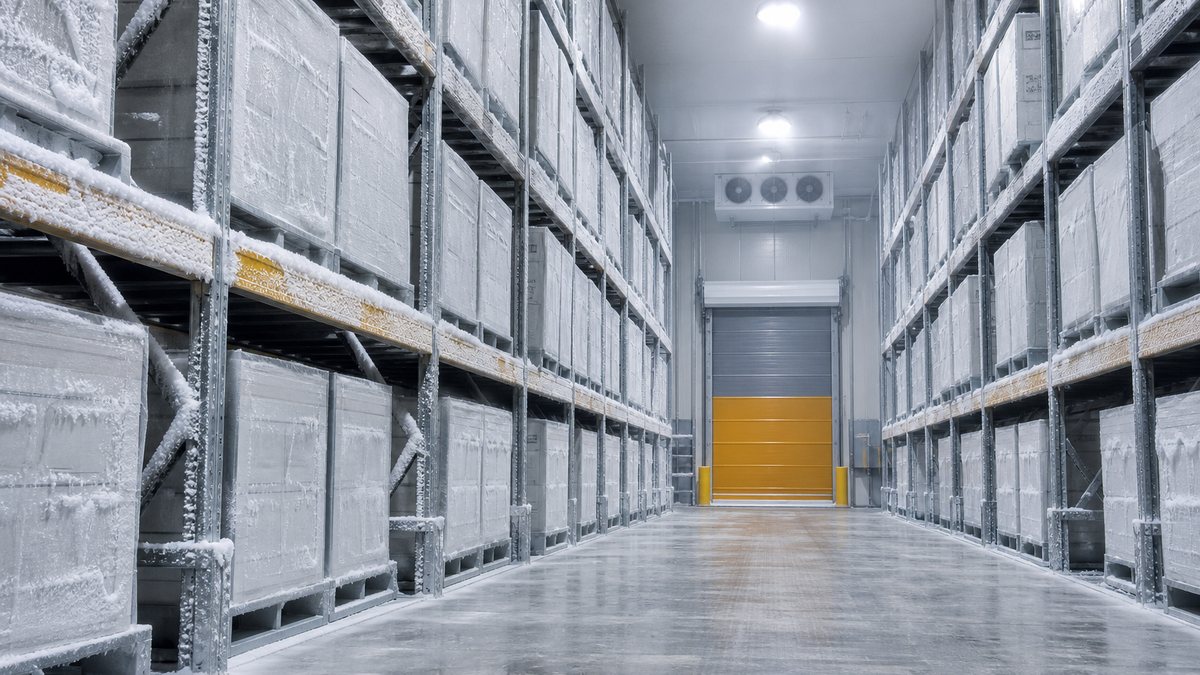
Cold storage is a growing part of the DFW industrial market, and it is one of the places where LED makes the most sense. Unlike some older light sources, LEDs start instantly in the cold and run efficiently at low temperatures. They also add very little heat to the space, which reduces the load on refrigeration equipment.
Freezer and cooler lighting still needs care:
- Temperature ratings: fixtures should be rated for the room's lowest operating temperature.
- Condensation: sealed fixtures prevent moisture getting in when doors open and warm, humid Texas air rushes in.
- Sensors that work in the cold: occupancy sensors must be rated for low temperatures and positioned to detect lift trucks entering through high-speed doors.
- Transitions: light levels at freezer doors and vestibules should help eyes adjust between areas.
Food and beverage plants, wash-down areas and chemical storage add requirements of their own, such as sealed housings, shatter-resistant lenses, corrosion-resistant finishes and, in classified areas, fixtures rated for the hazard. Your facility's safety team, insurer and the authority having jurisdiction set those requirements; the lighting design has to meet them.
Retrofit or new installation: which path fits?
Most industrial lighting projects in Arlington fall into one of three categories:
- Fixture-for-fixture retrofit: old high bays are swapped for LED fixtures in the same locations. It is the simplest path and works when the existing layout still suits the racking.
- Redesign retrofit: fixtures are relocated, re-spaced or reduced in number to match the current rack layout and add controls. This often delivers better light with fewer fixtures.
- New construction or tenant improvement: lighting is designed with the building or the new tenant's layout, coordinated with electrical, fire protection and racking from the start.
Retrofit kits and lamp replacements exist for some fixture types, but in high bay applications a complete new fixture is usually the more reliable choice, because it is designed as a system with matched optics, driver and heat management. Our lighting installation guide walks through each step of a commercial install, and our commercial LED retrofit services page explains what we handle.
Installing around live operations
A distribution center that ships every day cannot shut down for a week of lighting work. A good installation plan keeps the building running:
- Site walk and survey: fixture counts, mounting heights, circuits, controls, racking, obstructions and lift access.
- Design and proposal: photometric layout, fixture and control selections, phasing plan and schedule.
- Permits and coordination: many projects need an electrical permit; confirm with the city. Work is coordinated with your safety, operations and property management teams.
- Phased installation: zones are worked one at a time, often on nights or weekends, with lifts staged so aisles reopen quickly.
- Commissioning: sensors, dimming levels, time delays and schedules are set and tested, which energy codes commonly require.
- Close-out: old fixtures and lamps are removed and recycled appropriately, and your team receives as-built information and warranty details.
Older fixtures can contain components that need proper handling, such as fluorescent and metal halide lamps. Ask any contractor how they handle disposal and recycling.
Incentives and tax considerations
Industrial LED upgrades may qualify for utility incentives. In the Oncor service area, commercial customers may qualify for incentives on qualifying lighting work through participating service providers, depending on program availability; commercial programs commonly run on an annual cycle, so timing matters. Fixtures usually need to be DLC-qualified, and some programs require pre-approval before work begins. Ask early.
On federal tax incentives, the Section 179D energy-efficient commercial building deduction ended for projects whose construction begins after June 30, 2026, under 2025 federal legislation. Projects that began earlier may still qualify; confirm with your tax advisor.
What affects the cost of warehouse LED lighting
Every warehouse and industrial project is quoted individually. The main factors are:
- Building size and fixture count, driven by square footage, ceiling height and target light levels
- Fixture type, from standard high bays to cold-rated, vapor-tight, high-temperature or hazardous-location fixtures
- Controls, from simple integrated sensors to networked systems with energy reporting
- Layout changes, such as relocating fixtures to suit new racking or adding circuits
- Access and phasing, including lift types, night or weekend work and working around active operations
- Exterior scope, including wall packs, dock lights, pole lights and any pole or base repairs
- Permitting, disposal and commissioning
We help you weigh these factors against your operating hours, energy use and maintenance needs, so the design fits the building rather than a one-size-fits-all package. The result is a clear, project-specific proposal.
Common mistakes in industrial lighting projects
- Buying fixtures by wattage or lumens alone. Optics, spacing and mounting height decide whether the light lands where workers need it.
- Ignoring the racking. Fixtures that sit over the racks instead of the aisles leave rack faces dark.
- Over-lighting. More light than the task needs means more glare and wasted energy, especially on polished floors.
- Skipping controls. In a warehouse, controls are often where the biggest savings are, and they are commonly required by code.
- Sensors set wrong. Time delays that are too short, or sensors that cannot see down the aisle, frustrate workers and get overridden.
- Wrong fixture for the environment. Standard fixtures in freezers, wash-down areas or hot zones fail early.
- No plan for the next tenant. Flexible mounting and controls make future layout changes far easier.
Working with Arlington LED Lights
Arlington LED Lights designs and delivers commercial and industrial LED lighting for Arlington and the DFW metroplex, from the Great Southwest corridor to Mansfield, Grand Prairie, Fort Worth and Dallas. We bring 15+ years as an authorized architectural lighting dealer and project coordinator. Our licensed installation partner has completed over 200 major sports and commercial projects across the US and Canada, including NFL, NBA, NHL, MLS, NCAA and NASCAR.
For industrial clients, that means a site review, a photometric design matched to your racking and operations, fixture and control specifications suited to your environment, coordinated installation, and commissioning so the system works as designed. If you are comparing contractors, our guide on how to choose a commercial LED lighting company lists the questions to ask. For larger campuses and multi-building portfolios, see our large-scale commercial lighting projects guide, or explore the Luminance design-build program for a complete lighting transformation. We also handle ongoing lighting repair and service, and industrial buildings that also need lit signage can start with our LED signs guide.
Frequently Asked Questions
What is the best LED lighting for a warehouse?
How many footcandles does a warehouse need?
Should I use linear or round high bay lights?
Are occupancy sensors required in Arlington warehouses?
Can LED lights be used in freezers and cold storage?
Can you install warehouse lighting without shutting down operations?
Do warehouse LED upgrades qualify for rebates?
How much does warehouse LED lighting cost in Arlington?
Do you serve the Great Southwest Industrial District and Grand Prairie?
Let's light your warehouse
Request a site review and we will follow up to discuss your building, operations and timeline.
Related
More from our blog: LED sports lighting in Texas, LED video walls in Arlington, and every guide on our Arlington LED Lights blog. See all our services and the areas we serve.
Our DFW lighting network: Dallas LED video walls and commercial lighting, Fort Worth LED lighting, Irving LED lighting, Plano LED lighting, statewide Texas LED lighting, wholesale LED components, LED signs and message centers, fiber optic starlight ceilings, 360° fiber optic lighting, modular building solutions, and Dallas modular structures.