Lighting Contractor in Arlington, TX: A Guide to Commercial Lighting Repair, Maintenance & Upgrades
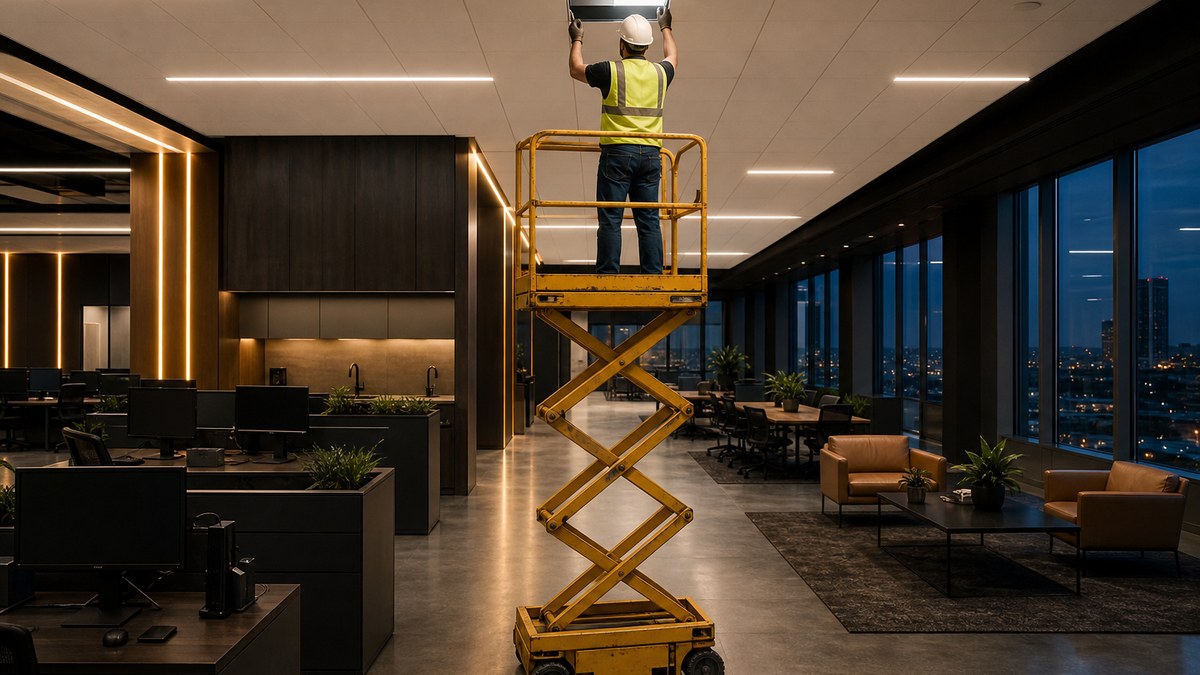
Finding the right lighting contractor in Arlington matters most when something is already wrong: a parking lot that went half dark, a row of office fixtures that flicker all afternoon, an exit sign that failed its fire inspection, or a warehouse aisle where the forklift drivers keep asking for more light. Lighting is one of the few building systems that everyone notices the moment it stops working, and one of the easiest to neglect until it does.
This guide is about the ongoing side of commercial lighting in Arlington: what a lighting contractor actually does after the install, how to troubleshoot common LED problems, how emergency and exit lighting testing works, when to repair and when to upgrade, and how a simple maintenance plan keeps a property looking right. It is written for property managers, facility teams, business owners and HOA or church boards across Arlington, Grand Prairie, Pantego, Mansfield and the rest of DFW. If you are planning a brand-new installation, start with our step-by-step lighting installation guide; if you are comparing companies, see how to choose a commercial LED lighting company.
A commercial lighting contractor in Arlington designs, installs, repairs and maintains lighting systems for businesses and properties.
- Repairs: dead or flickering fixtures, failed LED drivers, photocells, timers, sensors, pole lights and sign lighting
- Maintenance: scheduled walk-throughs, cleaning, controls checks and planned replacements instead of emergency calls
- Life safety: emergency and exit lighting is commonly tested monthly (30 seconds) and annually (90 minutes) under NFPA 101, with written records
- Upgrades: when repairs keep repeating, an LED retrofit or controls upgrade is often the better long-term move
- Licensing: in Texas, electrical work must be done by TDLR-licensed electricians working under a licensed contractor
- Pricing: service and upgrade work is quoted after a site review — every property is different
What a lighting contractor does in Arlington
"Lighting contractor" covers a wider range than most people expect. A general electrician can wire a fixture. A lighting-focused contractor thinks about the result: how much light lands on the floor, the parking stall or the shelf; whether it is even; whether the controls make sense; and whether the system will still look right in five years. In Arlington, that work typically falls into five buckets.
- Service and repair: diagnosing and fixing failed fixtures, drivers, ballasts, sensors, photocells, time clocks and circuits, inside and out.
- Preventive maintenance: scheduled inspections and planned replacements so failures are caught before tenants, customers or inspectors notice.
- Life-safety lighting: emergency lights and exit signs, including testing, battery replacement and record keeping.
- Upgrades and retrofits: converting older fluorescent, metal halide and high-pressure sodium lighting to LED, and adding modern lighting controls.
- Specialty lighting: facade and architectural lighting, LED sign lighting, LED video walls and feature lighting that general electricians rarely handle.
Arlington's building mix makes this range important. A single service area can include Entertainment District hotels and restaurants, older strip centers along Cooper Street and Pioneer Parkway, offices near the I-30 and I-20 corridors, churches, schools, apartment communities, and the warehouses of the Great Southwest Industrial District. Each has different hours, different risks and different priorities. Our lighting repair and service work is built around that variety.
Licensing, permits and who can do the work
Lighting repair looks simple from the floor, but most of it is electrical work, and Texas regulates electrical work closely. The Texas Department of Licensing and Regulation (TDLR) states that anyone who performs electrical work in Texas must be licensed, and an electrical contractor must have a licensed Master Electrician assigned to the company. TDLR has a free public license search, so you can check any contractor's license by name or number before work starts.
Sign lighting has its own path: electrical sign work is done under a TDLR Electrical Sign Contractor license (which must employ a Master Sign Electrician or Master Electrician) or an electrical contractor license.
Permits are the other half. City of Arlington Building Inspections handles electrical permits and inspections. Simple like-for-like repairs are treated differently from new circuits, new poles or major retrofits, and the rules can change, so the safest answer is: many projects need a permit, and your contractor should confirm with the city before work begins. A good contractor handles that conversation for you and tells you up front if an inspection is part of the schedule.
Before you sign a service agreement, ask three questions: Which licensed Master Electrician is assigned to your company? Will this work need a city permit? Who keeps the test records for our emergency lighting? Clear, specific answers are a good sign.
Common commercial lighting problems and what causes them
Most service calls in Arlington fall into a handful of patterns. Knowing them helps you describe the problem clearly, which shortens diagnosis and avoids paying for guesswork.
| Symptom | Common causes | Typical fix |
|---|---|---|
| LED fixture flickers or strobes | Failing driver, loose connection, incompatible dimmer or control, voltage problems on the circuit | Tighten or replace connections, replace driver, match control to driver type |
| Fixture completely dead | Failed driver or ballast, tripped breaker, bad sensor, open neutral, failed LED board | Trace circuit, test driver output, replace failed component or fixture |
| Exterior lights on during the day | Failed or dirty photocell, time clock set wrong or lost after an outage | Replace photocell, reset or upgrade to an astronomical time clock |
| Parking lot lights out in sections | Underground wiring damage, failed pole fixtures, tripped circuit, contactor failure | Locate fault, repair wiring or contactor, replace heads |
| Uneven color between fixtures | Mixed color temperatures from piecemeal replacements over the years | Standardize on one color temperature and CRI going forward |
| Lights turn off on people | Occupancy sensor time delay too short, sensor in the wrong spot, wrong sensor type | Re-aim, re-set or relocate sensors; switch technology |
| Exit sign or emergency light fails test | Battery at end of life, failed lamp or LED, charger fault | Replace battery or unit, retest, record result |
Flickering LEDs: the most common complaint
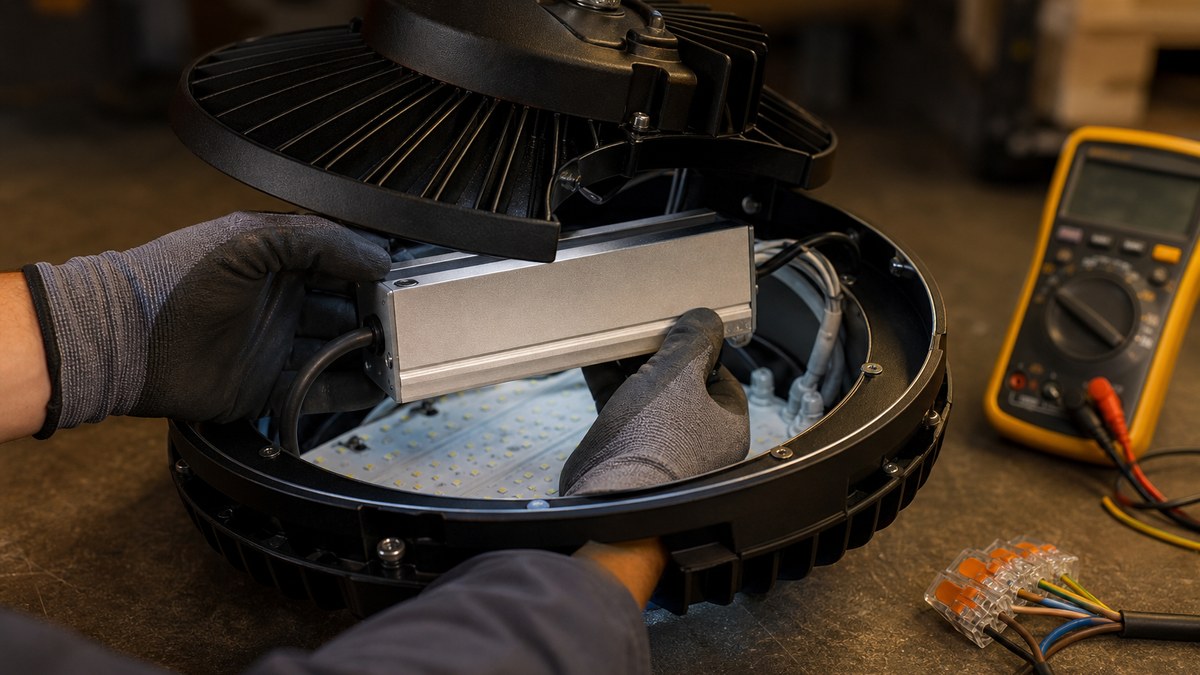
When an LED fixture flickers, the LEDs themselves are rarely the problem. The driver — the small power supply that converts building power into the steady current LEDs need — is the usual suspect, especially in fixtures that run hot. Loose connections, dimmers that were designed for incandescent lamps, mixed control types, and voltage drops on long or overloaded circuits are the other common causes. A careful contractor checks the circuit and control before replacing parts, because swapping a driver on a fixture with an incompatible dimmer just moves the flicker to next month.
Heat: a Texas-specific factor
North Texas summers are hard on electronics. Drivers in poorly ventilated fixtures, recessed cans under hot roofs, canopy lights over sun-baked asphalt and wall packs on west-facing walls all run hotter than their spec sheets assume. Heat shortens driver life. When we see repeat failures in the same location, the fix is often a fixture rated for the environment, not another replacement part.
Storms, surges and outages
Spring storm season in DFW brings lightning, power bumps and outages. Surges can take out drivers and photocells across a whole property at once, and outages can reset time clocks so lights run all day. Surge protection at the panel or fixture level and astronomical time clocks with battery backup are inexpensive ways to reduce those calls.
Emergency and exit lighting: the inspection items owners forget
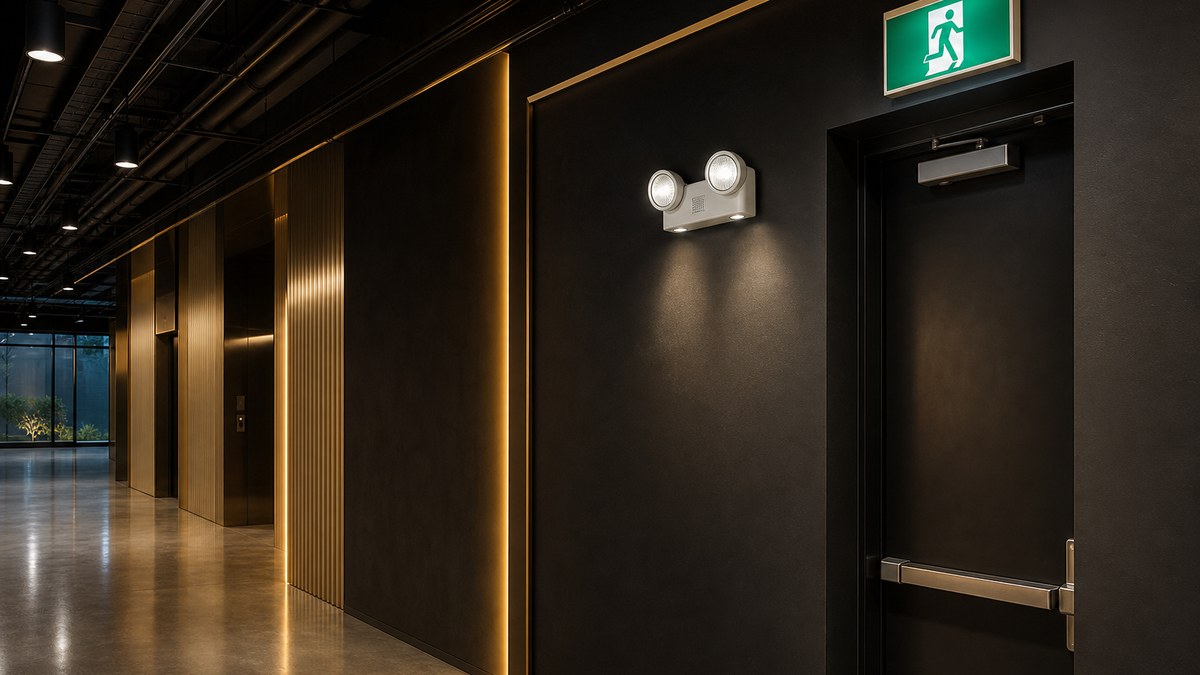
Emergency lights and exit signs sit quietly on the wall for years, which is exactly why they fail inspections. Under NFPA 101, the Life Safety Code that fire marshals commonly enforce, battery-powered emergency lighting is tested in two ways:
- Monthly: a functional test of at least 30 seconds at 30-day intervals, confirming each unit switches to battery and lights up.
- Annually: a full 90-minute (1.5-hour) test on battery. This is the test that reveals weak batteries, because a unit can pass 30 seconds and still die at 20 minutes.
- Records: written records of each test — the unit, the date, the type of test and the result — kept available for the fire inspector.
Self-testing (self-diagnostic) units can run the monthly test automatically, with staff checking the status light, but the annual 90-minute test still applies. Exit signs need a monthly visual check, and battery-backed exit signs follow the same 30-second and 90-minute tests. Requirements depend on the edition your fire department enforces and on your occupancy type, so confirm the details with the Arlington Fire Department or your fire protection provider.
For a busy property manager, the practical answer is to fold emergency lighting into a scheduled lighting maintenance plan. The contractor runs the tests, replaces failed batteries and units, and leaves you a clean log to hand the inspector. Upgrading old units to LED self-testing models during a retrofit also cuts the monthly labor.
Repair or upgrade? How to decide
Every property eventually hits the point where repairs stop making sense. Here is how we help Arlington owners decide.
| Situation | Usually repair | Usually upgrade |
|---|---|---|
| Fixture age and type | Recent LED fixtures with a single failed part | Fluorescent, metal halide or high-pressure sodium fixtures |
| Failure pattern | One-off failure after a storm or impact | Repeat failures across many fixtures |
| Parts availability | Parts in stock and matched to the fixture | Lamps or ballasts being phased out or hard to find |
| Light quality | Levels and color still meet the space's needs | Dim, uneven, mixed colors or glare complaints |
| Controls and code | Controls work and the space isn't changing | Renovation, tenant change or energy-code triggers |
| Maintenance access | Easy to reach | Lift or bucket truck needed every visit |
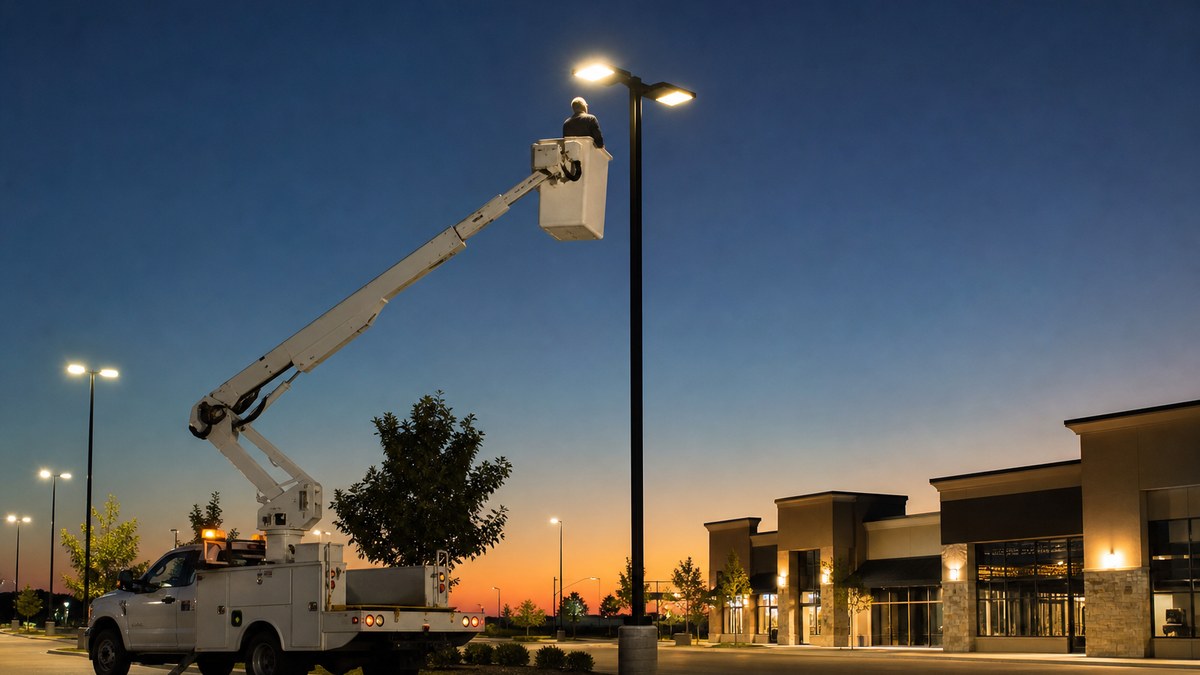
The last row matters more than people expect. In a warehouse with 35-foot ceilings, a parking lot with tall poles, or a hotel atrium, the cost of getting a lift on site is often larger than the part. When every repair needs equipment, a planned upgrade to long-life LED fixtures — done all at once, with one lift rental — usually makes more sense than chasing failures one at a time. Our warehouse and industrial LED lighting guide covers high-bay upgrades in detail.
Upgrading also opens the door to better controls. Occupancy sensors, daylight dimming and scheduling reduce run-hours and wear, and in many cases a renovation triggers energy-code control requirements anyway. LED systems commonly use far less energy than the lighting they replace, and some projects on Oncor meters may qualify for utility incentive programs, depending on program availability. We will tell you honestly when a repair is the smarter call.
Lights out, flickering or failing inspection?
Tell us what is happening and where. We will review the property and recommend the right fix — repair, maintenance plan or upgrade — with a project-specific proposal.
What a lighting maintenance plan should include
Reactive repairs feel cheaper until you add up the emergency calls, the lift rentals, the tenant complaints and the dark corners of the parking lot that nobody reported. A scheduled lighting maintenance plan replaces that with a predictable routine. A solid plan for an Arlington commercial property usually covers:
- Lighting walk-throughs on a set schedule, including at least one night survey of exterior lighting, because outdoor problems are invisible during the day.
- Emergency and exit lighting tests with a written log ready for the fire inspector.
- Controls checks: photocells, time clocks (reset after daylight saving changes and outages), occupancy sensors and daylight sensors.
- Cleaning: lenses, reflectors and diffusers collect dust and insects, especially in warehouses, kitchens and parking structures, which steadily reduces light output.
- Planned replacements: grouping replacements by area so lifts and bucket trucks are used efficiently.
- Spare parts: matched drivers, lamps and fixtures on hand so replacements match color and output.
- A fixture inventory: a simple list of fixture types, locations, color temperatures and install dates, which makes every future decision faster.
- An annual report with what failed, what was fixed, and what is coming up, so the next year's budget is not a surprise.
Group relamping vs spot replacement
For older lamp-based systems, group relamping — replacing all lamps in an area on a schedule rather than one at a time as they fail — has long been standard practice because it reduces labor and keeps light levels even. With LED, the logic shifts: fixtures last much longer, but they lose output gradually rather than failing suddenly. LED life is often rated as an L70 value, the hours until output falls to 70% of the original. Tracking install dates and planning replacements by area is the LED equivalent of group relamping.
Exterior lighting: parking lots, wall packs and canopies
Exterior lighting generates more service calls than anything else on a typical Arlington property, and the problems are usually discovered by a tenant, a customer or a security incident rather than by management. Common issues:
- Pole lights out: failed heads, damaged underground wiring from landscaping or trenching, corroded connections at the pole base, or failed contactors.
- Day-burning: lights running during the day because of a failed photocell or a time clock that lost its setting after an outage.
- Glare and dark spots: mismatched replacement heads aimed the wrong way, creating bright glare in one area and shadows in another.
- Wall packs and canopies: water intrusion, heat damage and impact damage at loading areas and drive-throughs.
Commonly cited IES guidance for open parking lots is a minimum of about 0.2 foot-candles with a max-to-min uniformity ratio of 20:1 or better, with higher levels for enhanced-security areas. A night survey with a light meter tells you whether your lot is anywhere close. Our shopping center lighting guide goes deeper on parking lots, storefronts and canopies, and our South Arlington, Pantego and Mansfield guide covers local retail centers.
How a service call works with us
- Tell us the symptoms. Which fixtures, where, since when, and whether anything changed — a storm, a renovation, a new tenant. Photos help.
- Site review. We inspect the fixtures, circuits and controls, and for exterior issues we look at the property after dark.
- Diagnosis and options. You get a clear explanation of what failed and why, with options: repair now, plan a broader fix, or both.
- Project-specific proposal. Scope, schedule and any permit or lift requirements, quoted to your property.
- Work and testing. Licensed work, scheduled around your business hours when possible, followed by testing of fixtures and controls.
- Documentation. What was done, what was found, and what to watch next.
For multi-site owners and larger properties, the same process scales into a planned program, and for complete transformations our Luminance design-build program takes a space from concept to finished lighting. Our licensed installation partner has completed over 200 major sports and commercial projects across the US and Canada — NFL, NBA, NHL, MLS, NCAA and NASCAR — and we bring 15+ years as an authorized architectural lighting dealer and project coordinator.
Lighting needs by property type in Arlington
Offices and medical buildings
Flicker, glare on screens and sensors that shut lights off on people are the top complaints. A controls tune-up and standardized fixtures usually solve more than a string of individual repairs. See our business lighting services guide.
Hotels, restaurants and Entertainment District venues
Guests notice a dead downlight in a lobby or a dim entry immediately. Hospitality properties benefit from fast-response service, matched spares for decorative fixtures and dimming systems that are kept tuned. Near AT&T Stadium, Globe Life Field and Texas Live!, event nights make exterior and wayfinding lighting especially visible. Our large-scale commercial lighting guide covers hospitality projects.
Warehouses and industrial sites
High ceilings make every repair expensive, so planned replacements and long-life fixtures pay off. Dock lighting, aisle lighting and exterior yard lighting are safety items, not cosmetics.
Retail and shopping centers
Storefront, canopy and parking lot lighting drive both safety and sales. Mixed color temperatures across a center look neglected; a coordinated plan fixes that.
Churches, schools and sports facilities
Sanctuaries, gyms and fields often have high-mounted fixtures and specialized controls. Our sports lighting guide covers gyms and fields.
Apartment communities and HOAs
Breezeways, stairwells, pools and parking areas are resident safety items. A night survey and a simple maintenance schedule prevent most complaints.
Questions to ask any Arlington lighting contractor
- Are you TDLR-licensed, and who is your Master Electrician of record?
- Do you handle permits and inspections when they are needed?
- Will you look at our exterior lighting at night?
- Can you test our emergency lighting and provide written records?
- When you recommend replacing instead of repairing, how do you explain why?
- Do you stock or source matched replacement parts so new fixtures match the old ones?
- Can you handle specialty work — signs, facade lighting, video walls — or only general lighting?
For a full checklist, including red flags, read our guide to choosing a commercial LED lighting company, and for the broader Texas picture see our commercial LED lighting buyer's guide.
Frequently Asked Questions
What does a commercial lighting contractor do?
Does a lighting contractor in Texas need a license?
Why do my LED lights flicker?
How often should emergency lights be tested?
Do I need a permit for lighting repairs in Arlington?
Should I repair my old lights or upgrade to LED?
Why are my parking lot lights on during the day?
What should a lighting maintenance plan include?
How much does commercial lighting repair cost in Arlington?
What areas do you serve?
Keep your property lit, safe and inspection-ready
Request a service visit or a maintenance plan review. We will follow up to discuss your property, the issues you are seeing and the right next step.
Related
Explore more: our services overview, the areas we serve, LED signage, video wall services, and the full Arlington LED Lights blog.
Our DFW lighting network: Dallas LED video walls and commercial lighting, Fort Worth LED lighting, Irving LED lighting, Plano LED lighting, statewide Texas LED lighting, wholesale LED components, LED signs and message centers, fiber optic starlight ceilings, 360° fiber optic lighting, modular building solutions, and Dallas modular structures.