Architectural & Facade Lighting in Arlington, TX: A Guide to Exterior Building Lighting for Hotels, Offices, Retail & Venues
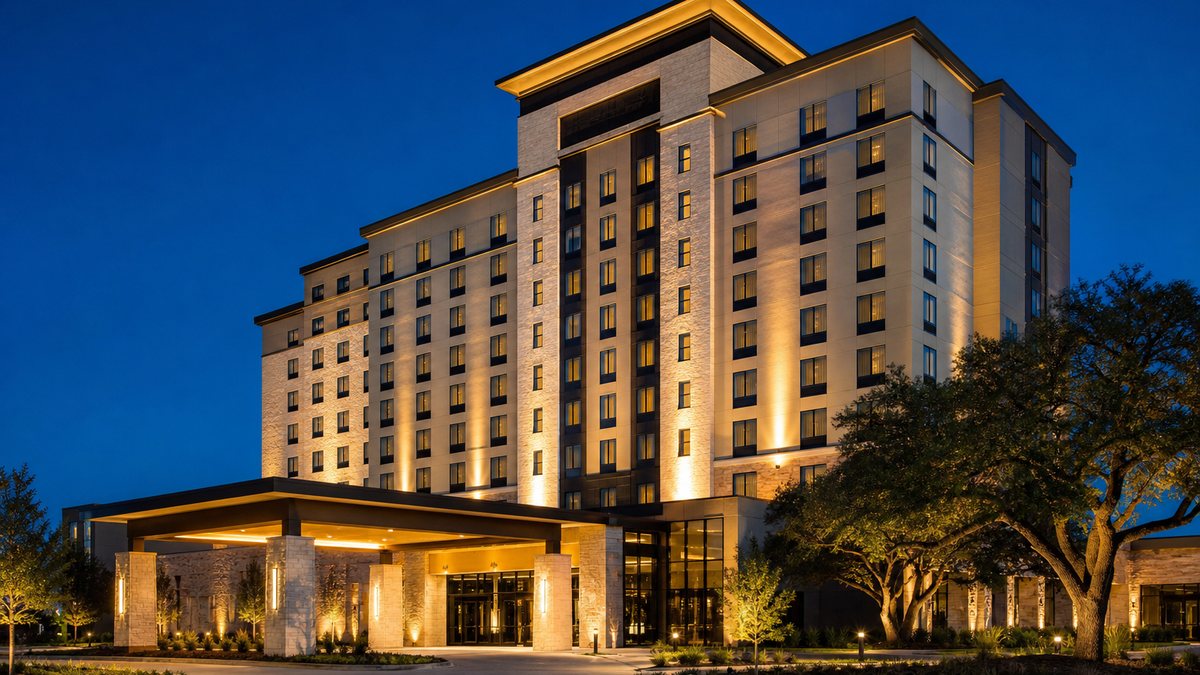
Architectural and facade lighting in Arlington, TX is the exterior lighting that makes a building visible, attractive and safe after dark: the wall washers on a hotel tower, the grazing lights on a stone office entrance, the color-changing accents on an Entertainment District venue, and the soffit, canopy and landscape lighting that ties a property together at night. Done well, it turns a building into a landmark. Done badly, it creates glare, hot spots, dark patches and fixtures that fail after one Texas summer.
This guide explains how commercial facade lighting works, the main techniques designers use, how to choose fixtures, color and controls for North Texas conditions, what to think about with codes, light trespass and neighbors, and how an architectural lighting project runs from first night survey to final aiming. It is written for property owners, hotel and venue operators, facility managers, architects and developers across Arlington, Grand Prairie, Mansfield and the wider DFW area.
Architectural facade lighting uses exterior LED fixtures to reveal a building's shape, materials and entrances at night. The main techniques are:
- Wall washing: even, soft light across a flat facade from fixtures set back from the wall
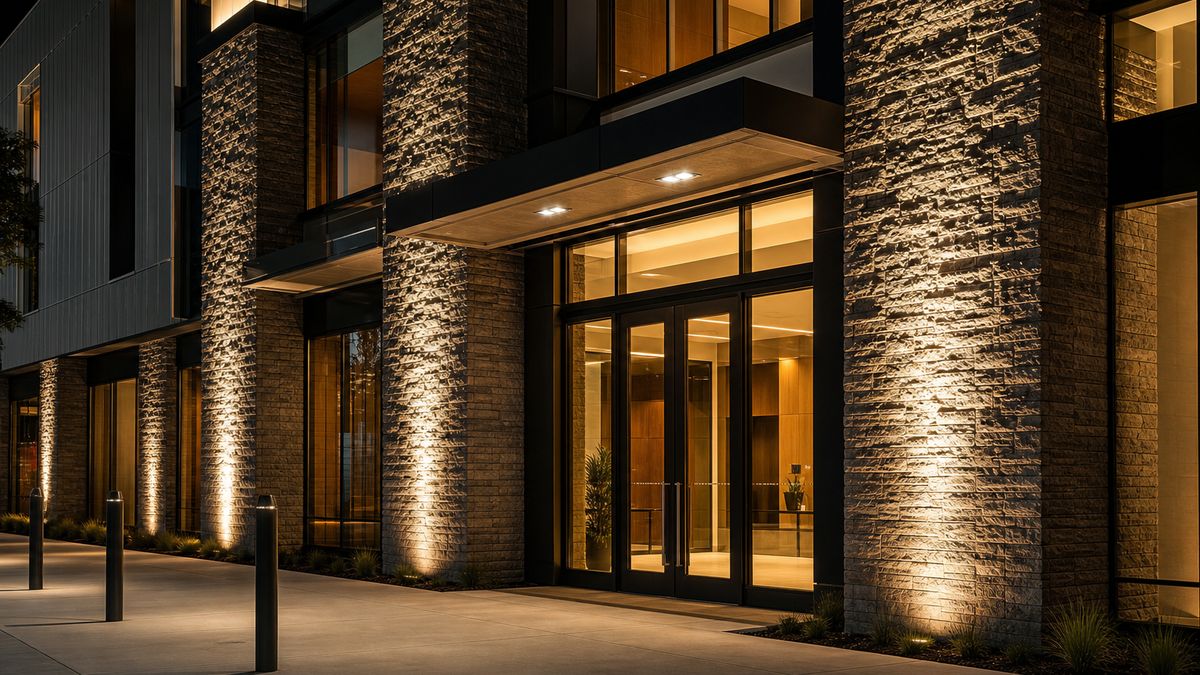
- Wall grazing: fixtures placed close to the wall to bring out texture in stone, brick and ribbed panels
- Uplighting and accent lighting: narrow beams on columns, piers, signs, trees and features
- Linear and outline lighting: LED lines along parapets, fins, canopies and rooflines
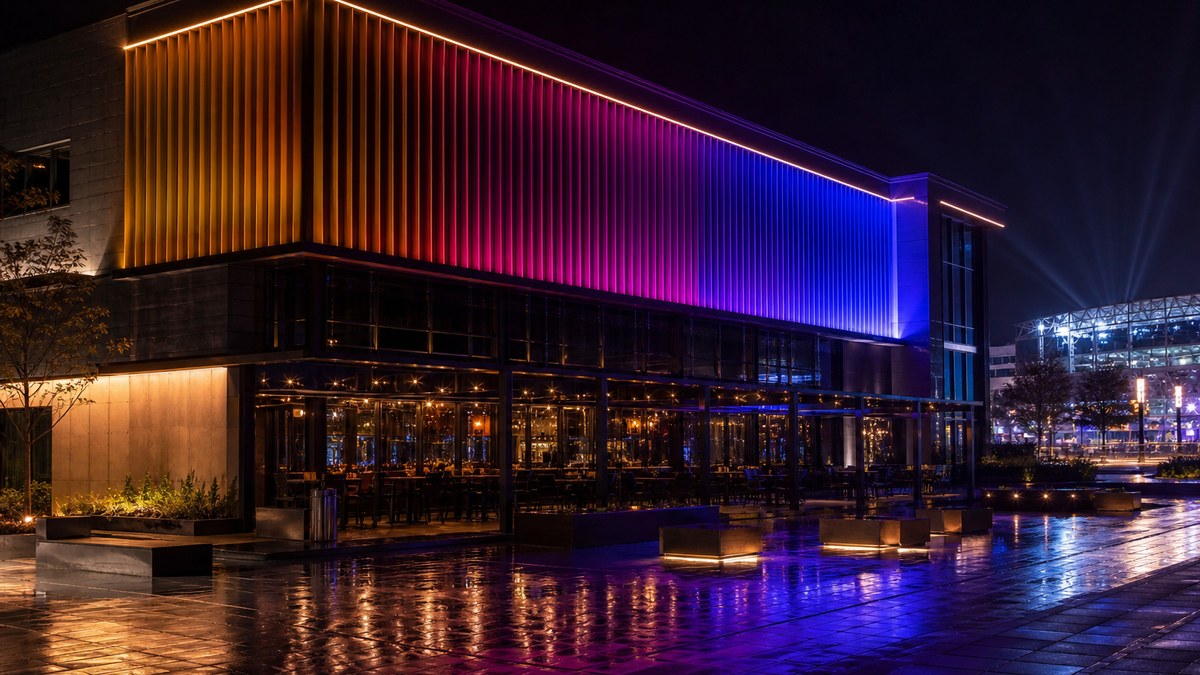
- Dynamic color (RGBW / tunable white): DMX-controlled scenes for events, seasons and brands
- Pricing: every facade is different, so projects are quoted as a project-specific proposal after a site and night review
What architectural facade lighting actually is
Architectural lighting is lighting designed around the building itself rather than just the tasks people do near it. General exterior lighting, such as parking lot poles and wall packs, exists so people can see where they are walking and driving. Facade lighting exists so people can see the building: its height, its materials, its entrances, its signage and its character.
In practice, most commercial properties need both. A hotel near the Arlington Entertainment District needs safe, uniform light in the drop-off and parking areas, but it also wants its tower and porte-cochère to read clearly from the highway at night. An office building on Collins Street or Cooper Street wants a lit entrance that feels welcoming and secure. A restaurant or venue wants a facade that photographs well and signals "open" from a distance. Architectural lighting is how those goals are reached without simply adding more, brighter fixtures.
Typical elements of an exterior architectural lighting scheme include:
- Facade lighting: wall washers, grazers and floodlights that light the main building surfaces.
- Entry and canopy lighting: downlights in soffits and canopies, accent lighting on entrance features, and lighting for porte-cochères and drop-offs.
- Linear and outline lighting: LED lines along parapets, cornices, fins and rooflines that define the building's silhouette.
- Accent lighting: narrow beams on columns, sculptures, water features, flagpoles and monument signs.
- Landscape lighting: uplights on trees, path lights and bollards that connect the building to the site.
- Media and dynamic elements: color-changing scenes and, on some projects, LED video walls or media facades.
Facade lighting techniques: washing, grazing, accenting and more
Every facade lighting design is built from a small number of techniques. Choosing the right one depends on the facade material, the building's shape, where viewers will be standing, and where fixtures can physically be mounted.
| Technique | How it works | Best for | Watch out for |
|---|---|---|---|
| Wall washing | Wide-beam fixtures set back from the wall spread even light across the surface | Smooth stucco, painted concrete, metal panels, large flat facades | Can flatten texture; needs correct setback to avoid scallops |
| Wall grazing | Fixtures mounted very close to the wall aim light almost parallel to it | Stone, brick, split-face block, ribbed or fluted panels | Exaggerates every flaw in smooth or uneven walls |
| Uplighting / accent | Narrow or medium beams aimed at specific features | Columns, piers, towers, signs, trees, sculptures | Glare toward viewers and light spilling into the sky |
| Floodlighting | Powerful fixtures light a large area from a distance | Tall towers, large venues, where fixtures cannot be near the wall | Glare, light trespass, flat "stadium" look if overused |
| Linear outline | Continuous LED lines along edges and architectural lines | Parapets, fins, canopies, rooflines, modern facades | Visible dots on cheap products; heat and water damage |
| Silhouetting / backlighting | Light behind a feature makes its outline read against a bright surface | Screens, letters, perforated panels, landscape features | Needs careful layering to avoid flat results |
| Dynamic color | RGBW or tunable-white fixtures controlled by DMX or another protocol | Hotels, venues, retail, civic and event-driven buildings | Over-use of saturated color; needs a solid control plan |
Wall washing vs wall grazing
This is the question owners ask most often, and the difference is simply the distance between the fixture and the wall. A wall washer sits farther out, usually with a wider, asymmetric beam, so light lands on the facade evenly and texture is softened. A grazer sits within a few inches of the wall with a narrow beam aimed along it, so every bump, joint and shadow stands out. A smooth, painted wall usually looks best washed. A stone or brick entrance usually looks best grazed. Grazing a smooth wall that has patches, waves or uneven joints will reveal all of them, which is why a site review matters before the fixtures are chosen.
Layering: why the best facades use more than one technique
The most successful facades layer two or three techniques: a soft wash on the main surfaces, grazing on a textured entrance or base, narrow accents on columns or signage, and a linear line defining the roof. Layering creates depth and hierarchy, so the eye goes to the entrance and the brand first. A building lit with one technique at one brightness tends to look flat, no matter how much light is used.
Lighting from the building vs from the ground
Fixtures can be mounted in the ground, on the landscape, on poles, on the building itself or on adjacent structures. In-grade uplights are discreet but need drainage, durable lenses and protection from mowers and vehicles. Building-mounted fixtures on ledges, brackets or parapets are easier to maintain and often throw cleaner light, but need careful coordination with the structure and waterproofing. Pole-mounted floodlights reach tall facades but carry the highest glare and trespass risk.
Choosing fixtures for North Texas conditions
Exterior architectural fixtures in Arlington live a hard life. Summer surfaces get extremely hot, spring storms bring wind-driven rain and hail, and fixtures in the ground sit in water after heavy downpours. Fixture quality matters more outside than almost anywhere else in a building.
- Ingress protection (IP rating): building-mounted exterior fixtures are commonly specified at IP65 or IP66, and in-grade fixtures that may sit in standing water commonly at IP67 or IP68. The rating should match the actual mounting location.
- Heat management: LED life depends on keeping the LEDs and driver cool. Look for solid aluminum housings, drivers rated for high ambient temperatures, and manufacturers who publish thermal data.
- Impact resistance: fixtures within reach of people, vehicles or landscaping equipment should have tough lenses and housings, often specified with an IK impact rating.
- Corrosion resistance: marine-grade or powder-coated finishes and stainless hardware hold up far better, especially near irrigation, fountains and pools.
- Optics: the beam shape is what makes a design work. Wall washers need asymmetric optics, grazers need narrow beams, and accent lights often need interchangeable lenses or glare shields.
- Color consistency: facade lighting shows color differences between fixtures clearly. Tight binning (often described in MacAdam steps) keeps a long run of fixtures looking uniform.
- Serviceability: drivers that can be replaced without removing the whole fixture, accessible wiring compartments, and available spare parts save money for years.
Ask for a mock-up. On larger facades, temporarily mounting two or three candidate fixtures and viewing them at night is the single best way to confirm beam spread, color and brightness before committing to the full order.
Color temperature, color rendering and dynamic color
White light: warm, neutral or cool?
Most architectural facades in North Texas look best in warm to neutral white, roughly 2700K to 3500K. Warm white flatters limestone, brick, wood and earth-toned stucco, and it feels inviting for hotels, restaurants and offices. Cooler white (4000K and above) can suit glass, steel and very modern facades, but it can look harsh on warm materials. Many lighting designers and dark-sky advocates also recommend 3000K or warmer outdoors to reduce glare and sky glow. The key is consistency: mixing color temperatures across a facade almost always looks like a mistake.
Color rendering (CRI)
A higher color rendering index makes materials look like themselves. Red brick looks red instead of brown, and painted brand colors look accurate. For facades that matter to the brand, a CRI of 80 is a minimum and 90+ is common for premium projects.
RGBW and tunable white
Color-changing fixtures, usually RGBW (red, green, blue and white) or RGBA, let a building change its look for holidays, events, game days, charity causes or seasonal campaigns. Tunable-white fixtures adjust between warm and cool white without saturated color. Dynamic lighting is popular with hotels, venues and retail near Arlington's stadiums and Texas Live!, where buildings compete for attention on event nights. The rule of thumb: design a beautiful white "everyday" scene first, then add color as an occasional feature rather than a constant light show.
Controls: DMX, scheduling and the everyday scene
Facade lighting is only as good as the controls behind it. Even simple white schemes need reliable on/off timing, and dynamic schemes need a proper control system. For a deeper look at protocols, see our guide to commercial lighting controls in Arlington.
- Astronomical time clocks: switch facade lighting on at dusk and off or down at a set time, adjusting automatically through the year. They avoid the day-burning problems that come with failed photocells.
- Night reduction: dimming or switching off decorative layers after business hours or late at night saves energy, reduces sky glow and is often required or encouraged by energy codes.
- DMX512 and RDM: the standard protocol for color-changing architectural lighting. Each fixture or group gets an address, and a controller plays stored scenes and shows. RDM adds two-way diagnostics so failed fixtures can be found remotely.
- Network control (Art-Net, sACN) and app-based scheduling: larger projects often run DMX over Ethernet and let staff trigger scenes from a tablet or schedule them by calendar.
- Integration: facade controls can tie into building automation so lighting follows the property's schedule.
Energy codes also apply outside. Commercial energy codes commonly require exterior lighting to turn off automatically during daylight and to reduce output late at night, with specific exceptions. Texas's statewide commercial minimum is based on the IECC, and many cities, including Arlington, adopt their own editions, so confirm the current requirements with Arlington Building Inspections before design is finalized.
Glare, light trespass and being a good neighbor
The goal of architectural lighting is to light the building, not the sky, the street or the neighbors. Light that spills past the facade wastes energy, creates glare for drivers and pedestrians, and can generate complaints from nearby residents, especially where commercial property backs onto neighborhoods.
- Aim down where you can: lighting facades from above (from parapets, ledges or brackets) usually keeps more light on the building than uplighting from the ground.
- Use the tightest beam that works: narrow optics and glare shields keep light on the surface instead of past the roofline.
- Check BUG ratings for area fixtures: the IES backlight-uplight-glare (BUG) rating system helps compare how much stray light site fixtures produce.
- Balance brightness to the surroundings: a facade does not need to be the brightest object on the street. Contrast with darker surroundings often makes a building stand out more than raw output.
- Reduce after hours: dimming or turning off decorative layers late at night is one of the simplest ways to cut sky glow.
Arlington's sign rules are set out in the Unified Development Code, and outdoor lighting can be affected by zoning, site plan conditions and lease or HOA requirements. We have not found a single Arlington outdoor-lighting rule specifically for facade lighting, so the safe approach is to confirm the current requirements with the City of Arlington early in design, especially for properties next to residential areas. Lighting that forms part of a sign, such as illuminated letters or a monument sign, also has to follow the city's sign standards; see our guide to LED signs in Arlington.
Make your building stand out after dark
Tell us about your property and we'll arrange a site and night review, then prepare a project-specific proposal for your facade, entry and exterior lighting.
Facade lighting by property type in Arlington
Hotels and hospitality
Hotels near the Arlington Entertainment District, the Arlington Convention Center and the I-30 corridor rely on their exterior to be found and chosen at night. Typical priorities include a clearly lit tower or crown visible from the highway, a warm, welcoming porte-cochère, accent lighting on the entrance and signage, and layered landscape lighting. Many hotels add RGBW accents so the building can join game-day, holiday or event themes.
Office buildings and corporate campuses
Offices usually want a calm, premium look: warm-white grazing on stone or textured bases, washed upper facades or lit crowns, well-lit entrances, and lighting that supports security cameras and safe walkways. Night reduction after business hours is an easy energy win.
Retail, restaurants and mixed-use
For retail centers and restaurants, the facade is advertising. Lighting usually focuses on storefronts, tenant signs, canopies and architectural towers or entry features. Consistent color temperature across the whole center matters, because mismatched tenants make a property look tired. Our guide to shopping center LED lighting in Texas covers canopies and parking areas in more detail.
Entertainment venues and event spaces
Venues near AT&T Stadium, Globe Life Field and Texas Live! compete for attention on event nights. Dynamic color, linear outline lighting, media elements and integrated video displays are common. These projects need robust DMX or network control, careful glare management for crowds and traffic, and fixtures that survive heavy use.
Churches and institutional buildings
Churches, schools and civic buildings often use facade lighting to highlight steeples, bell towers, crosses, columns and entrances. Warm white grazing and accent lighting typically suits traditional architecture, while scheduled scenes can mark holidays and special services.
Industrial and flex buildings
Even warehouses and flex buildings in the Great Southwest Industrial District benefit from simple architectural touches: lit entrances and office fronts, accent lighting on signs, and uniform, well-shielded exterior lighting that makes the property look cared for. See our warehouse and industrial LED lighting guide for site lighting.
How an architectural lighting project works with us
- Goals and brief. What should the building say at night? Which views matter most: the highway, the street, the parking lot, the entrance? Any brand colors or event plans?
- Day and night site review. We look at facade materials, mounting options, power and control locations, and the existing lighting after dark, including glare and dark spots.
- Concept and renderings. A lighting concept showing techniques, fixture types and the "everyday" white scene, plus optional dynamic scenes.
- Mock-up where it matters. On larger facades, a night-time test of candidate fixtures to confirm beam, color and brightness.
- Project-specific proposal. Fixture schedule, controls, scope, schedule, and permit, lift and access requirements, quoted to your building.
- Installation and commissioning. Licensed electrical work, fixture mounting and waterproofing, DMX addressing and programming, schedules and night reduction.
- Night aiming and handover. Final aiming is done after dark, followed by documentation, scene settings and a maintenance plan.
Arlington LED Lights brings 15+ years as an authorized architectural lighting dealer and project coordinator, and our licensed installation partner has completed over 200 major sports and commercial projects across the US and Canada — NFL, NBA, NHL, MLS, NCAA and NASCAR. For larger programs, our Luminance design-build program keeps design, products and installation under one coordinated plan.
Maintenance: keeping a facade looking like opening night
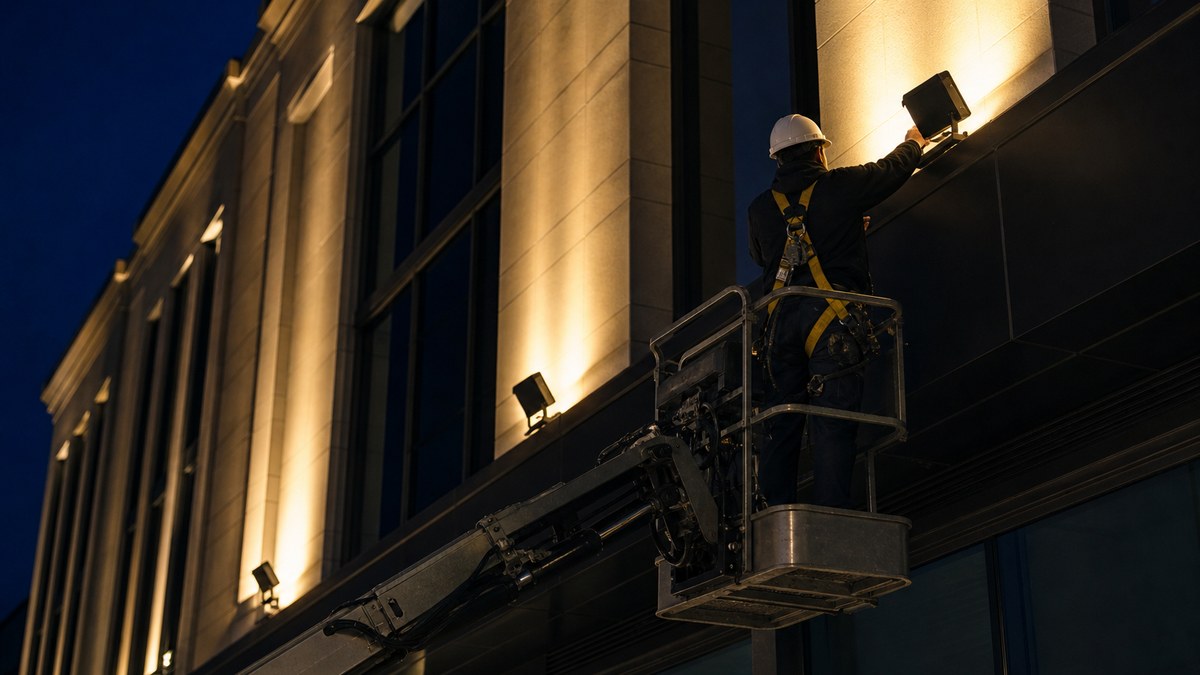
Exterior architectural lighting gets less attention than interior lighting until something goes dark. A single failed wall washer leaves a visible gap; a fixture knocked out of aim throws light into the street; one replaced fixture in the wrong color temperature stands out for years. A simple plan prevents most of this:
- Night walk-throughs on a set schedule, because facade problems are invisible during the day.
- Re-aiming checks after storms, high winds, roof work or landscaping.
- Lens cleaning for in-grade and ledge-mounted fixtures that collect dirt, leaves and insects.
- Controls checks: time clocks, scenes and schedules, especially after power outages and daylight saving changes.
- Matched spares: keeping a few fixtures or drivers from the same product line and color bin on hand.
- Seal and gasket inspections on in-grade fixtures before water damage starts.
For ongoing service, see our guide to working with a lighting contractor in Arlington for repairs and maintenance.
Incentives, energy and upgrades from older lighting
Many older facades in Arlington still use metal halide floodlights, high-pressure sodium fixtures or early-generation LED products. Upgrading to modern LED architectural fixtures commonly uses far less energy, improves color, and cuts maintenance because high fixtures need far fewer lift visits. Some projects may qualify for utility incentives through Oncor's commercial programs, depending on program availability and the work involved. If federal tax deductions such as 179D are part of your plans, note that the deduction ended for projects whose construction begins after June 30, 2026; earlier projects may still qualify, so confirm with your tax advisor. We cover retrofits more broadly in our commercial LED lighting in Texas buyer's guide.
Questions to ask before you light a facade
- Which views of the building matter most, and where will people be standing when they see it?
- Does the facade material suit washing, grazing or a mix?
- Can we see a mock-up or renderings of the white "everyday" scene before committing?
- What IP rating, finish and driver rating are proposed for each mounting location?
- How will the lighting be controlled, scheduled and reduced late at night?
- How will glare and light trespass toward streets and neighbors be managed?
- Who handles permits, lifts, roof access and final night aiming?
- What spare parts and maintenance plan come with the project?
Not sure where to start? Our guide to choosing a commercial LED lighting company in Arlington covers what to look for in any lighting partner.
Frequently Asked Questions
What is architectural facade lighting?
What is the difference between wall washing and wall grazing?
What color temperature is best for building facade lighting?
Can facade lighting change colors for events and holidays?
What IP rating do exterior architectural lights need?
Are there outdoor lighting rules in Arlington, TX?
How do you avoid glare and light pollution with facade lighting?
Is LED facade lighting worth upgrading from metal halide?
How much does architectural facade lighting cost in Arlington?
What areas do you serve for architectural lighting?
Ready to light your building the right way?
From hotel towers and office entrances to venue facades and color-changing scenes, we design, supply and install exterior architectural lighting across Arlington and DFW. Request a consultation or call us today.
Related
Explore more: our services overview, commercial LED lighting, the areas we serve, lighting in South Arlington, Pantego and Mansfield, business lighting services, lighting installation, LED sports lighting, LED signage, and the full Arlington LED Lights blog.
Our DFW lighting network: Dallas LED video walls and commercial lighting, Fort Worth LED lighting, Irving LED lighting, Plano LED lighting, statewide Texas LED lighting, wholesale LED components, LED signs and message centers, fiber optic starlight ceilings, 360° fiber optic lighting, pool and water feature lighting, modular building solutions, and Dallas modular structures.