Church Lighting & LED Video Walls in Arlington, TX: A Guide to Sanctuary, Stage, Livestream & Exterior Lighting
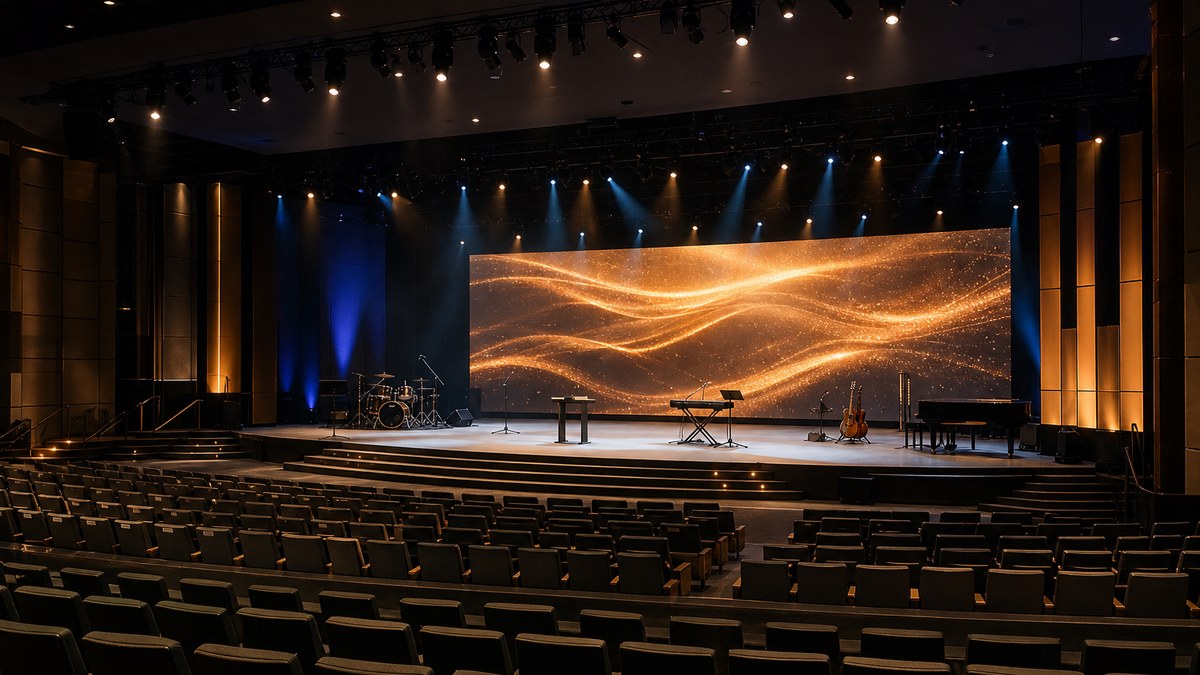
Church lighting in Arlington, TX has changed more in the last decade than in the fifty years before it. Sanctuaries that once relied on a few rows of incandescent cans and a projector now have LED stage lighting, dimmable house lights, LED video walls, cameras for livestreaming and color-changing exterior lighting on the steeple. Done well, the technology disappears and people simply see, hear and feel the service. Done badly, it creates glare in the pastor's eyes, washed-out faces on the livestream, a screen nobody in the back row can read, and a control system only one volunteer understands.
This guide explains how modern church lighting and LED video walls work, what matters for in-person worship and for cameras, how to plan an upgrade from older fixtures and projectors, and how a project runs from first walk-through to training day. It is written for pastors, executive pastors, facilities and operations leaders, technical directors, worship leaders and building committees at churches across Arlington, Grand Prairie, Mansfield, Pantego and the wider DFW area.
A complete church lighting system usually has five layers that work together:
- House lighting: dimmable LED fixtures for the congregation, with smooth fades and preset levels for worship, preaching and fellowship
- Platform (stage) lighting: front light on faces from roughly 45 degrees, plus back light and color wash for depth and atmosphere
- Camera-ready light: flicker-free LED fixtures with good color rendering and balanced levels so livestreams look natural
- LED video wall or displays: sized to the room and chosen by pixel pitch for the closest viewer
- Exterior and architectural lighting: steeples, crosses, entrances and parking areas lit for safety and welcome
- Pricing: every sanctuary is different, so projects are quoted as a project-specific proposal after a walk-through
Why church lighting is different from other commercial spaces
A church sanctuary is part auditorium, part broadcast studio and part community hall. In a single week the same room may host a contemporary worship service with haze and color, a traditional liturgy that needs calm warm light, a funeral, a wedding, a children's program, a concert and a midweek Bible study. Few commercial buildings ask that much of one lighting system.
There are also people factors that office or retail lighting never deals with. Most church technical teams are volunteers who rotate weekly. The lighting has to work on Sunday morning for someone who has had ten minutes of training. The pastor needs to see the congregation, not a wall of glare. Older members need enough light to read a printed bulletin or a hymnal. And a growing share of the congregation now attends online, which means the camera is effectively a seat in the room that must be lit too.
That is why church lighting should be planned as a system rather than a shopping list of fixtures. The goal is a room that supports worship in person and on screen, with controls simple enough for volunteers and robust enough for special events.
The five layers of a modern church lighting system
| Layer | What it does | Typical LED equipment | Common mistakes |
|---|---|---|---|
| House lighting | Lights the congregation for reading, fellowship and safe movement | Dimmable LED downlights, pendants, high-bay or cove fixtures | Fixtures that flicker or "pop" when dimmed low; no smooth fades |
| Front (key) light | Lights faces of pastors, worship leaders and choir | LED ellipsoidal (profile) or Fresnel-style fixtures | Lights hung too steep (raccoon eyes) or too flat (glare in eyes) |
| Back and side light | Separates people from the background and adds depth | LED wash fixtures, PAR-style units, moving heads | Skipping back light so the platform looks flat on camera |
| Color and effects | Sets atmosphere for worship, seasons and events | RGBW or RGBAL wash fixtures, LED strip, moving lights, haze | Over-saturated color that fights the video wall and the camera |
| Video and displays | Lyrics, scripture, sermon notes, IMAG and announcements | LED video walls, LED displays, confidence monitors | Wrong pixel pitch, screens too small or too bright for the room |
| Exterior and architectural | Steeples, crosses, entrances, walkways and parking | LED floodlights, grazers, bollards, pole and wall fixtures | Glare toward neighbors; dark walkways after evening services |
House lighting: the layer everyone notices when it fails
House lighting is the general lighting over the congregation. In older sanctuaries it is often incandescent or halogen cans mounted high in a vaulted ceiling, which means expensive lamp changes on tall ladders or lifts. LED replacements solve the maintenance problem, but only if they dim well. Cheap LED fixtures can flicker, step visibly or shut off abruptly at low levels, which is distracting during a quiet prayer or a candlelight service. When choosing house lighting, ask how the fixture dims (0-10V, DMX, DALI, phase dimming), how low it goes, and whether you can see a demonstration at the low end of the range.
Front light: lighting faces the right way
The single most important light in a sanctuary is the light on the faces of the people leading worship. A long-standing stage lighting practice is to light each speaking area from two front positions, each roughly 45 degrees to the side and about 45 degrees above the subject. That angle gives natural modeling on faces without casting deep shadows under the eyes or blinding the speaker. Lights hung too steeply create "raccoon eyes"; lights hung too low shine straight into the pastor's eyes so they cannot see the room. In many sanctuaries, getting the front light position right does more for the look of the service than any amount of colored light.
Back light, side light and color
Back light hits people from behind and above, creating a rim that separates them from the background. It is the difference between a platform that looks flat and one that looks three-dimensional, especially on camera. Color wash fixtures, usually RGBW or similar, add atmosphere to the stage walls, set pieces and band. Moving lights and haze add movement and beams for contemporary services. The key is restraint: color and effects should support the moment, not compete with the video wall or make faces look green on the livestream.
Build a small set of reliable "looks" before adding effects: walk-in, worship, message, response and dismissal. If those five scenes are right and saved in the console, a volunteer can run a great-looking service with a handful of button presses.
Lighting for livestream and in-person worship at the same time
Many Arlington-area churches now stream every service. Cameras see light differently from the human eye, so a room that looks fine in person can look dim, noisy, flickery or oddly colored on a stream. A few principles make a big difference:
- Flicker-free fixtures: some LED drivers produce flicker that the eye cannot see but cameras capture as rolling bands or strobing. Lighting manufacturer ETC, for example, suggests looking for LED fixtures with a refresh rate at or above 20 kHz for camera work. Ask for the fixture's dimming and refresh specifications and test it with your own camera.
- Good color rendering: skin tones look natural when fixtures have high color rendering. CRI is the common metric; TLCI is a camera-oriented metric some manufacturers publish. Higher is better for faces on screen.
- Consistent color temperature: mixing warm house lights, cool stage lights and a daylight-colored video wall confuses the camera's white balance. Tunable-white fixtures let you match the stage, house and screens.
- Balanced levels: cameras struggle with big contrast. A brightly lit pastor in front of a much brighter video wall, or a bright stage with a black congregation, forces the camera to choose. Balanced levels, with some light on the front rows, look better on screen and in the room.
- Less color on faces: keep saturated color on backgrounds, walls and band, and keep faces in clean white light during the message.
Planning lighting and cameras together also saves money and frustration. Camera positions, lens choices and lighting angles all affect one another, so it pays to have one coordinated plan rather than adding cameras to a lighting system designed only for in-person worship.
LED video walls for churches
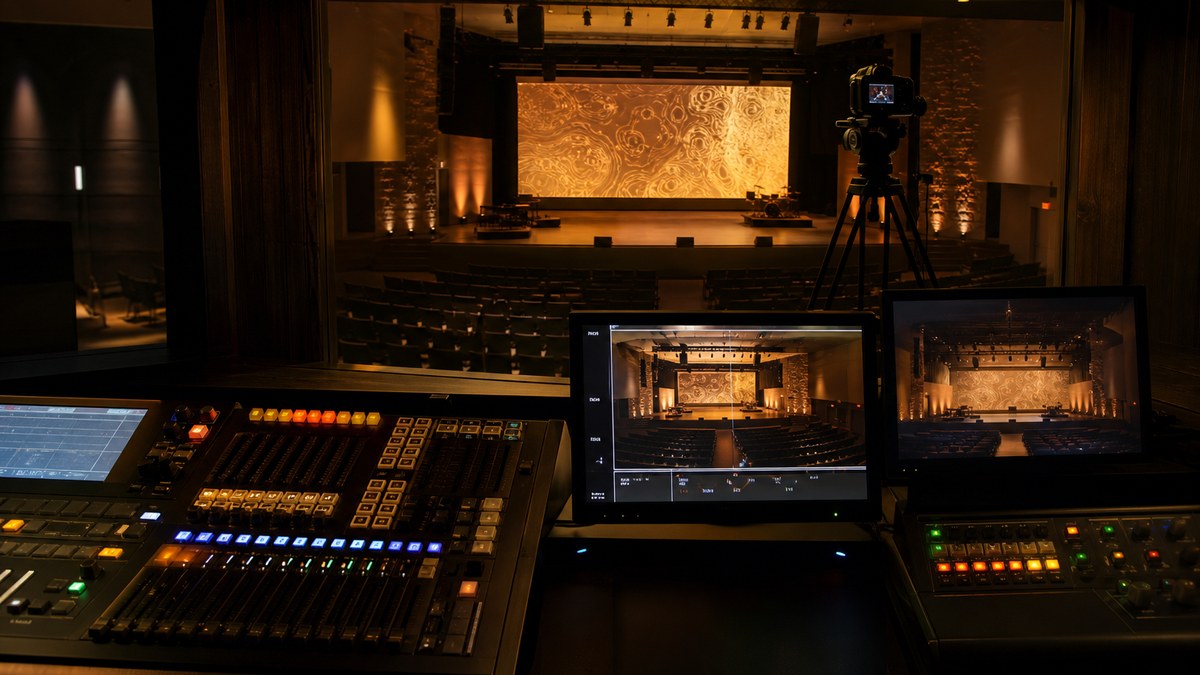
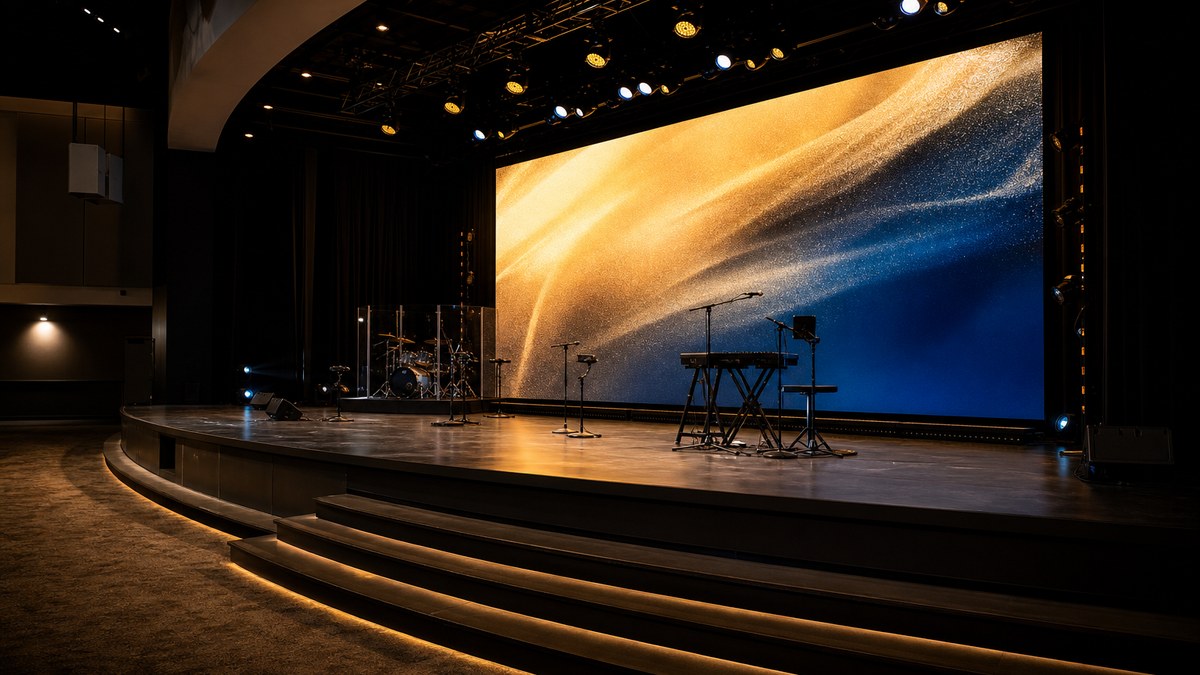
LED video walls have become the most requested upgrade in church tech. Unlike a projector, an LED wall produces its own light, so it stays bright and saturated even with house lights up and daylight coming through windows. There is no lamp to replace, no fan noise from a projector over the congregation, and no shadow when someone walks in front of the screen. LED walls are also modular, so they can be built in wide, tall or curved shapes that fit the architecture. For a broader look at the technology, see our full guide to LED video walls in Arlington.
Pixel pitch: matching the wall to your closest seat
Pixel pitch is the distance between the centers of neighboring pixels, measured in millimeters. A smaller pitch means more pixels, a sharper image up close and a higher project cost. A larger pitch is fine when viewers are farther away. A widely used rule of thumb is to divide the minimum viewing distance in feet by about 3.28 to estimate the maximum pixel pitch in millimeters. For example, if your front row is about 12 feet from the wall, a pitch of roughly 3.6 mm or finer will look smooth from that seat.
| Closest viewer | Typical pixel pitch range | Common church use |
|---|---|---|
| 6–10 ft | About 1.8–2.5 mm | Small chapels, youth rooms, walls close to front seating, close-up camera shots |
| 10–16 ft | About 2.5–3.9 mm | Most mid-size sanctuaries with the wall behind the platform |
| 16–25 ft | About 3.9–6 mm | Larger worship centers, side screens, walls set high above the stage |
| 25 ft and beyond | About 6–10 mm | Very large rooms, balcony-facing displays, outdoor signs |
These ranges are general industry guidance, not hard rules. The right pitch also depends on content (lyrics need to be readable from the back; IMAG of the pastor's face needs fine detail up front), on whether cameras will shoot the wall, and on budget. A walk-through and a demonstration panel in your room are the best way to decide.
Size, placement and brightness
- Size from the back row: one common guideline is to make the screen width roughly one-sixth of the distance to the farthest seat, so text stays readable for everyone.
- Placement: walls behind the platform create a unified backdrop; side screens left and right keep sightlines clear for traditional chancels; a rear confidence display helps worship leaders and the pastor see lyrics and notes.
- Brightness: indoor LED walls are far brighter than most sanctuaries need at full output. In practice they run dimmed so the screen does not overpower faces on stage, and they are calibrated so the wall and cameras agree. Brightness control by scene is as important as maximum brightness.
- Camera-friendly refresh: if the wall will be on camera, specify panels and processing with a high refresh rate and test them with your cameras to avoid scan lines.
- Structure and power: a large LED wall is heavy. Mounting needs structural review, and power is typically run on dedicated circuits, so electrical and structural planning are part of the project from day one.
- Serviceability: front-serviceable panels make repairs possible without building access behind the wall, which matters in many sanctuaries.
LED wall or projector?
Projectors still have a place, especially for very large images on a limited budget or in rooms where the screen is used only occasionally. But in most sanctuaries with windows, house lights up during worship, or a camera ministry, an LED wall delivers a brighter, sharper, more consistent image with much less maintenance. Many churches plan a phased move: an LED wall behind the platform first, with side displays or lobby screens added later.
Planning a sanctuary lighting or video upgrade?
Tell us about your worship space and we'll arrange a walk-through, then prepare a project-specific proposal for lighting, LED video walls, controls and exterior lighting.
Controls that volunteers can actually run
The best lighting system in the world fails if the Sunday team cannot operate it. Church lighting controls should be designed for the least experienced person who will use them, with deeper access for the technical director. For a deeper look at protocols and energy code, see our guide to commercial lighting controls in Arlington.
- Wall stations with presets: simple buttons at the doors and in the booth for "Walk-in," "Worship," "Message," "Full house" and "Off" let anyone set the room without opening the console.
- A lighting console for services: DMX-based consoles or software store cues and scenes for the production team, from simple to complex.
- One system for house and stage: when house lights and stage lights live on the same control system, fades between worship and message are smooth and consistent.
- Protocols: DMX512 is the standard for stage and color fixtures; RDM adds remote diagnostics; Art-Net and sACN carry DMX over a network for larger systems; 0-10V and DALI are common for architectural house lighting.
- Lockouts and documentation: password-protected settings, a printed quick-start card in the booth and labeled breakers prevent most Sunday-morning emergencies.
- Training: a handover session for staff and volunteers, plus a refresher after the first few services, is part of a good project.
Fellowship halls, classrooms and the rest of the campus
The sanctuary gets the attention, but most church square footage is elsewhere: fellowship halls, gyms and family life centers, classrooms, children's wings, offices, hallways, kitchens and parking lots. These spaces are where LED retrofits often deliver the most practical benefit, because many of them still run older fluorescent or metal halide fixtures for long hours during the week.
- Fellowship halls and gyms: durable LED high-bay or linear fixtures with occupancy sensors and dimming for events. Gym fixtures need guards against balls. Our LED sports lighting guide covers gym light levels.
- Classrooms and children's areas: comfortable, glare-free LED panels with occupancy sensors so rooms do not stay lit all week.
- Hallways and lobbies: welcoming warm-white lighting, lobby displays, and well-lit wayfinding for visitors.
- Offices and kitchens: standard commercial LED lighting with sensors and time schedules.
- Emergency and exit lighting: battery-backed emergency lights and exit signs must work every time the building is occupied. Under commonly applied NFPA 101 testing, battery units get a functional test of at least 30 seconds every 30 days and a 90-minute test once a year, with written records. Confirm your exact requirements with your fire department.
Exterior church lighting: steeples, entrances and parking
For many churches, the exterior is the first impression. Exterior lighting does three jobs: it helps people find the building and the right entrance, it keeps them safe walking to their cars after evening services, and it makes the building itself a visible part of the neighborhood at night.
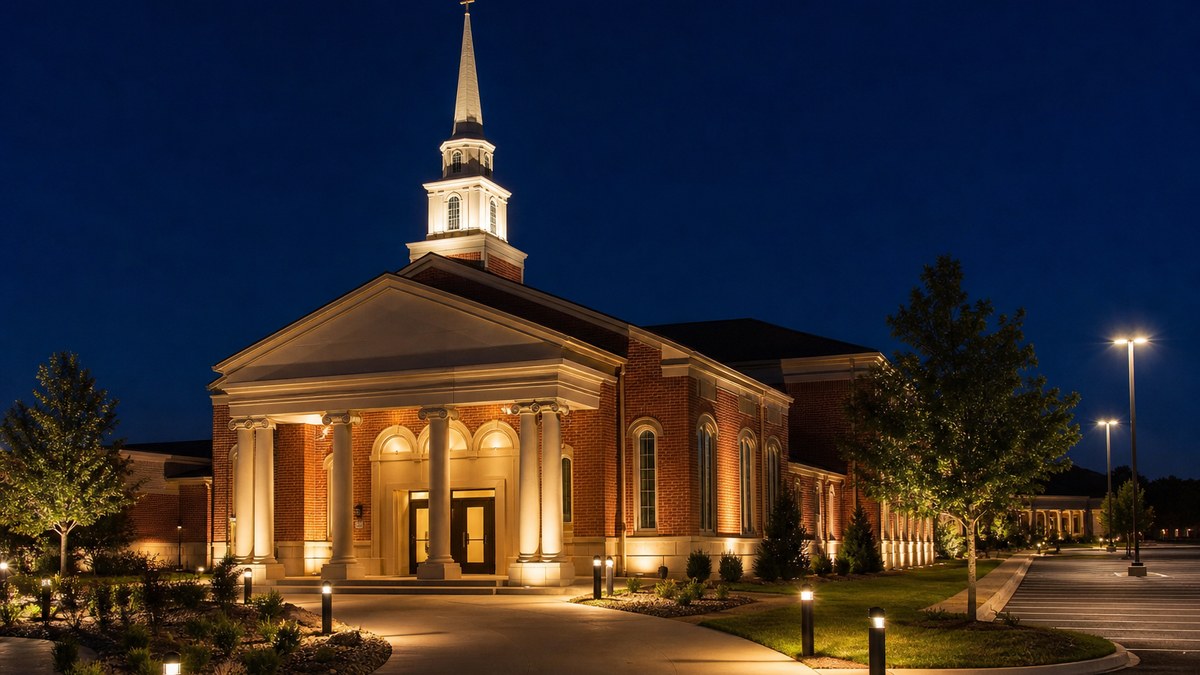
Architectural lighting for steeples, crosses and facades
Warm-white grazing on stone or brick, narrow accents on a steeple or bell tower, and a softly lit cross can make a church recognizable from the road without glare. Color-changing fixtures can mark Advent, Christmas, Easter or community events, but most churches look best with a beautiful white scene as the everyday setting. Our guide to architectural and facade lighting in Arlington explains wall washing, grazing, fixtures for Texas heat and glare control.
Parking lots and walkways
Many congregations meet after dark for midweek services, youth groups and events. Commonly cited IES guidance for open parking lots is a minimum of about 0.2 footcandles with a maximum-to-minimum uniformity of 20:1 or better, and higher minimums for enhanced-security lots. Modern LED pole and wall fixtures with good optics put light where it is needed without spilling into neighboring homes. Lighting the walkways, steps and entrances evenly matters as much as the lot itself, especially for older members.
Signs and message centers
An illuminated monument sign or LED message center helps people find the church and see service times and events. Arlington's sign rules apply to church signs too, including restrictions on motion; see our guide to LED signs in Arlington before planning a digital sign.
Upgrading an older sanctuary: what to expect
Many Arlington churches were built decades ago with lighting designed around incandescent fixtures and later patched with whatever was available. Upgrading is usually less disruptive than people expect, but it needs planning around the church calendar.
- Survey existing circuits and dimmers: older dimmer racks may not work with LED fixtures. Some churches keep the rack in "non-dim" mode and control LEDs directly with DMX; others replace it entirely.
- Plan around high ceilings: vaulted sanctuaries often need lifts or scaffolding, which affects scheduling and protects pews, flooring and stained glass.
- Schedule between services: work is usually sequenced Monday to Friday so the room is ready for the weekend, or around holidays and summer schedules.
- Phase if needed: house lighting and front light first, then color and effects, then video. A good plan makes each phase work on its own.
- Licensed electrical work and permits: in Texas, electrical work must be done by TDLR-licensed contractors and electricians, and many projects in Arlington need an electrical permit through Arlington Building Inspections. Confirm requirements with the city early.
- Energy code: new lighting and controls in commercial buildings fall under the energy code adopted locally; confirm the edition and requirements with Arlington Building Inspections during design.
Energy, maintenance and incentives
LED fixtures commonly use far less energy than the incandescent, halogen, fluorescent and metal halide fixtures they replace, and they last much longer, which means fewer trips up a lift to change lamps in a tall sanctuary ceiling. Some church projects may qualify for utility incentives through Oncor's commercial programs, depending on program availability and the work involved. If your church is exploring federal energy deductions such as 179D, note that the deduction ended for projects whose construction begins after June 30, 2026; earlier projects may still qualify, so confirm with your tax advisor.
How a church lighting project works with us
- Listening meeting. We start with your worship style, services and events, online ministry, volunteer team, problems with the current system and long-term plans for the campus.
- Walk-through. We review the sanctuary and other spaces, including mounting positions, power, existing dimming and controls, sightlines, camera positions and exterior lighting at night.
- Concept and options. A lighting and video concept with fixture types, LED wall size and pixel pitch options, control approach and phasing ideas.
- Demonstration where it matters. A sample LED panel or test fixtures in your room, so your team can judge sharpness, color and brightness in person and on camera.
- Project-specific proposal. Equipment, scope, schedule, structural and electrical requirements, permits and training, quoted to your building and your goals.
- Installation and programming. Licensed electrical work, rigging and mounting, DMX addressing, video processing setup, scene programming and calibration, scheduled around your services.
- Training and handover. Hands-on training for staff and volunteers, quick-start guides, documentation and a maintenance plan.
Arlington LED Lights brings 15+ years as an authorized architectural lighting dealer and project coordinator, and our licensed installation partner has completed over 200 major sports and commercial projects across the US and Canada — NFL, NBA, NHL, MLS, NCAA and NASCAR. For larger campuses or building programs, our Luminance design-build program keeps design, products and installation under one coordinated plan. Not sure how to compare partners? Our guide to choosing a commercial LED lighting company in Arlington covers what to ask any contractor.
Questions to ask before you upgrade church lighting or video
- What services and events must the room support, and what does each one need from lighting and video?
- Will the system be designed for cameras as well as for people in the room?
- How do the proposed LED fixtures dim at the low end, and are they flicker-free on camera?
- What pixel pitch and wall size are proposed, and how were they chosen from our seating and content?
- Can we see a demonstration panel or test fixtures in our sanctuary?
- How will volunteers operate the system each week, and what training is included?
- Who handles structural review, electrical permits, lifts and scheduling around services?
- What warranty, spare parts and maintenance support come with the equipment?
If you also need ongoing service for existing fixtures, see our guide to working with a lighting contractor in Arlington for repairs and maintenance.
Frequently Asked Questions
What is the best lighting for a church sanctuary?
What pixel pitch should a church LED video wall have?
Is an LED video wall better than a projector for a church?
How do we light a church for livestreaming?
Why do our LED lights flicker on camera?
Can our volunteers run a new lighting system?
Will new LED lighting work with our old dimmer rack?
Do church lighting upgrades need a permit in Arlington?
How much does church lighting or an LED video wall cost?
What areas do you serve for church lighting?
Ready to light your worship space the right way?
From sanctuary and stage lighting to LED video walls, livestream-ready fixtures, controls and steeple lighting, we design, supply and install church lighting across Arlington and DFW. Request a consultation or call us today.
Related
Explore more: our services overview, the areas we serve, lighting repair and service, lighting in South Arlington, Pantego and Mansfield, business lighting services, lighting installation, commercial LED lighting in Texas, parking and site lighting, warehouse and industrial lighting, LED signage, and the full Arlington LED Lights blog.
Our DFW lighting network: Dallas LED video walls and commercial lighting, Fort Worth LED lighting, Irving LED lighting, Plano LED lighting, statewide Texas LED lighting, wholesale LED components, LED signs and message centers, fiber optic starlight ceilings, 360° fiber optic lighting, pool and water feature lighting, modular building solutions, and Dallas modular structures.