Restaurant & Bar Lighting in Arlington, TX: A Guide to Dining Rooms, Bars, Patios & Kitchens
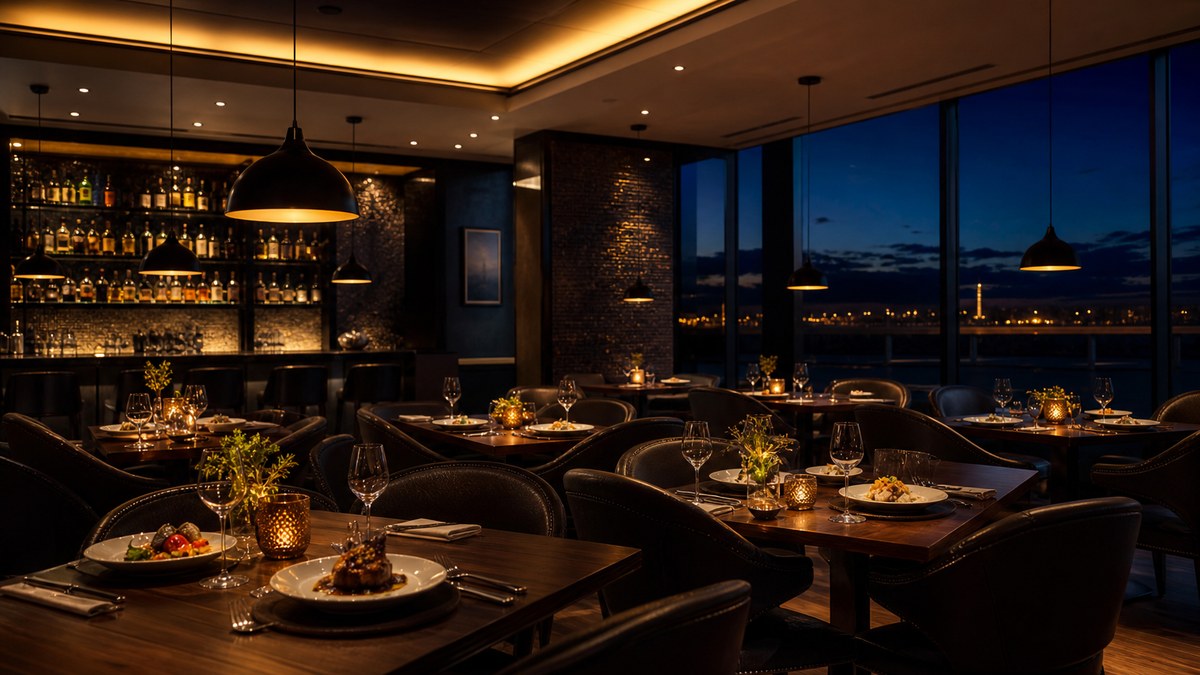
Restaurant and bar lighting in Arlington, TX does more work than almost any other lighting in commercial real estate. In one evening the same room has to welcome a family at 5 p.m., set a mood for a date at 8, carry a packed game-night crowd before and after events in the Entertainment District, and still give the kitchen enough clean, bright light to cook and plate safely. Guests rarely notice good restaurant lighting. They notice bad lighting immediately: food that looks gray, glare from a bare bulb, a patio that feels dark and unsafe, or a menu nobody can read.
This guide explains how modern LED lighting works in restaurants, bars, breweries, hotel restaurants and patios, how to choose color temperature, color rendering and light levels for each zone, how to keep dimming smooth and flicker-free, what the kitchen and back-of-house need, and how a lighting upgrade runs from walk-through to opening night. It is written for owners, operators, general managers, franchise groups, designers and property managers across Arlington, Grand Prairie, Mansfield, Pantego and the wider DFW area.
Good restaurant and bar lighting is layered and zoned:
- Dining room: warm white (about 2700K–3000K), high color rendering (CRI 90+), dimmable ambient light plus focused light on tables
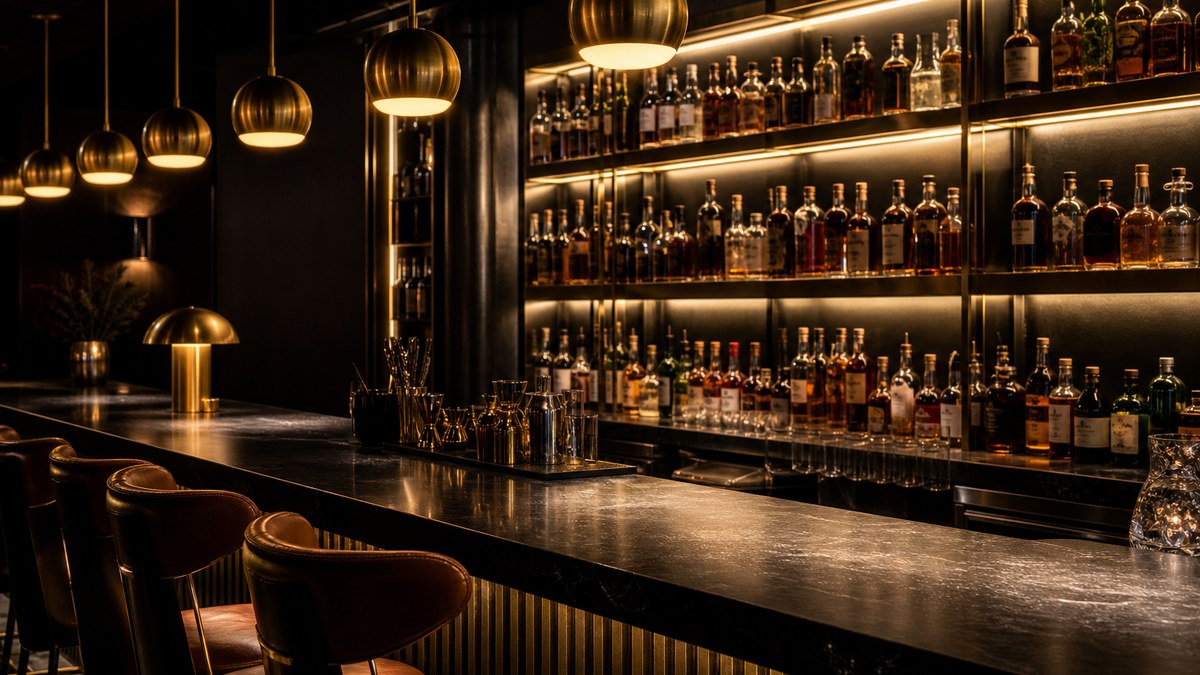
- Bar: a glowing back bar and bottle display, task light on the bar top and service well, and pendants that add character without glare
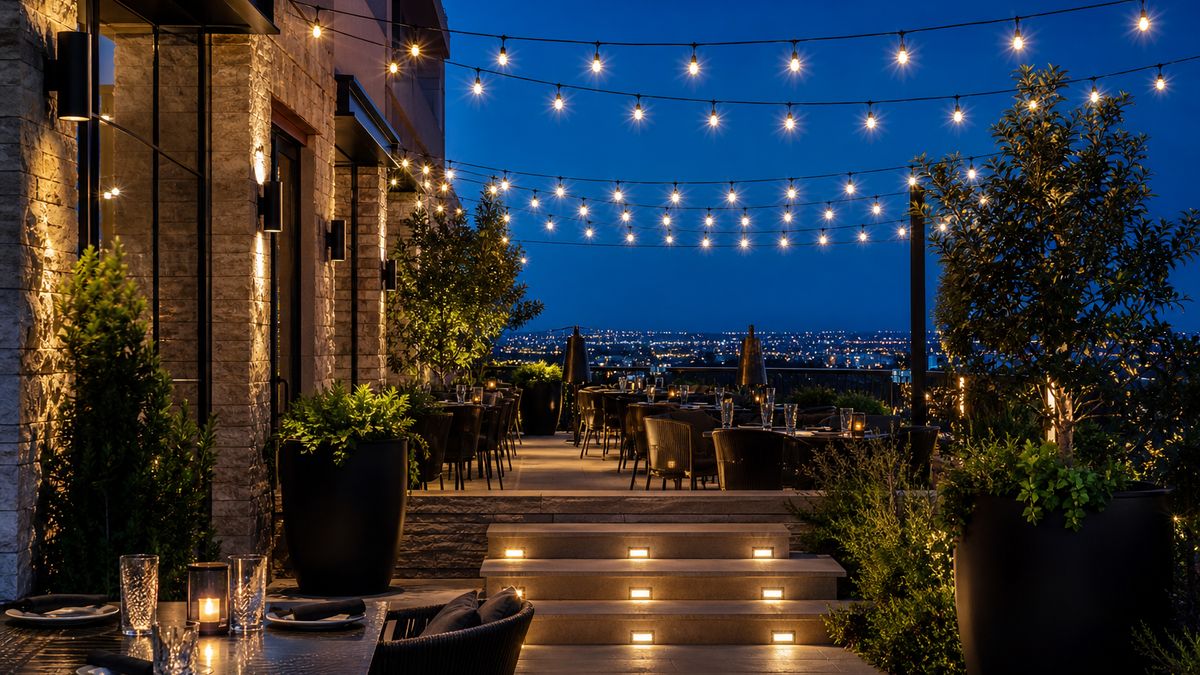
- Patio: wet-rated, shielded fixtures, string or catenary lighting for mood, and enough path and step light for safety
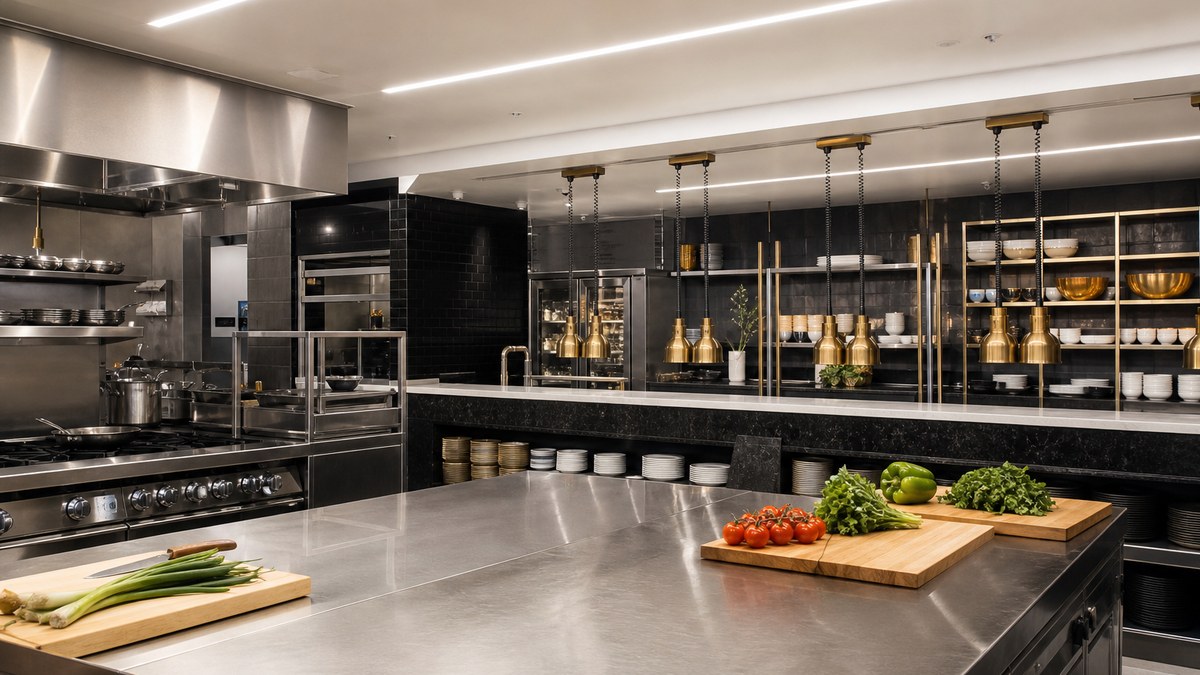
- Kitchen and back-of-house: bright, even, shielded light on prep and cooking surfaces, set by health-code minimums
- Controls: scenes for lunch, dinner, late night and cleaning, with LED-compatible dimming that stays smooth at low levels
- Pricing: every space is different, so projects are quoted as a project-specific proposal after a walk-through
Why lighting matters so much in restaurants and bars
In an office, lighting is mostly about seeing the task. In a restaurant it is also part of the product. Light changes how food looks on the plate, how drinks glow on the bar, how comfortable guests feel staying for another round, and how the room photographs when someone posts a picture of their meal. It also affects staff: servers need to read tickets and check plates, bartenders need to see what they pour, and cooks need clear light to judge doneness and keep surfaces clean.
Lighting also sends a signal about the concept before a guest reads the menu. Bright, cooler light reads as fast and casual. Low, warm, layered light reads as relaxed and upscale. Many operators run more than one concept in a single day, from a bright lunch to a moody dinner and a lively late-night bar, which is why dimming and scene control are as important as the fixtures themselves.
Finally, lighting is one of the larger energy loads in many restaurants that still run older halogen, incandescent or fluorescent fixtures for long hours every day. Switching to LED commonly uses far less energy, produces much less heat in the dining room and kitchen, and cuts down on ladders and lamp changes. Those operational wins add up for a business open from morning prep to after midnight.
The lighting zones of a restaurant or bar
The easiest way to plan restaurant lighting is to break the space into zones and give each zone its own goals, fixtures and controls. The table below shows a typical layout.
| Zone | Main goal | Typical LED fixtures | Common mistakes |
|---|---|---|---|
| Entry & host stand | Welcome guests, make the host visible, transition from daylight | Warm downlights, a feature pendant, accent on signage or art | Entry too dark at lunch, so guests walk into a "cave" |
| Dining room | Flattering light on faces and food, comfortable mood | Dimmable downlights, pendants over tables, cove or indirect light | Overhead light only, which casts harsh shadows on faces |
| Bar & back bar | Show off bottles and the bar as a focal point; give bartenders task light | LED strip under shelves and bar top, pendants, accent spots | Glare from exposed sources at eye level for seated guests |
| Patio & rooftop | Atmosphere after dark, safe steps and paths | Wet-rated catenary or string lights, step lights, shielded wall lights | Indoor-rated products outdoors; bright floods that blind neighbors |
| Kitchen & prep | Bright, even, shadow-free light on cooking and prep surfaces | Sealed LED troffers or linear fixtures, hood lighting | Unshielded lamps over food; low light levels at prep tables |
| Restrooms & corridors | Clean, safe, consistent with the brand | Mirror lighting, downlights, sensor-controlled fixtures | Cool harsh light that clashes with a warm dining room |
| Exterior & parking | Visibility from the street, safe arrival | Facade and sign lighting, pole and wall lights | Dark parking areas and a facade that disappears at night |
Color temperature: setting the mood by concept
Color temperature, measured in Kelvin (K), describes how warm or cool white light looks. Lower numbers look warmer and more golden; higher numbers look whiter and cooler. For most restaurants and bars, warm light is the default because it flatters skin tones and makes food and drinks look appealing.
- Fine dining, steakhouses and wine bars: around 2700K, sometimes warmer at low dim levels, for an intimate, candlelit feel.
- Casual dining, brewpubs and sports bars: about 2700K–3000K in the dining room, with brighter, slightly cooler task light where the team works.
- Fast casual and quick service: often 3000K–3500K, and some lighting suppliers suggest up to about 4000K, to feel bright, clean and quick. Many brands still keep the seating area warmer than the service line.
- Hotel restaurants and lobby bars: warm white that matches the lobby, so the transition from hotel to restaurant feels seamless.
- Kitchens and back-of-house: commonly 3500K–4000K for clear, alert light that makes it easy to see color and cleanliness.
The bigger mistake than choosing the "wrong" color temperature is mixing them. A room with 2700K pendants, 4000K downlights and a 5000K display case looks patchy and unplanned. Pick a target for each zone and specify it on every fixture. Dim-to-warm LED fixtures, which shift warmer as they dim (similar to an incandescent lamp), are popular in dining rooms because the room naturally becomes cozier as the evening goes on. Tunable-white fixtures let you set a brighter, crisper look for lunch and a warmer one for dinner from the same fixtures.
Color rendering: making food and drinks look right
Color rendering describes how naturally a light source shows colors. The common metric is CRI (Color Rendering Index); higher is better. Restaurant lighting guides commonly recommend CRI 90 or higher for dining rooms and bars, where the look of food, drinks and faces matters most, and at least CRI 80 for circulation, kitchens and outdoor areas.
Low-CRI lighting can make a perfectly cooked steak look dull, greens look gray and red wine look muddy. It also makes faces look tired, which matters on a date night or in a photo. When comparing fixtures, also ask about R9 (the saturated red value), because red tones in meat, tomatoes, sauces and wine are where poor color rendering shows up first. Color consistency between fixtures matters too: a batch of LEDs that all claim "3000K" can still look slightly pink or green next to each other if the manufacturer's tolerance is loose.
How bright should a restaurant or bar be?
Light levels are measured in foot-candles (fc). There is no single "correct" number for a dining room, because a quick-service counter and a fine-dining room have very different goals. The figures below are commonly cited ranges in restaurant lighting guides and are a useful starting point, not a requirement. Kitchen numbers are covered separately under health code below.
| Area | Commonly cited range | Notes |
|---|---|---|
| Fine dining room | Lower end, often well under 20 fc at dinner | Focus light on tables; keep the rest of the room soft |
| Casual dining room | About 20–30 fc | Use dimming to drop levels for evening service |
| Bar and counter | About 30–50 fc on the work surface | Task light for the bartender, softer light for guests |
| Circulation and corridors | About 10–15 fc | Consistent, no dark spots at steps or level changes |
| Patio and outdoor dining | About 10–20 fc at tables | Shield sources; light steps and paths for safety |
| Kitchen and prep | Set by the food code (see below) | Bright, even and shadow-free on work surfaces |
Just as important as the average level is contrast. A dining room feels inviting when the tables, bar and artwork are a little brighter than the walkways and ceiling. Many designers aim for accent light several times brighter than the surrounding ambient light to create that effect. Glare control matters as well: shielded or deep-regressed downlights, diffused pendants and low-glare optics keep guests from staring into a bright source while they eat.
Layering light: ambient, task, accent and decorative
Most great restaurant interiors use four layers of light, each on its own control zone so the room can be tuned for different times of day.
Ambient light
Ambient light sets the general brightness of the room. In restaurants this often comes from recessed downlights, cove lighting that bounces off the ceiling, or indirect linear fixtures. The goal is soft, even light that lets guests move safely and read the menu without making the room feel like an office.
Task light
Task light helps people do a specific job: the bartender at the well, the host at the stand, the server at the POS, the expo line at the pass. Under-shelf LED strip at the bar, focused downlights over the host stand and bright, even light at the pass make the team faster and more accurate without flooding the dining room.
Accent light
Accent light draws the eye to what makes the space special: a bottle wall, a feature wall, artwork, a wine room, plants or a branded element. Narrow-beam LED spotlights, linear grazers and backlit shelving are typical tools. In bars, a well-lit back bar is often the single most important accent, because it is what guests look at all night.
Decorative light
Decorative fixtures such as statement pendants, chandeliers, sconces and filament-style LED lamps are part of the interior design. They add character and sparkle but rarely provide enough useful light on their own. Choose decorative fixtures for the look, then make sure ambient and task layers do the real work.
Hang pendants over tables low enough to light the table rather than people's eyes. Many restaurant lighting guides place the bottom of the shade roughly 28–34 inches above the table surface, then adjust on site. Confirm clearances around booths, high-tops and service paths before ordering.
Dimming and scenes: one room, many moods
Dimming is where many restaurant LED projects go wrong. LED fixtures need drivers and dimmers that are designed to work together. When they are not, the result is flicker, buzzing, fixtures that "pop" on at a high level, or lights that drop out before the room is dim enough. A few principles avoid most problems:
- Match driver and dimmer: phase-dimmed LEDs may need a trailing-edge (ELV) or leading-edge dimmer depending on the driver. Professional systems often use 0–10V, DALI or DMX control instead, which separates the control signal from the power and generally dims more smoothly.
- Check low-end performance: a dining room at dinner may run at a small fraction of full output. Ask what the fixture's minimum dim level is and test it at that level before buying in volume.
- Watch for flicker: some LED drivers flicker at low levels in a way the eye barely notices but phone cameras capture as bands. Since guests photograph food and drinks constantly, flicker-free drivers are worth asking for.
- Program scenes: "Lunch," "Dinner," "Late night," "Private event" and "Cleaning" scenes on a simple keypad let a manager set the whole room with one button and keep the look consistent from shift to shift.
- Use astronomical time clocks: exterior, sign and patio lighting can switch on at sunset and step down at closing automatically.
Controls also help with energy code. Commercial energy codes require automatic shutoff and other controls in many spaces, and requirements vary by code edition and by how a space is classified. For more detail on sensors, dimming protocols and energy-code basics, see our guide to commercial lighting controls in Arlington.
Opening, remodeling or refreshing a restaurant or bar?
Tell us about your space and concept. We'll arrange a walk-through and prepare a project-specific proposal for dining room, bar, patio, kitchen and exterior lighting, with controls your team can run.
Bar lighting: making the bar the focal point
Whether it is a cocktail lounge, a brewery taproom, a hotel lobby bar or a sports bar near the stadiums, the bar is usually the visual center of the room. Good bar lighting does three things at once: it makes the bottle display glow, gives bartenders enough light to work quickly and accurately, and keeps guests sitting at the bar comfortable.
- Back bar and bottle shelves: LED strip under or behind each shelf lights bottles from below or behind so they glow. Frosted or acrylic shelves and mirrored backs multiply the effect. Use high-CRI strip so liquor colors look rich, and make sure the LED dots are hidden from view.
- Bar top and service well: focused downlights or a concealed linear fixture over the well give bartenders task light without shining into guests' eyes.
- Under-bar glow: a strip under the bar-top overhang adds depth and helps guests find foot rails and stools.
- Pendants: a row of pendants along the bar adds personality. Use diffused or shielded lamps so seated guests are not looking straight into a bright source.
- Displays and screens: sports bars and venues often add large displays or an LED video wall. Plan screen brightness and room lighting together so the screens are easy to watch without overpowering the room. Our guide to LED video walls in Arlington covers sizing and pixel pitch.
Color-changing (RGBW) lighting can add drama to a bar or lounge for late-night service or events, but most operators get the best results using color sparingly, such as under the bar or on a feature wall, while keeping faces and drinks in warm, high-CRI white.
Patio, rooftop and outdoor dining lighting
Patios are a big draw in North Texas for much of the year, and in Arlington's Entertainment District, near AT&T Stadium, Globe Life Field and Texas Live!, outdoor seating often fills up before and after games and concerts. Patio lighting has to look good, survive the weather and keep people safe.
- Use wet- or damp-rated products: fixtures exposed to rain and sprinklers should be listed for wet locations, and many outdoor fixtures carry ingress protection ratings such as IP65 or higher. Indoor products used outdoors are a common cause of early failure.
- Catenary and string lighting: commercial-grade festoon or catenary lighting on a properly supported cable, with LED lamps and outdoor-rated connections, creates the classic patio mood. Plan structural support for wind.
- Light steps, ramps and level changes: step lights, low bollards and concealed linear lighting keep guests safe after a few drinks without making the patio bright.
- Shield and aim fixtures: fully shielded fixtures aimed down reduce glare for guests, neighbors and drivers. Keep color temperature warm outdoors, around 2700K–3000K, so the patio matches the dining room.
- Heat and sun: Texas summers are hard on outdoor equipment. Choose fixtures and drivers rated for high ambient temperatures and protect controls from direct sun.
- Rooftops: rooftop bars combine all of the above with wind, longer cable runs and visibility from the street. Perimeter and railing lighting, shielded table light and a lit feature element tend to work well.
Outdoor lighting rules for light trespass and shielding vary by city and by development; we have not found an Arlington-specific outdoor lighting ordinance text for restaurant patios, so confirm current requirements with the City of Arlington before final design. Pool areas at hotels and resorts have their own requirements; our network partner pool and water feature lighting covers that specialty.
Kitchen and back-of-house: where health code sets the bar
Commercial kitchens need bright, even, shadow-free light. Cooks judge doneness by color, prep teams handle knives and slicers, and inspectors check that surfaces are clean. Lighting here is about safety and food code, not mood.
The Texas Food Establishment Rules are based on the FDA Food Code, which sets minimum light intensities for food establishments. Under the FDA Food Code, those minimums are approximately:
- About 10 foot-candles (108 lux) in walk-in refrigeration and dry food storage areas, and in other areas during cleaning
- About 20 foot-candles (215 lux) in consumer self-service areas, at handwashing and warewashing areas, equipment and utensil storage, and in toilet rooms
- About 50 foot-candles (540 lux) at surfaces where employees work with food or with utensils and equipment such as knives, slicers, grinders and saws, where employee safety is a factor
The Food Code also calls for light bulbs to be shielded, coated or otherwise shatter-resistant in areas with exposed food, clean equipment and utensils, and unwrapped single-service items. Health rules are adopted and enforced locally, so always confirm current requirements with the local health authority that inspects your establishment before you finalize a kitchen lighting design.
In practice, that means sealed, easy-to-clean LED fixtures with lenses rather than open lamps over prep areas, walk-ins and dish areas; fixtures rated for the conditions they face, such as cold walk-in coolers or the humidity near dish machines; and enough fixtures to avoid shadows from shelving and hoods. Hood lighting is typically part of the hood system, so coordinate with the hood supplier. LED's lower heat output is a bonus in a hot kitchen.
Emergency egress lighting and exit signs are required in most restaurants and bars and are inspected by the fire department. When you remodel or change fixtures, make sure emergency lighting still covers the path out, including patios and dark dining rooms at low dim levels. Our lighting contractor guide covers emergency lighting testing and maintenance.
Hotel restaurants and Entertainment District venues
Arlington's hotels, convention spaces and Entertainment District venues add a few more considerations. Hotel restaurants and lobby bars usually need to match the hotel's lighting palette and brand standards. Restaurants that host private events want scene control for receptions, presentations and late-night parties. Venues near the stadiums see huge swings in occupancy between event days and quiet weeknights, which makes flexible controls and durable fixtures more valuable.
Exterior presence matters too. A well-lit facade, signage and entry help a restaurant stand out on a busy street at night. Our guides to architectural and facade lighting and LED signs in Arlington cover those layers, including Arlington's sign standards. For restaurants in retail centers, see our guide to shopping center LED lighting for parking lot and storefront lighting.
Upgrading an existing restaurant vs. lighting a new build-out
Many Arlington restaurants are in second-generation spaces, where a new operator inherits someone else's lighting. Others are ground-up builds or full remodels. The approach differs:
| Situation | Typical approach | Watch out for |
|---|---|---|
| Lamp swap in existing fixtures | Replace halogen, incandescent or CFL lamps with dimmable LED lamps | Dimmer compatibility; mixed color temperatures; fixtures not rated for LED retrofit |
| Fixture retrofit | Replace old downlights, troffers and strip lights with LED fixtures; add dimming | Ceiling conditions, existing circuits and access during business hours |
| Second-generation space | Keep good infrastructure, redesign layers and controls for the new concept | Old wiring, missing emergency lighting, previous tenant's brand look |
| New build-out or full remodel | Full lighting design with zones, scenes and code compliance from the start | Coordinating with the architect, MEP engineer, kitchen designer and permit schedule |
Restaurants have one more constraint: downtime. Most operators cannot close for long. Lighting work is often scheduled around service, overnight or on closed days, and phased by zone so the dining room, bar and patio can stay open. Many projects need an electrical permit and inspection; confirm with the City of Arlington, and make sure the installer is properly licensed by the Texas Department of Licensing and Regulation. Our lighting installation guide explains the process step by step.
How a restaurant lighting project works with Arlington LED Lights
- Walk-through: we visit the space, ideally during service and after dark, to see how it is used, what is working and what is not.
- Concept and goals: we talk through the brand, service style, hours, events and any franchise or hotel standards.
- Lighting plan: zones, fixtures, color temperature, color rendering, light levels and control scenes, with kitchen and emergency lighting checked against code.
- Mock-ups and samples: where it matters, we test fixtures on site so you can see food, drinks and finishes under the actual light.
- Project-specific proposal: a clear scope with options, and guidance on whether your project may qualify for utility incentives through programs such as Oncor's, depending on program availability.
- Installation: scheduled around service, phased by zone where needed, with permits and inspections handled.
- Programming and training: scenes are set and fine-tuned at night, and managers learn the keypads and time clocks.
Our team brings 15+ years as an authorized architectural lighting dealer and project coordinator. Our licensed installation partner has completed over 200 major sports and commercial projects across the US and Canada — NFL, NBA, NHL, MLS, NCAA and NASCAR. The Luminance design-build program is available for projects that want one team from design through installation.
Frequently Asked Questions
What is the best color temperature for restaurant lighting?
What CRI should restaurant lights have?
How bright should a restaurant dining room be?
How much light does a commercial kitchen need in Texas?
Why do my LED restaurant lights flicker when dimmed?
What is dim-to-warm lighting and is it good for restaurants?
What lighting works best for a restaurant patio in Texas?
How should a bar be lit?
Can lighting be upgraded without closing the restaurant?
How much does restaurant lighting cost in Arlington?
Ready to make your dining room, bar and patio look their best?
From warm, dimmable dining room lighting and glowing back bars to weather-ready patio lighting, code-ready kitchens and scene controls, we design, supply and install restaurant and bar lighting across Arlington and DFW. Request a consultation or call us today.
Related
Explore more: our services overview, the areas we serve, lighting repair and service, LED video walls, LED signage, lighting in South Arlington, Pantego and Mansfield, business lighting services, commercial LED lighting in Texas, large-scale hotel and venue projects, how to choose a lighting company, church lighting and video, warehouse and industrial lighting, sports and venue lighting, and the full Arlington LED Lights blog.
Our DFW lighting network: Dallas LED video walls and commercial lighting, Fort Worth LED lighting, Irving LED lighting, Plano LED lighting, statewide Texas LED lighting, wholesale LED components, LED signs and message centers, fiber optic starlight ceilings, 360° fiber optic lighting, modular building solutions, and Dallas modular structures.