Hotel Lighting in Arlington, TX: A Guide to Lobbies, Guest Rooms, Corridors, Ballrooms & Exteriors
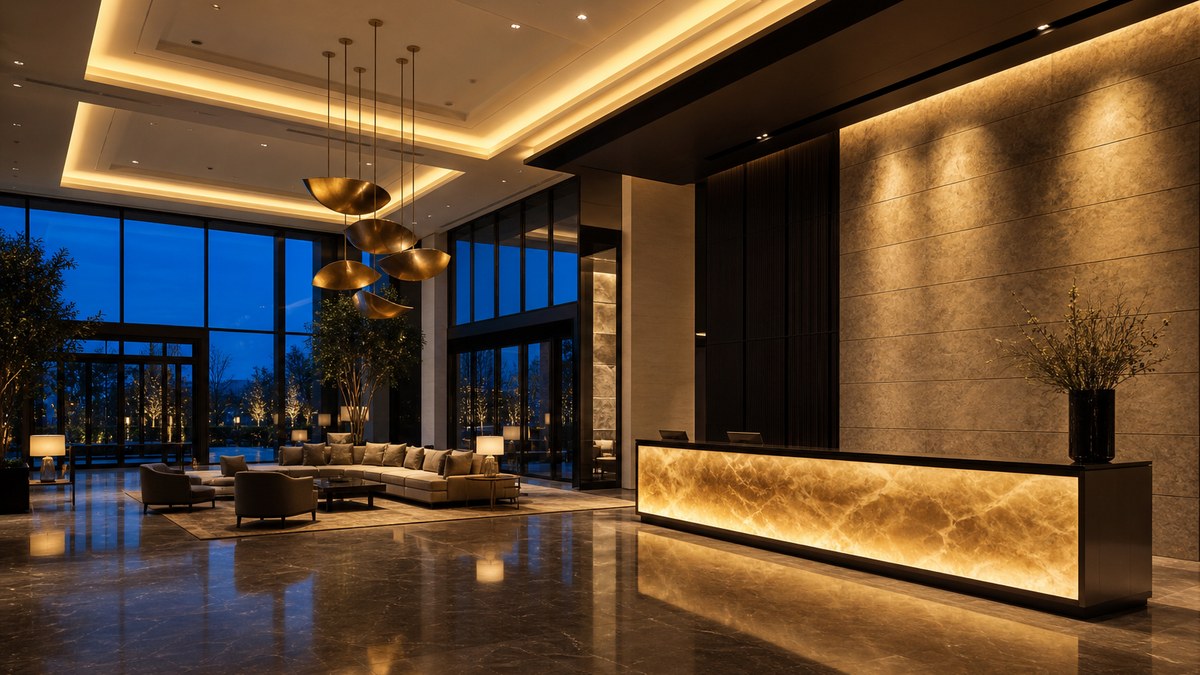
Hotel lighting in Arlington, TX does more work than almost any other lighting system in the city. It welcomes guests at the curb after a game at AT&T Stadium or a concert at Globe Life Field, guides them through the lobby and down long corridors, sets the mood in the bar and restaurant, lets them read in bed and get ready at the mirror, and turns a ballroom from a breakfast meeting into an evening gala. It also runs every hour of every day, which makes it one of the largest controllable energy loads in the building.
Arlington's hotel market keeps growing around the Entertainment District, the Arlington Convention Center, Texas Live! and UT Arlington, and along I-20 and I-30. In January 2026 the City of Arlington announced plans for a 507-room Americana by Loews hotel, adding to the district's existing full-service hotels. New properties raise guest expectations, and older hotels feel the pressure to look as good after dark as the newest building down the street. This guide explains how modern LED hotel lighting works space by space, what light levels and color choices are commonly recommended, which controls the energy code expects in guest rooms and common areas, where LED video walls fit, and how a phased upgrade runs while the hotel stays open. It is written for owners, general managers, asset managers, chief engineers, management companies, franchise owners and developers in Arlington, Grand Prairie, Mansfield and across DFW.
Good hotel lighting is layered, warm, easy to control and planned space by space:
- Lobby: layered ambient, accent and wall lighting in warm white (around 2700K–3000K), with brighter task light at the front desk
- Guest rooms: separate entry, ambient, bedside reading, desk and vanity lighting; newer energy codes require guest room lighting to shut off automatically after guests leave (or a key-card system)
- Corridors and stairs: even, comfortable light that meets egress and emergency lighting rules, with dimming where the code allows
- Ballrooms and meeting rooms: fully dimmable, scene-based lighting that works for banquets, presentations and cameras, often paired with an LED video wall
- Exterior: a welcoming porte-cochere, facade accents, signage and shielded parking lot lighting on astronomical schedules
- Pricing: every property is different, so projects are quoted as a project-specific proposal after a walk-through
Why hotel lighting deserves a real plan
Hotel guests judge a property within seconds, and much of that judgment is about light. A dim, flat, bluish lobby feels tired no matter how new the furniture is. A guest room where the only light switch is by the door, the bedside lamp is too weak to read by and the bathroom mirror throws shadows across the face earns complaints and lower review scores. A corridor with a few dead fixtures and a mix of old and new color temperatures looks neglected.
A planned LED upgrade pays off in several ways at once:
- Guest experience: warm, layered, glare-free light makes lobbies feel inviting and rooms feel comfortable, and it photographs well for booking sites and social media.
- Brand standards: most flags have lighting requirements for color temperature, fixture types and guest room controls, and a consistent LED system makes them easier to meet at a property improvement plan (PIP).
- Lower energy use: LED commonly uses far less energy than incandescent, halogen and fluorescent sources for the same useful light, and in a building that never closes, the hours add up quickly.
- Less maintenance: long-life LED sources mean fewer ladder trips in two-story lobbies, fewer burned-out corridor lights and fewer room-out-of-order tickets.
- Revenue spaces: ballrooms, meeting rooms, restaurants and rooftop bars sell experiences, and flexible lighting and video help them book more events.
- Code and safety: egress, emergency and exterior lighting must work every night, and modern controls are expected when you renovate.
The question for most Arlington hotels is not whether to move to LED but how: which spaces first, which fixtures and controls, how to keep to brand standards, and how to do it without taking rooms out of inventory on a busy weekend.
Recommended light levels: what the guidance says
Hotel lighting is usually designed to guidance from the Illuminating Engineering Society (IES), with brand standards layered on top. Light levels are measured in foot-candles (fc) or lux. The ranges below come from the IES Lighting Handbook illuminance categories as summarized in a manufacturer's hospitality lighting guide. They are starting points, not rules; your designer should confirm current IES guidance, your brand standards and the look the property wants.
| Space | Commonly cited range | Design notes |
|---|---|---|
| Lobby, general lighting | About 10–20 fc | Layer with accent and wall lighting; warm white sets the mood |
| Lobby reading / work areas | About 20–50 fc | Table and floor lamps or focused downlights at seating |
| Front desk / registration | About 50–100 fc on the work surface | Brighter task light so staff can read screens and IDs; avoid glare in guests' eyes |
| Corridors, elevators, stairs | About 10–20 fc | Even light; meet egress and emergency lighting requirements |
| Guest room reading / grooming | About 20–50 fc at the task | Bedside reading lights and vanity lighting that lights the face evenly |
| Conference / meeting rooms | About 20–50 fc | Dimmable, with scenes for presentations and video calls |
| Restaurant dining | Lower ambient, brighter at tables | See our restaurant and bar lighting guide |
Two things matter as much as the numbers. Layering means combining ambient light, task light and accent light so a space has depth instead of looking flat. The same guide notes the IES suggests roughly a 5:1 ratio between accent lighting and ambient light to make art, feature walls and displays stand out. Vertical light on walls, faces and artwork makes a lobby feel bright and welcoming even at modest foot-candle levels.
Walk the property at 9 p.m., not 2 p.m. Note the dark corners, the glare at the front desk, the mismatched color temperatures and the fixtures that are out. Night is when guests arrive from games and events, and it is when lighting problems are most visible.
Color temperature and color quality in hospitality spaces
Color temperature is measured in Kelvin (K). Warm white sits below about 3000K, neutral white about 3000K–3500K, and cool white above 3500K. Hotels lean warm in guest-facing spaces because warm light feels relaxing and flatters skin tones, wood and stone.
- Lobbies, lounges, bars and guest rooms: about 2700K–3000K is a common choice.
- Meeting rooms and pre-function areas: 3000K–3500K works well, and tunable white lets planners shift from a bright, alert morning session to a warm evening reception.
- Back of house, laundry, kitchens and service corridors: 3500K–4000K is common for visibility and task work.
- Exteriors: warm to neutral white, around 2700K–3500K, with 3000K or warmer often recommended outdoors to limit glare and sky glow.
Color rendering (CRI) describes how accurately light shows colors. Higher is better in guest-facing areas: food, finishes, artwork and faces all look better under high-CRI LED. Many designers specify CRI 90+ for lobbies, restaurants and guest room vanities, and CRI 80+ for back-of-house areas. The most common mistake we see is not a single bad fixture but a mix of sources at different color temperatures and CRI in the same space; one consistent specification fixes that.
Hotel lobby lighting: the first impression
The lobby sets the tone for the whole stay. A well-lit lobby uses several layers that can be adjusted through the day:
- Ambient light: recessed downlights, cove lighting or linear fixtures that light the space evenly without glare. Cove lighting along a ceiling edge makes a lobby feel taller and softer.
- Feature and wall lighting: wall washing for smooth, even light on large walls, or grazing to bring out the texture of stone, brick or wood.
- Decorative fixtures: pendants and chandeliers are part of the interior design. Most can be specified or retrofitted with dimmable LED sources that match the warm glow guests expect.
- Front desk task light: brighter, focused light on the work surface and soft vertical light on the agents' faces so guests are greeted by people they can see clearly.
- Accent light: adjustable LED spots on art, displays, plants and the brand wall.
- Day-to-night scenes: brighter and cooler during the day, warmer and dimmer in the evening, changed automatically on a schedule or by astronomical time clock.
Lobbies near the Entertainment District often see big surges of guests after games and events. Lighting that guides people clearly from the entrance to the desk, the elevators and the bar helps the space handle crowds without signage overload.
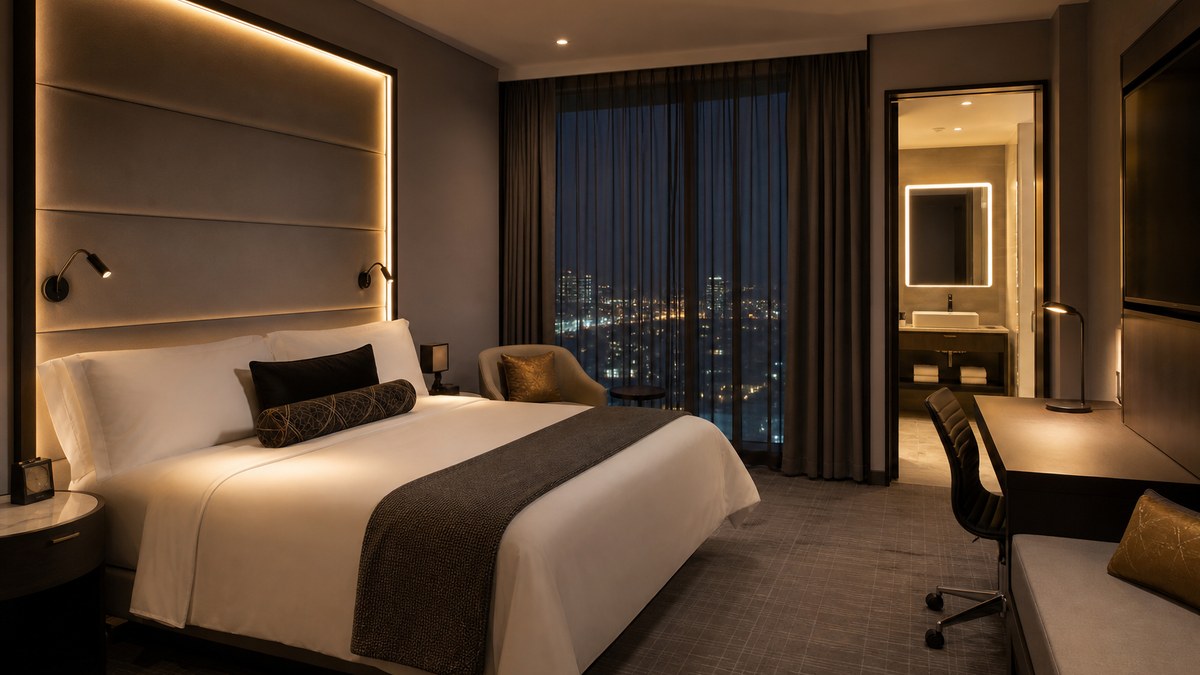
Guest room lighting: comfort, control and code
Guest rooms are where most guest complaints about lighting come from, and where energy codes have changed the most. A well-designed room includes:
- Entry light: a light near the door that comes on easily, so guests are not walking into a dark room.
- Ambient light: enough general light that the room does not feel dim, often from ceiling downlights, a cove or a floor lamp.
- Bedside reading lights: one per side, adjustable and controlled from the bed, so one guest can read while the other sleeps.
- Desk light: focused light for laptops and paperwork, with convenient outlets.
- Vanity and bathroom light: even light on the face from the front or sides (an LED-lit mirror is a popular choice) rather than a single downlight that casts shadows.
- Night light: a low-level path light to the bathroom, often under the vanity or bed.
- Simple controls: clearly labeled switches or keypads, a master control at the entry, and bedside control of the main lights.
What the energy code expects in guest rooms
Newer editions of the International Energy Conservation Code (IECC) require automatic shutoff in hotel and motel sleeping units. Manufacturer summaries of the 2021 IECC describe the requirement as a master control device that turns off all installed luminaires and switched receptacles within 20 minutes of occupants leaving the room, with an exception for lighting and switched receptacles controlled by a captive key (key-card) system. The 2018 edition also requires automatic shutoff of installed luminaires and switched receptacles in guest rooms.
Which edition applies depends on where and when you build or renovate. Texas's statewide commercial minimum has been the 2015 IECC, and many cities adopt newer editions locally. Arlington adopted the 2021 International Building Codes and the 2020 National Electrical Code effective for permit applications from January 1, 2023. Always confirm the energy code edition and guest room control requirements with Arlington Building Inspections (817-459-6521) and your design professional before you specify controls.
In practice, hotels meet guest room requirements with key-card energy management systems, occupancy and door-switch sensors tied to the room's controls, or networked guest room management systems that also handle HVAC. The right choice depends on the brand standard, the existing wiring and whether the renovation is a soft-goods refresh or a full gut.
Corridors, stairs and elevator lobbies: safe and efficient around the clock
Hotel corridors are lit 24 hours a day, which makes them one of the biggest energy opportunities on the property. They are also part of the path of egress, so safety rules come first.
- Even light, no dark spots: uniform corridor light helps guests find their rooms and feel secure. Sconces or wall-mounted fixtures add vertical light that makes long corridors feel shorter.
- Egress first: life safety codes require illumination along exit paths whenever the building is occupied. One lighting controls manufacturer's code summary notes that automatic full-off is not suggested in corridors and stairwells that serve as egress, so the usual approach is to dim, not switch off.
- Occupancy-based dimming: where the code and the fire marshal allow, corridor fixtures can drop to a lower level when no one is present and return to full when someone steps off the elevator.
- Emergency lighting: battery-backed fixtures, emergency drivers or central systems must keep egress paths lit during a power failure. Under NFPA 101, battery units commonly need a functional test of at least 30 seconds every 30 days and an annual 90-minute test, with written records for the authority having jurisdiction. Confirm the requirements with the Arlington Fire Department.
- Exit signs: LED exit signs use little power and last far longer than older lamps, but they still need monthly visual checks and the same testing when battery-backed.
Ballrooms, meeting rooms and pre-function spaces
Meeting and event space is a major revenue center for full-service hotels near the Arlington Convention Center and the stadiums. Lighting has to work for very different events in the same room on the same day: a breakfast, a training session, a press conference, a wedding and an awards dinner.
- Full-range dimming: general lighting needs to dim smoothly from full to a glow without flicker or color shift. That means LED drivers and dimmers or control protocols (0–10V, DALI or DMX) that are designed to work together and are tested at low levels.
- Preset scenes: banquet, presentation, video, dance and clean-up scenes on a simple wall keypad or touchscreen, so staff do not have to adjust a dozen zones by hand.
- Partition-aware controls: rooms that split with air walls need controls that follow the partitions, so each section can run its own scene.
- Decorative chandeliers: LED retrofits or new LED chandeliers keep the look while removing hundreds of hot, short-life lamps from hard-to-reach ceilings.
- Color and uplighting: built-in RGBW wall washers or uplights let planners match event colors without bringing in temporary gear for every booking.
- Camera-friendly light: livestreams and hybrid meetings need light on faces at the lectern and stage, and LED fixtures with a high refresh rate. One theatrical lighting manufacturer recommends LED fixtures for camera work at or above 20 kHz to avoid scan lines.
Dated lobby, dim rooms or a PIP deadline coming up?
Tell us about your property. We'll arrange a walk-through, review your fixtures, controls and brand standards, and prepare a project-specific proposal for an LED upgrade phased around your occupancy and events calendar.
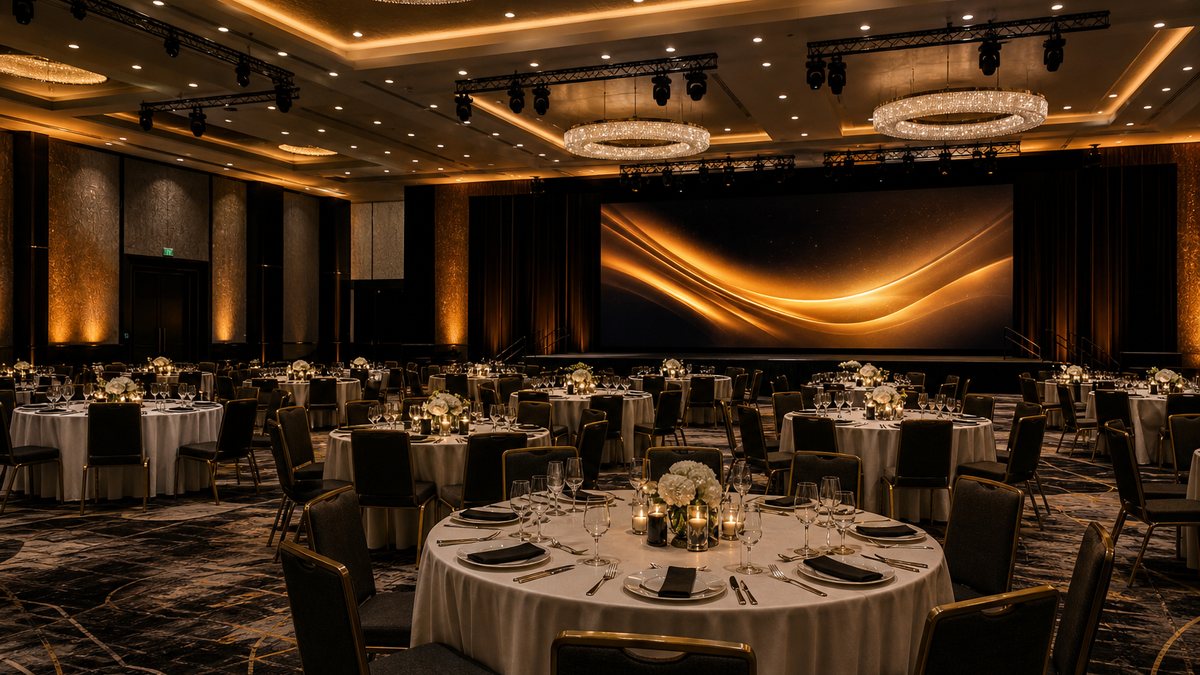
LED video walls in hotels
LED video walls have become a common feature in Arlington-area hotels, in ballrooms, lobbies, bars and pre-function spaces. They replace projectors and screens with a bright, seamless image that looks good even with the room lights up.
- Ballrooms and meeting rooms: a permanent stage wall for presentations, sponsor content and event graphics, which can be a selling point when booking groups.
- Lobbies: a feature wall for welcome messages, art and local content.
- Sports bars and lounges: large-format game-day screens, which matter in a city that hosts NFL, MLB and major events.
- Exteriors: outdoor-rated displays where local sign rules allow; Arlington's sign code prohibits signs with motion, so check with the city before planning exterior video.
The key decision is pixel pitch, the distance between LEDs. A common rule of thumb from industry guides divides the closest viewing distance in feet by about 3.28 to estimate the largest pixel pitch in millimeters that still looks smooth. A lobby wall viewed from a few feet away needs a much finer pitch than a ballroom wall viewed from the back of the room. Large walls also need structural review, dedicated circuits and planned cooling and service access. Our LED video walls guide for Arlington covers sizing, pitch and planning in detail, and our video wall services page explains how we deliver them.
Restaurants, bars, pools and amenity spaces
Hotel restaurants, lobby bars, rooftop lounges, fitness centers and pool decks each have their own lighting needs:
- Restaurants and bars: warm, dimmable light, brighter at tables and the bar top, with backlit bottle displays and under-counter LED. Our restaurant and bar lighting guide covers this in depth.
- Fitness centers: bright, even, neutral light with low glare overhead, since guests often look up during floor exercises.
- Pools and spas: wet-location and underwater-rated fixtures, color-changing pool lights and fiber optic accents for a resort feel. See pool and spa lighting for options.
- Feature ceilings: fiber optic star ceilings in lounges, spas or suites create a signature look without heat at the ceiling.
- Back of house: laundry, kitchens, storage and service corridors are ideal for straightforward LED retrofits with occupancy sensors, often with the fastest operating savings on the property.
Hotel exterior lighting: porte-cochere, facade, signs and parking
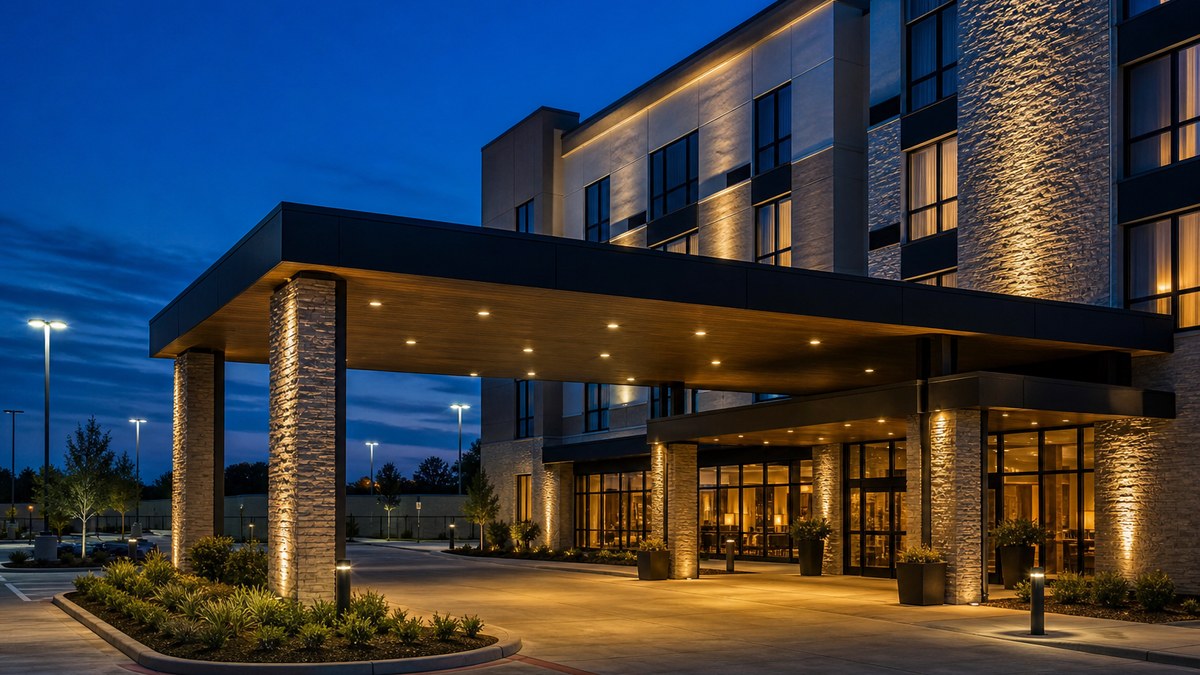
For a hotel, the exterior is the first thing a guest sees from I-30, Collins Street or Cooper Street, and it is the last impression when they leave. Good exterior lighting combines welcome, wayfinding and security:
- Porte-cochere and entry: warm, even canopy downlights at the drop-off lane so guests can see luggage, curbs and faces, with brighter light at the doors.
- Facade lighting: wall washing or grazing on columns and feature walls, and color-changing RGBW accents for events and holidays. Exterior fixtures are commonly IP65 or IP66 rated, and in-grade fixtures IP67 or IP68. Our architectural and facade lighting guide explains the techniques.
- Signs: illuminated building signs and monument signs must follow Arlington's sign standards. See our LED signs guide and LED signs and message centers.
- Parking lots and garages: commonly cited IES guidance for open lots is a minimum of about 0.2 fc with a max-to-min uniformity of 20:1 or better, and about 0.5 fc and 15:1 for enhanced-security lots. Many hotels choose the enhanced level. Our parking lot and garage lighting guide covers lots and structures.
- Shielding: fully shielded fixtures keep light on the property and out of guest room windows, which matters when parking sits right under room windows.
Exterior controls are part of the energy code too. Manufacturer summaries of the 2021 IECC describe automatic daylight shutoff, facade and landscape lighting that turns off by dusk/dawn and schedule, and a reduction of other exterior lighting by at least 30% overnight, after business hours, or when no activity is detected for more than 15 minutes, with exceptions for areas that must stay lit for safety. Hotels operate around the clock, so a designer will apply these rules area by area.
Controls that pay off in a 24/7 building
LED fixtures on their own save energy. Controls decide how much more. In a hotel, the most useful controls are:
- Guest room energy management: key-card or occupancy-based systems that shut off lights and switched outlets when guests leave.
- Corridor and stair dimming: occupancy-based reduction where permitted, with egress levels maintained.
- Back-of-house occupancy sensors: storage, laundry, housekeeping closets and restrooms.
- Scene control: lobby, restaurant and ballroom scenes on time schedules and keypads.
- Daylight dimming: near large lobby windows, atriums and skylights.
- Astronomical time clocks and photocells: exterior on at dusk, reduced overnight, off at dawn.
- Networked controls: one dashboard for the chief engineer to change schedules, spot failed fixtures and verify that everything is working.
Energy codes also call for functional testing of lighting controls before final inspection, so controls are verified, not just installed. For a deeper look, read our commercial lighting controls guide.
Incentives and tax considerations
Hotels in Oncor's service area may qualify for incentives through Oncor's commercial programs for qualifying lighting work, depending on program availability; these programs typically run through participating service providers and commonly open early in the year. Federal 179D deductions ended for projects whose construction begins after June 30, 2026; earlier projects may still qualify, so confirm with your tax advisor. We do not quote incentive amounts in advance because they depend on the program, the fixtures and the hours of operation; we will help you understand what may apply during the proposal stage.
How a hotel lighting upgrade runs while you stay open
Hotels cannot close for a lighting project, so planning and phasing matter as much as the fixtures. A typical project runs like this:
- Walk-through and audit: we walk the property, day and night, and document fixtures, lamp types, controls, emergency lighting, brand standards and problem areas.
- Priorities and design: together we set priorities (for example, exterior and lobby first for curb appeal, back of house first for fast operating savings, or guest rooms tied to a PIP), then select fixtures, color temperature, CRI and controls. Mock-ups in a sample room or lobby bay let the team see the result before committing.
- Code and permits: confirm the applicable energy code, guest room control requirements and emergency lighting with the city, and pull electrical permits through licensed electricians. In Texas, anyone who performs electrical work must be licensed through TDLR.
- Phasing plan: schedule work floor by floor or wing by wing around occupancy, group bookings and major events in the Entertainment District, with lobby and ballroom work in off-peak hours.
- Installation: clean, quiet work with protected floors, rooms returned to inventory the same day where possible, and daily coordination with housekeeping and the front desk.
- Commissioning: program scenes and schedules, test dimming at low levels, run functional testing of controls and emergency lighting, and walk the property at night.
- Handover and support: labeled controls, as-built documentation, training for engineering staff, spare parts and warranty information.
Our team brings 15+ years as an authorized architectural lighting dealer and project coordinator, and our licensed installation partner has completed over 200 major sports and commercial projects across the US and Canada — NFL, NBA, NHL, MLS, NCAA and NASCAR. For hotels that want one team from concept to commissioning, our Luminance design-build program covers design, supply and installation. See our full commercial LED lighting services, architectural lighting and repair and service.
Common hotel lighting mistakes to avoid
- Mixing color temperatures: replacing failed lamps one at a time with whatever is in the storeroom leaves a patchwork of warm and cool light.
- Choosing lamps without checking dimmers: LED lamps and drivers that are not compatible with the dimmers cause flicker, buzzing and dead zones at low levels.
- Too much downlight, not enough wall light: a lobby can meet the foot-candle number and still feel dark if the walls and ceiling are unlit.
- Glare at the front desk and in guest rooms: exposed bright sources at eye level are uncomfortable; shielded optics and diffusers fix this.
- Forgetting emergency lighting: new fixtures must keep egress and emergency lighting working and tested.
- Over-lighting the parking lot: more light is not always safer; uniform, shielded light without glare into rooms and cameras works better.
- Ignoring maintenance access: fixtures in two-story lobbies and ballroom ceilings should be specified for long life and easy service.
For help comparing contractors, see how to choose a commercial LED lighting company in Arlington, and for ongoing service read our lighting contractor guide to repair and maintenance.
Frequently Asked Questions
What color temperature is best for hotel lighting?
How bright should a hotel lobby be?
Do hotel guest rooms need automatic lighting shutoff?
Can hotel corridor lights be dimmed or turned off when no one is there?
Can you upgrade hotel lighting without closing rooms?
Are LED video walls a good idea for hotel ballrooms?
How much does a hotel LED lighting upgrade cost?
Are there incentives for hotel LED lighting in Arlington?
Can old hotel chandeliers and decorative fixtures be converted to LED?
Do you work with hotels outside Arlington?
Ready to light your hotel like the newest property in town?
From lobbies and guest rooms to corridors, ballrooms, LED video walls, porte-cocheres and parking, we design, supply and install hotel and hospitality lighting across Arlington and DFW. Request a consultation or call us today.
Related
Explore more: our services overview, the areas we serve, LED signage, office and commercial interior lighting, large-scale commercial projects, business lighting services, lighting installation, church lighting and video, shopping center lighting, sports and venue lighting, commercial LED lighting in Texas, and the full Arlington LED Lights blog.
Our DFW lighting network: Dallas LED video walls and commercial lighting, Fort Worth LED lighting, Irving LED lighting, Plano LED lighting, statewide Texas LED lighting, wholesale LED components, fiber optic star ceilings, 360° fiber optic lighting, modular building solutions, and Dallas modular structures.